The proven playbook already exists
China's mini-game market did not grow by accident. Studios there spent years learning what casual players want, how to tune difficulty curves, and how to monetize without scaring users away. By 2025 the domestic market reached ¥53.5 billion, up 34.4% year over year, with 571 million WeChat mini-game monthly actives. That is a library of battle-tested games — and most of it has never been offered to players outside China.
The opportunity is not to rebuild those games. It is to localize them and ship them into the super-apps of other regions.
Localization is the multiplier, not the obstacle
A common fear is that "going global" means translating strings and hoping. The data says localization pays for itself. According to GameRefinery research cited by cross-border operators, games that complete UI and UX localization see Day-1 retention lift of around 22% and payer-conversion uplift of about 9% — before any new marketing spend. Casual games are the friendliest genre to localize: simple loops, few words, visual humor that travels.
Two forms of localization matter most for mini-games:
- Language and UX — not just translation, but local payment habits, social-share mechanics, and art direction that fits the region.
- Pricing — emerging markets will not pay US rates. Publishers using regional pricing and purchasing-power adjustments cut prices by 40–60% in markets like Brazil, India, and Southeast Asia, driving double-digit revenue growth where it counts.
Overseas super-apps are ready channels
The super-app distribution model is not unique to China. Southeast Asia, Latin America, and the Middle East each have host apps with hundreds of millions of users — ride-hailing, chat, payments, and commerce apps where people already spend hours daily. Those hosts are hunting for lightweight content that increases engagement and session time, exactly what mini-games provide.
The monetization tailwinds are real too: the global battle-pass market grew 31.2% in 2025 to about $18.7 billion, with user growth of 41% in Southeast Asia and 37% in Latin America — the fastest-rising regions. Mini-games plugged into those hosts inherit both the audience and the spending momentum.
| Localization lever | What changes | Measured impact |
|---|---|---|
| UI/UX localization | Familiar flows, local art | ~22% D1 retention lift |
| Payer-conversion tuning | Local offers, right moments | ~9% payer uplift |
| Regional pricing | PPP-adjusted packs | up to 40–60% lower price |
| Host-app distribution | Built-in audience | CAC near zero |
One runtime, many markets
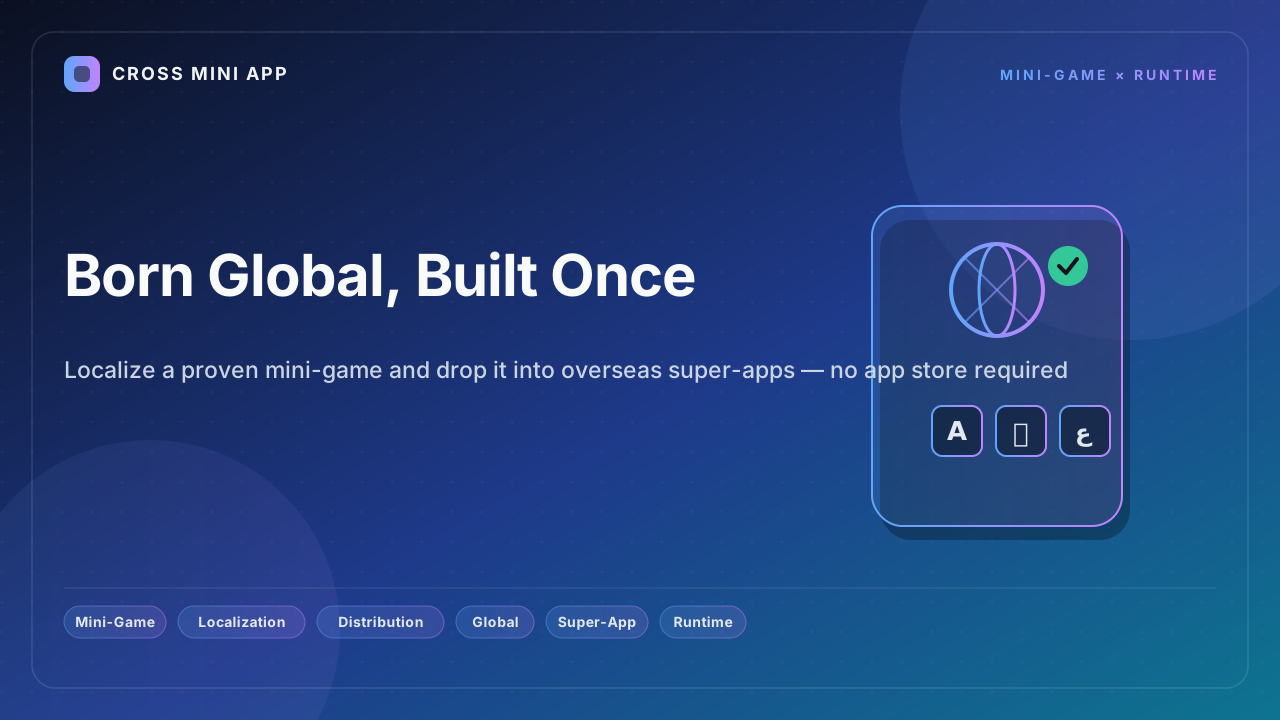
Here is where a shared runtime changes the math. A mini-game built once against the runtime can be re-skinned and re-priced for a new region without rewriting the engine or re-integrating a store SDK. The localization work is content and config, not code. Turn on a second host in a second market the same week you finish the first.
That is the inverse of the old export model, where every new country meant a new store listing, a new review cycle, and a new acquisition auction. With super-app distribution, the channel is already warm.
What this means for your roadmap
If you run a host app outside China, the fastest way to add a games catalog is to license proven titles and localize them — not to recruit a game studio. If you build games, the runtime plus a localization pass is the cheapest path to a global audience that does not require bidding against the world for every install.
Cross Mini App turns "going global" from a multi-year expansion into a content-and-config exercise — proven games, localized once, live in the super-apps your users already open every day.