A Soft Launch Is a Cheap Way to Be Wrong
Plenty of teams treat a soft launch like a glorified beta — push to one small store, watch the crash reports, call it done. That misses the point. A soft launch is the cheapest experiment you'll ever run on whether your game actually has a business underneath it, and most teams waste it by measuring the wrong things or running it for too long.
Q: What is a soft launch, and why bother for a mini-game?
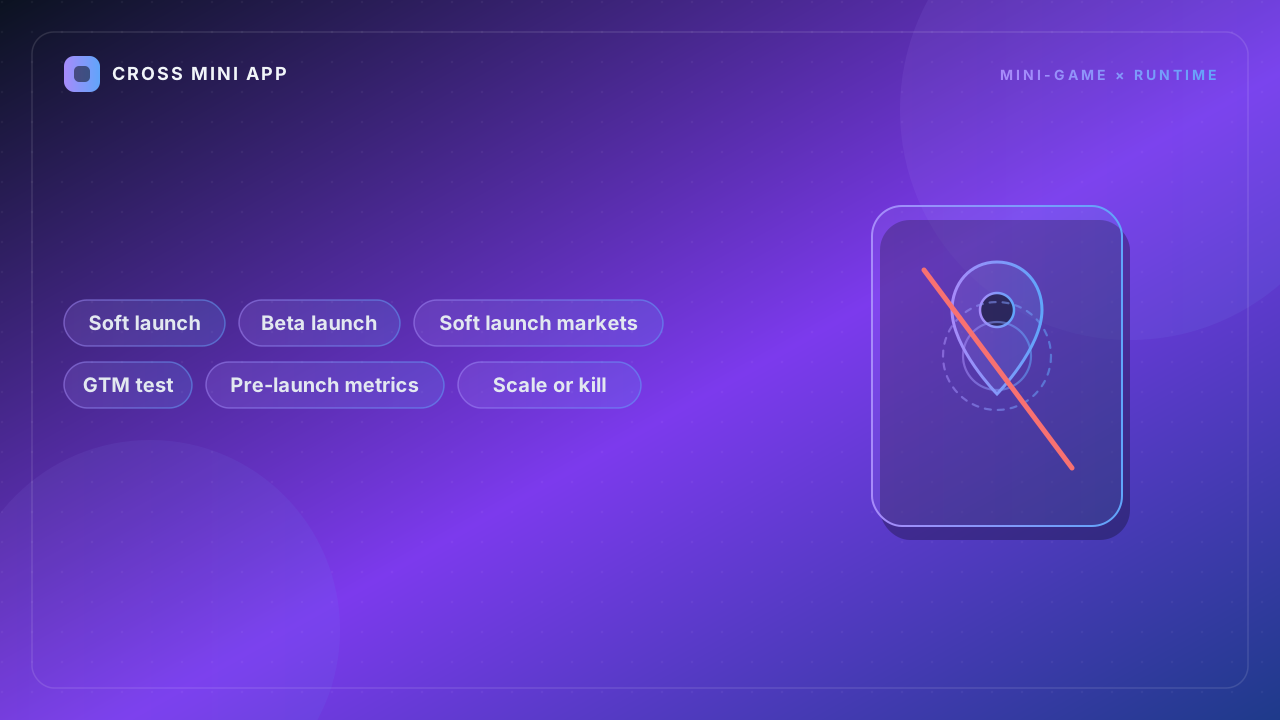
A soft launch ships the full game to a limited audience — usually one or two countries — before the global push, so you can watch real retention, monetization, and tech stability without paying global user-acquisition rates. For a mini-game it matters more than for a premium title, because your whole thesis is "this cheap game earns on volume," and volume economics only show up with real traffic. A soft launch is where you find out if that thesis holds before you've spent the marketing budget proving it doesn't.
Q: Which markets should I pick for a soft launch?
Pick by what you want to learn, not by convenience. If you need clean monetization signal, pick a market with mature payment habits and cheap traffic — the Philippines, Indonesia, or Mexico often stand in for broader emerging-market behavior at a fraction of US cost. If you need creative or retention signal, pick a market close to your target audience's culture. The mistake is launching in Canada or New Zealand because they're English and "safe" — you'll learn your game works for polite English speakers, which you already knew, and learn nothing about the markets that will actually carry your volume.
Q: What signals tell me to kill vs scale?
Two numbers decide it: D1/D7 retention and D30 LTV against your projected CPI. If D1 retention is under 25% or D7 under 10% in your soft-launch market, the game has a leak no amount of UA will fix — kill or rework before spending. If retention holds and D30 LTV clears 30–40% of CPI, you have a fundable machine. Everything else — reviews, feature requests, store ranking — is noise until those two lines are healthy. Teams that scale on a green store rating while retention is bleeding are buying users to watch them leave.
Q: How long should a soft launch run?
Long enough to see a D30 cohort, short enough that you're not bleeding opportunity cost. For most mini-games that's three to five weeks of real traffic — enough to watch one full monetization cycle and one live-ops event, not so long that you've aged out the trend you're chasing. If by week four your retention and LTV lines haven't moved after two iterations, the answer is no. A soft launch is a decision tool, not a permanent state; the goal is a clear "scale" or "kill," not an endless polite pilot.
| Pick this market if you want | Avoid it if you want |
|---|---|
| Cheap, clean monetization signal | To learn about your real volume markets |
| Mature payment, low traffic cost | Cultural signal close to target audience |
| Fast D30 read on a shoestring | A "safe" English proxy that teaches you nothing |
A soft launch only works if it's allowed to disagree with you. Pick the market for the lesson, watch retention and LTV like they're the only instruments, and make the call by week five. The teams that win don't run longer pilots — they make the kill-or-scale decision faster than their competitors are willing to.