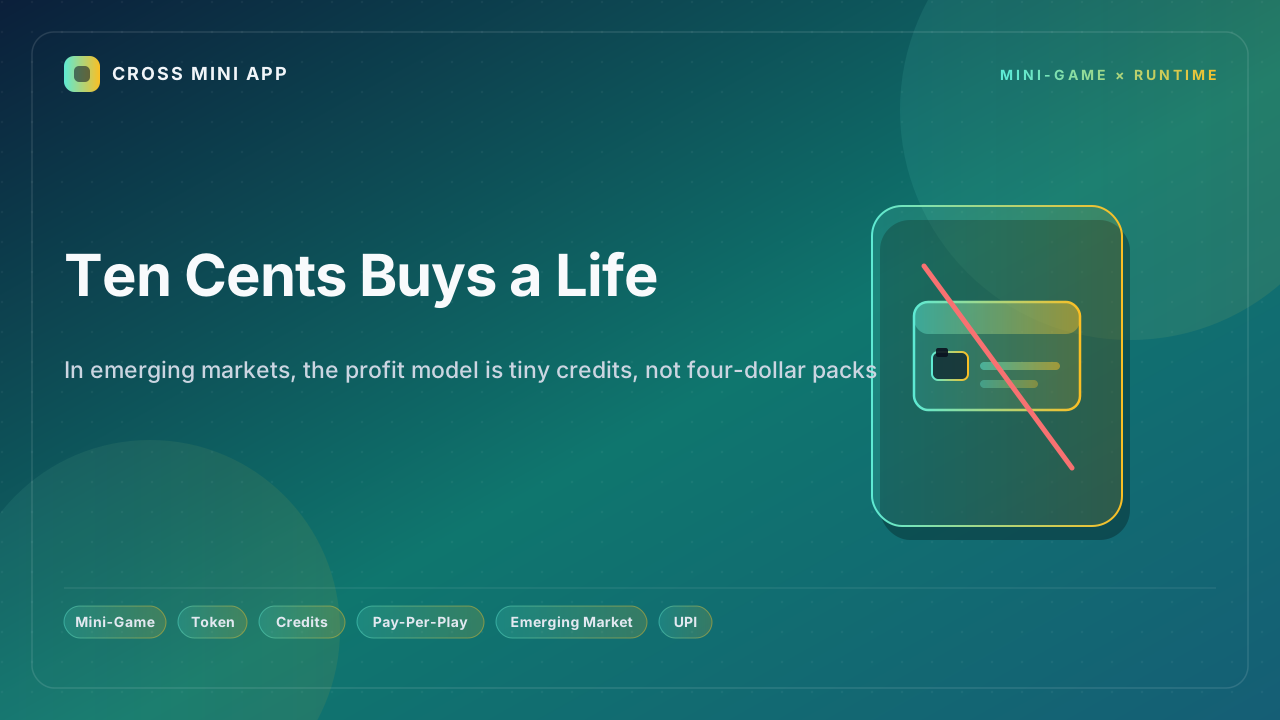
Ten Cents Buys a Life
There's a number that breaks a lot of western monetization decks: nine rupees. That's about ten US cents. In India, it's the price point where a huge chunk of players make their very first in-game purchase, and from there some go on to spend ten thousand rupees. The four-dollar starter pack that funds a western casual game is dead on arrival in most of the world. The model that works is a stack of tiny, repeatable credits — and the rails that let you charge for them without a credit card.
The pack that doesn't travel
Most monetization guides are written for an audience that already has a card on file and a comfortable relationship with a five-dollar impulse. That audience is a minority of the planet's players. In India, Southeast Asia, Latin America, and large parts of the Middle East and Africa, the gamer base is enormous and the paying base used to be thin. The reasons were boring and structural: no card, no bank, no trust, no small enough price.
What changed the equation wasn't a clever offer. It was plumbing. India's UPI put a payment button in every phone. Brazil's Pix did the same. Carrier billing — charging a micro-purchase to a phone bill — unlocks users across the Middle East and Africa who will never own a Visa. When the friction of a single transaction drops to a tap, a ten-cent credit stops being too small to bother with and starts being the most important product you sell.
| Market signal | What the data shows | Why it matters for credits |
|---|---|---|
| India entry price | Rs 9–19 first purchase; some users scale to Rs 10,000 | Sub-dollar pricing unlocked microtransactions at scale |
| India ARPPU | $2–5 (five years ago) → $25–30 today | More payers, not just bigger spenders |
| Payment rails | UPI (India), Pix (Brazil), carrier billing (MEA) | Removes card and bank friction entirely |
| Battle royale in India | 47% of all genre monetization in FY25 | Cosmetics + event passes, not power |
| Emerging markets | ~3% of global IAP revenue, huge install base | The growth corridor everyone is chasing |
Credits are a habit, not a transaction
The genius of the credit model is that it trains a behavior. A player buys a hundred rupees of coins, loses them in a run, and buys another hundred because the next attempt is right there. The amount per purchase is tiny and the frequency is what builds the business. Hitwicket, an Indian studio, sees users walk in at Rs 9 and climb to five figures — not because they were targeted with a big pack, but because the first step was small enough to say yes to.
This is also why cosmetics win in these markets. Gen Z spenders in India put roughly three-quarters of their money into skins and identity, not power-ups. Players there will tell you plainly they don't want pay-to-win; they want to look good and feel progress. A credit economy that funds cosmetics and event passes fits that instinct better than a loot box ever did.
The honest risk
Selling ten-cent credits at volume means your margin lives and dies on payment processing cost and fraud. A 2% fee on a hundred-rupee purchase is a different animal from a 2% fee on a twenty-dollar one — the absolute take is smaller, so your processing and support costs eat a bigger share. And thin-file users are exactly who fraud rings probe first. The model only works if your runtime sits on local rails natively, not bolted on through a foreign processor that adds a dollar of overhead to a ten-cent sale.
There's a second risk nobody likes to say out loud: when your whole business rests on micro-prices, a single platform fee change or a local tax on digital goods can erase the margin. That's the trade you make for access to a base the west can't reach.
Sources
- Economic Times: India's in-app purchase economy matures, Rs 9 entry point
- Dataintelo: Online Microtransaction Market by region, 2025
- Reinout te Brake: Mobile gaming 2025, emerging markets leapfrogging
- Moloco: 2025 State of Mobile Gaming, payer conversion and emerging markets
- WorldWideDigest: mobile game monetization models to watch in 2025, pay-per-play