The download step is where reach dies
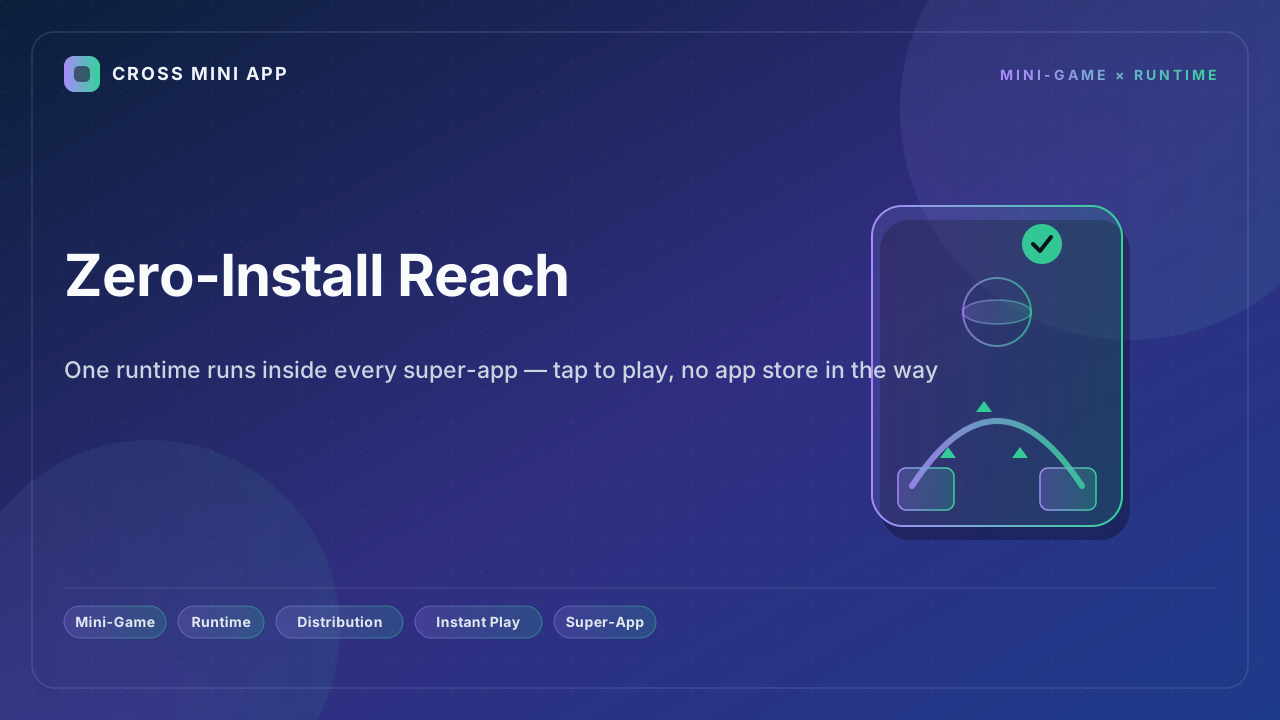
A native game's funnel has a cliff: an ad or a store listing can spark interest, but then the player must tap install, wait, approve permissions, and open. Each step sheds people. Mini-games remove the cliff. They run inside a super-app the player already has open, so "try it" is a tap, not a download.
The proof is already at scale
China's mini-game market is the clearest evidence. WeChat mini-games alone reached roughly 571 million monthly active users, and the broader mini-game market crossed ¥53.5 billion in 2025, up about 34% year over year. None of that reach required a single app-store install — it rode on super-app traffic the players were already using.
| Step | Native app | Mini-game (runtime) |
|---|---|---|
| Discovery | ad / store listing | in-super-app feed |
| Install | download + permissions | tap to play, 0 bytes |
| Update | app-store rollout | server-side, instant |
| Reach | your own UA budget | borrowed from host's MAU |
One build, every host
The silent advantage of a runtime is portability. Because the game logic runs inside a shared runtime rather than a native binary, the same mini-game drops into any super-app that embeds the runtime — no per-store rebuild, no per-platform SDK fork. A title launched in one host is a configuration change away from the next, not a new project.
Why this matters for distribution economics
Distribution cost is usually your UA budget buying attention you don't own. A mini-game flips the model: the host already owns the audience and the session, and you inherit both. Your spend shifts from "rent reach" to "earn depth" — retention, LiveOps, and repeat play inside a destination the player returns to anyway.
The takeaway for developers
If you build games, the runtime lets you treat distribution as a deployment target, not a marketing campaign. Ship once, appear wherever the audience already is, and let the host's traffic do the acquisition. If you run a host app, a runtime-ready catalog means you can populate an instant-play section without commissioning native titles.
Cross Mini App provides one runtime that runs inside any super-app, so a mini-game reaches every host's audience from a single build.