A mini-program catalog solves the supply problem and immediately creates a discovery problem. Thousands of services sit in a runtime, and the user opens the app with a specific need and no patience to browse. If the right mini-program does not surface in the first interaction, the supply might as well not exist. The shelf is full. The room is dark.
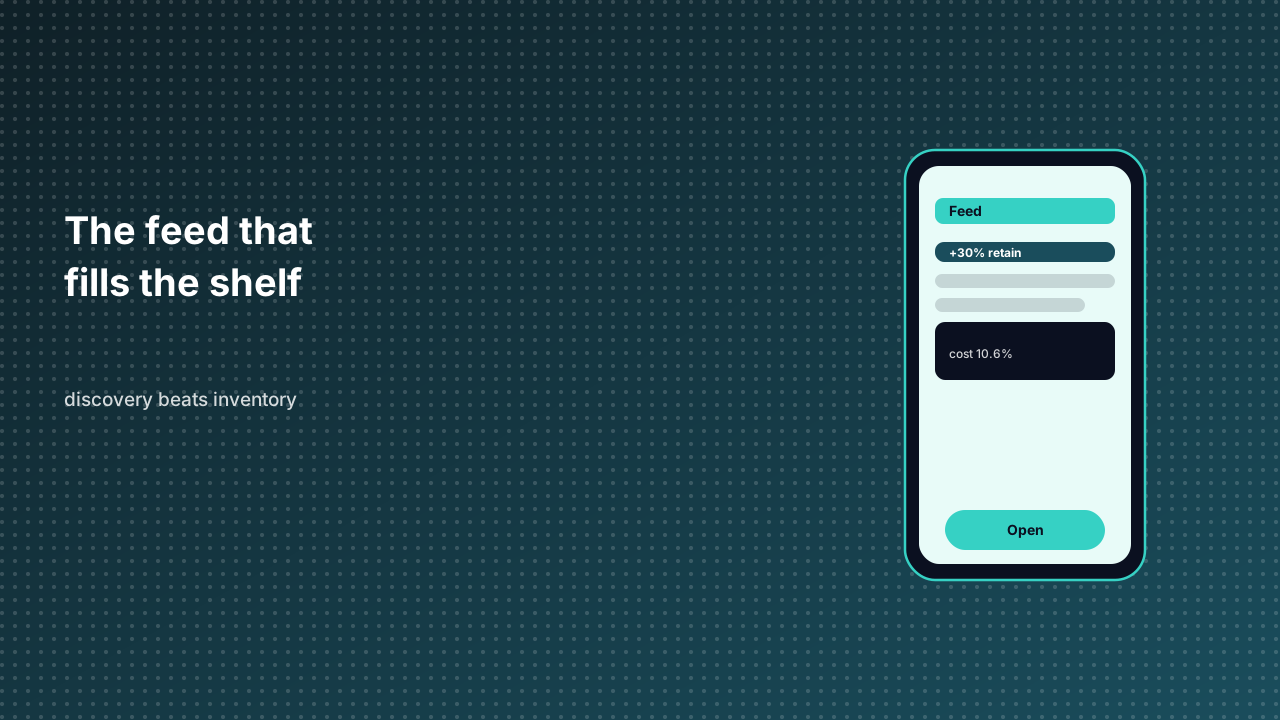
The retention stakes make this urgent. Most mobile apps lose over 80 percent of users within the first 7 to 14 days. The apps that survive share one advantage: they show the user something relevant before the user has to ask. AI-powered personalization is the mechanism, and the measured effect is large — apps with AI-driven recommendations report up to 30 percent higher retention.
The technology has matured past guesswork. A 2025 end-to-end generative recommendation system reduced operating cost to 10.6 percent of the traditional approach while increasing effective compute tenfold, and lifted in-app dwell time. A mid-sized streaming service deploying a hybrid recommendation engine saw a 27 percent increase in content discovery and a 19 percent reduction in churn among diverse-taste users. Roughly 92 percent of leading technology companies run neural collaborative filtering in production. The infrastructure to do this is now a commodity, not a research project.
A catalog is the ideal substrate for this. Every mini-program launch generates interaction signals — opens, dwell time, repeats, abandonments — that feed a recommendation model with clean, first-party data the host already owns. The model then places the right mini-program in front of the right user at the right moment, turning a static directory into a live, personalized feed.
| Distribution method | Discovery rate | Retention effect | Cost |
|---|---|---|---|
| Static category listing | Low (browse-dependent) | None | Near zero |
| Search only | Medium (intent-dependent) | Weak | Low |
| AI-personalized feed | High (proactive) | Up to +30% | Model infra (amortized) |
The business case is not the model. It is the margin. A recommendation layer that lifts retention by double digits compounds across every mini-program in the catalog, because the same feed serves all of them. The host does not build a discovery engine per partner. It builds one and amortizes it across the entire supply side.
The risk is relevance decay. A model trained on stale interactions recommends stale services, and the feed goes quiet. The mitigation is continuous, incremental updates — modern systems refresh factors hourly and retrain weekly, cutting retraining cost by 65 to 80 percent while keeping 98 percent of accuracy. A catalog with a live learning loop stays sharp. One without it becomes the dark room again, just with better lighting that nobody maintains.
The takeaway is that discovery is not a feature the host can defer. It is the layer that decides whether the catalog's supply ever converts into usage. A full shelf with no light is inventory. A full shelf with a good feed is a marketplace.
A more practical point is cold start. A newly listed mini-program has no interaction history, and naive collaborative filtering has nothing to recommend from. The catalog's advantage is a content-based fallback using the host's existing user profiles and metadata such as device and region, switching to collaborative filtering once interactions accumulate. That smooth handoff is exactly what a standalone app struggles to replicate cheaply, because it depends on a behavior graph the host has already accumulated across mini-programs.
Sources
- AI personalization and mobile retention — retention uplift from personalization.
- OneRec generative recommendation system — cost and dwell-time gains from generative recsys.
- Recommendation system production metrics — churn reduction and incremental training.
- AI-powered personalization in mobile apps 2025 — business benefits of recsys.