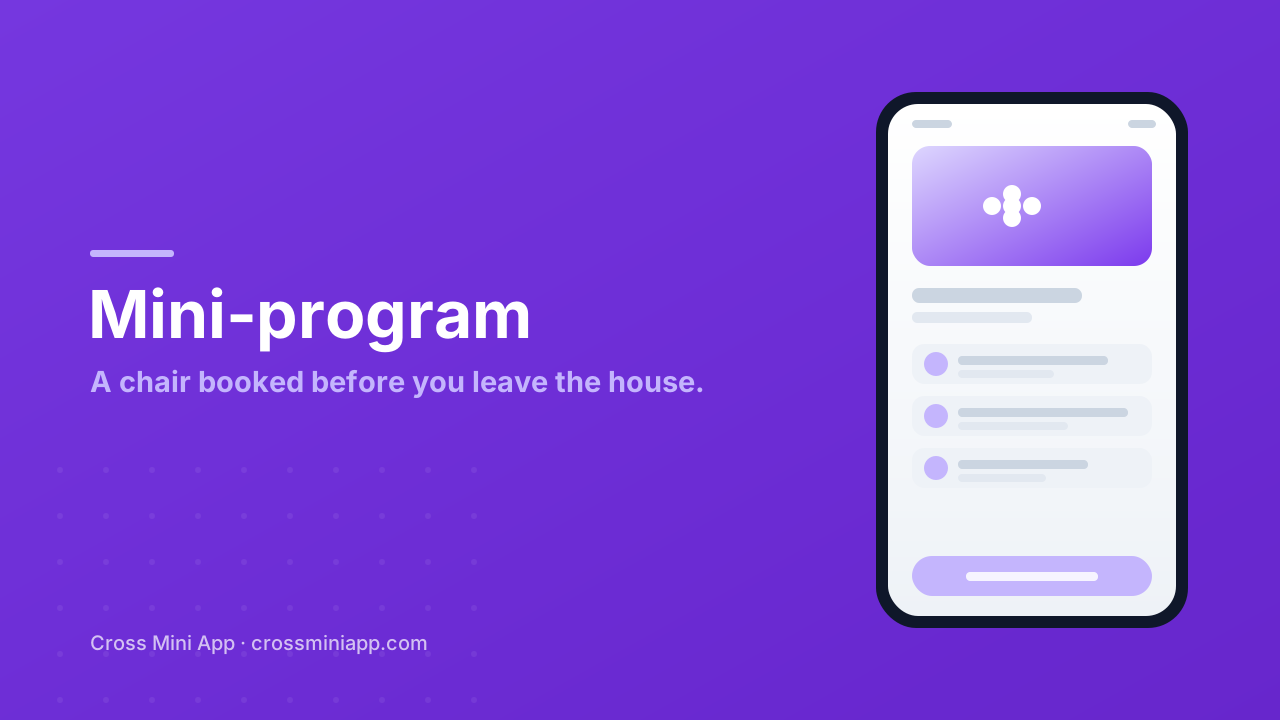
Morning, still half-asleep, you open the same app you use to message friends and you see your regular stylist has a gap at 4pm. You tap it. By the time you've made coffee, the chair is yours. No receptionist, no hold music, no downloading yet another booking app that you'll forget to open next month.
That's the experience Chinese beauty and salon mini-programs have already normalized. Walk into almost any mid-sized salon in a Chinese city and the booking, the stylist pick, the membership balance and the rebook all live on one lightweight screen inside a super app. We keep meeting teams overseas who think this is exotic. It isn't. It's just where local services went first.
The phone call is the real bottleneck
Salons lose money in two quiet ways, and neither is a marketing problem. The first is the no-show: a slot held by a verbal promise that evaporates when the client's day goes sideways. The second is booking friction — every step that asks the client to switch apps, remember a password, or call during business hours filters people out. A phone-only salon is effectively closed whenever the receptionist is busy cutting hair.
A booking surface that lives where the client already is removes both. The slot shows as taken the moment it's reserved, so the calendar stops lying. Reminders arrive in the same thread as the confirmation. Rebooking after the cut is a single tap on the stylist's profile, not a promise to call later that nobody keeps.
| What the client does | The old phone flow | What a mini-program does |
|---|---|---|
| Picks a time | Calls, hopes a slot is free | Sees live availability, taps it |
| Chooses a stylist | Asks who's good today | Browses profiles, reviews, past cuts |
| Remembers the appointment | Relies on memory or a text | Confirmation and nudge in one thread |
| Books the next visit | Promises to call | Taps rebook on the stylist's page |
| Checks their balance | Asks at the desk | Balance and perks shown in the screen |
Membership as a habit, not a punch card
We've written before about loyalty programs in the abstract, and that's a different animal. A salon membership isn't really a rewards scheme — it's a standing relationship made visible. The client sees their remaining sessions, the stylist they trust, and the quiet nudge that this is the person who knows their hair. The surface works because it sits inside the daily app, so opening it is effortless, not a separate errand.
The mistake is to bolt generic points onto a booking tool and call it loyalty. Clients don't rebook because they earned stars. They rebook because the next slot with the stylist they like is right there, and the app already knows them. The membership layer should make that continuity feel natural, not gamified.
The part that actually transfers overseas
Here's the thesis we keep coming back to. The Chinese beauty mini-program is not a Chinese trick. It's a proven pattern — live availability, stylist choice, membership, rebooking — built on a runtime that runs inside a host app. The services themselves are local and universal: a haircut in São Paulo is still a haircut. What doesn't travel is the specific host ecosystem.
That's the job of a universal runtime plus an open catalog. The runtime lets one mini-program run inside whatever host app a market already trusts — a messaging app, a payments app, a regional super app. The open catalog means the salon's service definitions, stylist profiles and booking logic aren't rewritten per country; they're described once and rendered everywhere. The booking experience that took years to refine in one market becomes a starting point, not a rebuild.
The honest tradeoff
We won't pretend porting is free. A stylist's reputation is local, and reviews, pricing and even what counts as a session vary by market. A runtime normalizes the plumbing, not the taste. You still tune the copy, the imagery and the per-market payment method. And some salons genuinely like the phone — a personal call is part of the service for high-ticket clients.
But the plumbing is the expensive part, and it's the part that shouldn't be re-solved every time. Get the runtime and catalog right and the salon team spends its energy on the thing that matters: the chair, the cut, and the client who comes back because coming back was never hard.
Sources
- Think with Google — Consumer behavior on mobile — how people actually discover and book local services from their phones.
- McKinsey — Beauty and consumer retail — where loyalty and repeat visits come from in personal-care markets.
- BCG — Retail and consumer engagement — why embedded, low-friction booking beats standalone apps.
- StatCounter — Mobile market share — why the host app, not a new download, is the realistic front door.