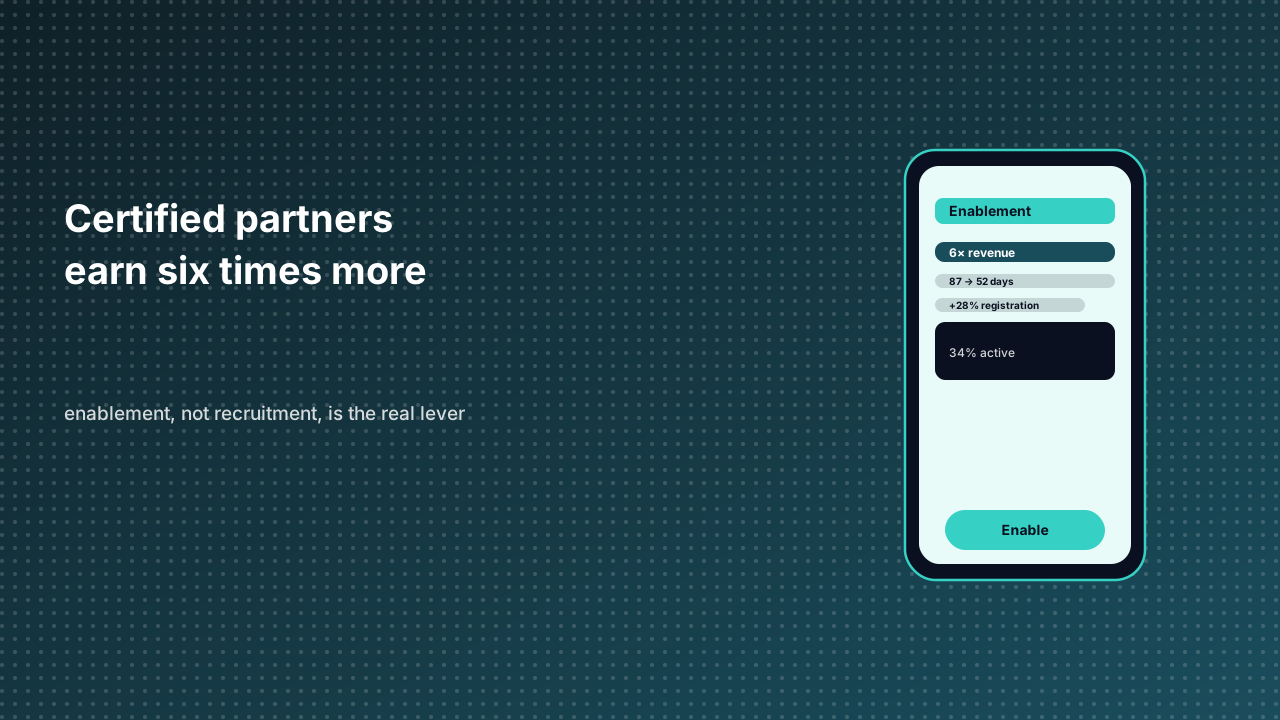
A partner signs the agreement, attends the kickoff, and then produces nothing for three months. That gap between recruitment and first order is where most distribution programs quietly fail. Forrester's 2025 Channel Benchmark puts the average at 87 days for a human-led enablement process; automated enablement compresses it to 52 days, a forty percent reduction. The difference is not motivation. It is whether the program treats enablement as a workflow or as a series of meetings.
The same benchmark reports that automated programs see a 28 percent higher deal-registration rate and 19 percent larger average orders. Both numbers point to the same mechanism: a partner who can find the collateral, register the deal, and see the commission rule without asking a human is a partner who transacts sooner and more often. Crossbeam's 2025 Ecosystem Report supplies the cost side. B2B SaaS companies spend about 14,200 dollars per partner in the first year on average; automation brings that down to 5,800 dollars.
Activity is the harder problem than cost. Crossbeam found that among an average of 47 partners, only 16 — about 34 percent — actively register deals in a given quarter. Partnership Leaders reported in 2025 that under manual enablement only 34 percent of recruited partners are actively selling within twelve months, a figure that rises to 61 percent with automation. Effective onboarding, the same source notes, lifts first-year partner productivity by 40 percent. Recruiting is cheap; activation is where the budget goes.
First order is the right metric because it is the first moment a partner's economics become real. Until a deal is registered and settled, the relationship exists only in a CRM. Every day of delay is a day the partner spends learning a system without feedback, which is why the 35-day gap between manual and automated enablement matters more than the recruitment numbers that usually headline partner reports.
The enablement economics, side by side:
| Metric | Manual enablement | Automated enablement |
|---|---|---|
| Days to first order | 87 | 52 |
| First-year cost per partner | 14,200 dollars | 5,800 dollars |
| Recruited partners active in 12 months | 34 percent | 61 percent |
| Deal-registration rate | baseline | 28 percent higher |
| Average order size | baseline | 19 percent larger |
Certification is the lever that looks most like a silver bullet, and it is worth treating with care. Intellum reports that certified partners generate six times the revenue of non-certified ones, and Forrester attributes a two-times revenue growth to mature partner programs, which contribute 28 percent of revenue on average against 18 percent at low-maturity companies. But certification is an outcome of a functioning enablement system, not a substitute for one. Handing a badge to a partner who has never registered a deal produces the appearance of maturity without the revenue.
Scale makes the distinction visible. Microsoft derives 95 percent of commercial revenue from its partner ecosystem and Cisco reports 90 percent of orders through partners. Forrester's State of B2B Partner Ecosystems 2025 found that two-thirds of ecosystem leaders expect partner-influenced revenue to grow more than 30 percent year on year. None of those figures describe a program that runs on goodwill and quarterly webinars. They describe infrastructure that makes the partner's path to a registered, settled transaction the shortest available route.
For a host operating a mini-program catalog, enablement is mostly a question of what the runtime exposes. If the partner can pull the service package, the attribution rules, and the settlement schedule directly from the shared layer, the 87-day ramp collapses toward the automated figure. Cross Mini App gives the host that layer, so certification tracks recorded activity rather than attendance. The catalog then becomes a place where a partner learns by transacting, not by reading a handbook.
The order of operations matters. Automate the path to a first order first, measure which partners actually reach it, and only then attach certification to the behaviour that produced the result. A program that reverses that sequence ends up certifying attendance sheets and wondering why the revenue never follows. The 5,800-dollar enablement cost is not a discount to be earned; it is what the system costs when the path from contract to settled deal is something a partner can walk without a guide. The six-times figure describes what a working system yields; it is not the starting point.
Sources
- SaaS partner enablement automation ROI analysis — time to first order and deal-registration gains.
- Channel sales enablement — certification and revenue impact of mature programs.
- Partner programme maturity — revenue share and the six-times certified-partner figure.
- The role of partner programmes in long-term business relationships — ecosystem revenue contribution and maturity benchmarks.