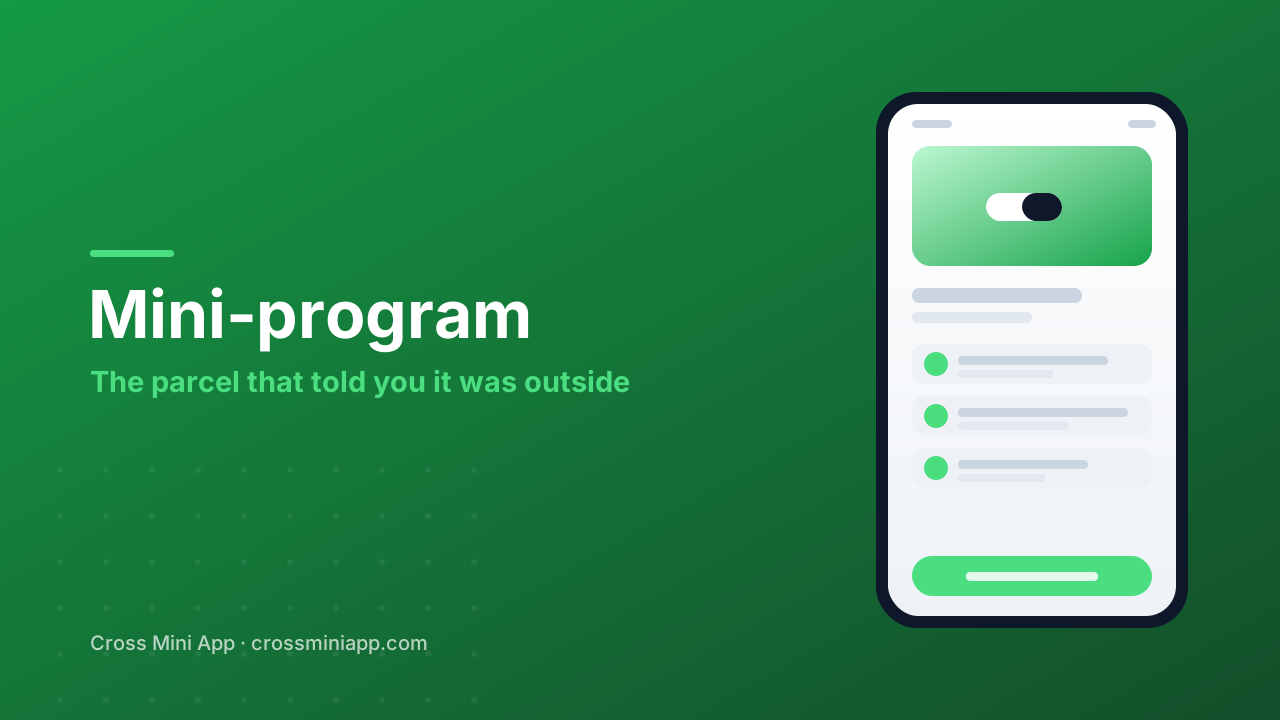
The parcel arrived and your phone already knew. The drop pinged the app you open every day, the photo proof landed in the same thread, and the redelivery was one tap when you missed it. In Chinese cities, that's the default for last-mile delivery — notify, prove, and reschedule in one surface. In the West, it's a carrier site you forgot the password to, a "we missed you" card, and a redelivery form that means another day off. The parcel that told you it was outside is the one you actually receive.
Courier is a quietly ideal mini-program surface because the need is local, time-critical, and already mediated by a trusted app. You don't want a separate carrier app for a box you get weekly; you want the ping, the proof, and the redelivery at the moment the doorbell doesn't ring. A mini-program that lives inside the host app meets that intent exactly — at the notification, in the map entry, in the chat where the household decides who's home. For the carrier it means fewer missed drops, fewer angry calls, and a delivery loop that doesn't depend on a portal nobody logs into.
| Recipient moment | What the mini-program does | Why it beats the website |
|---|---|---|
| Arrival | Ping from the notification | No carrier login, no "track number" hunt |
| Proof | Photo in the same thread | No "did it even come" doubt |
| Missed | One-tap redelivery | No redelivery form, no day off |
| Neighbor | Handoff noted in chat | The instruction isn't a separate portal |
Here's the pushback the carrier-app vendors won't like. They sell a branded app as the tracking fix. But recipients don't reopen a carrier app on a random Tuesday; they reopen the app they already live in — the messenger, the super app, the one with the doorbell camera. The tracking wasn't in the app; it was in the ping that met the doorstep. A portable mini-program runtime moves that ping into the host app the recipient already trusts, and the carrier keeps its dispatch backend. You didn't need a heavier app; you needed a lighter front door that travels with the household.
And the loop is the moat. One delivery is easy. Notify, prove, redeliver, and confirm is what turns a missed drop into a retained route. Logistics is a recurring, low-margin business, and the flow that shortens the gap between "it's out for delivery" and "it's in the hand" is not a feature, it's the doorstep. The Chinese delivery platforms that won at this didn't gamify the box; they removed the step between "driver at gate" and "recipient notified."
The local angle is the part carriers underestimate. Delivery is hyper-local — the parcel reaches the building you're at, not the nearest depot. Mini-programs are discovery-light: the recipient gets the ping through the host's notification, a friend's share of the tracking, or a QR on the slip. That's a cheaper, stickier experience than a paid install for a carrier app nobody asked for, and it already proved out in Chinese cities where notify, proof, and reschedule share one surface.
The thesis worth stating plainly: the courier flow that already serves millions of recipients in China doesn't need reinventing for Jakarta, São Paulo, or Lagos. The behavior is the same — notify, prove, redeliver, confirm. What's missing is a runtime that runs the same logic inside whatever super app or messenger a market lives in, plus an open catalog of courier templates so a local carrier doesn't start from a blank screen. You don't ship a Chinese courier app overseas; you ship the proven pattern and let a universal runtime render it inside the local host.
I won't pretend the port is trivial. Localization isn't just language — address formats, proof-of-delivery rules, and data-privacy laws differ sharply by country, and a wrong "delivered" flag on a missing parcel isn't a glitch, it's a lost shipment claim. A template catalog helps only if someone maintains it; a broken notification sync means the recipient misses the drop twice. The honest risk is treating courier as a tracking demo and skipping the address, identity, and data-protection work real logistics demand. We shouldn't.
But the direction is clear. The recipient already has the app. The carrier already has the route. The parcel already exists. The only missing piece is a runtime that carries a proven Chinese courier flow into the app a Jakarta or Lagos recipient opens to receive a box. Build that catalog, keep the address and data rules local, and the parcel tells you it was outside.
Sources
- StatCounter — Mobile market share — why a host app, not a new download, is the realistic front door.
- Think with Google — Consumer behavior — how recipients track and manage local deliveries on mobile.
- World Bank — Logistics and trade data — where last-mile demand and local delivery activity actually show up.
- web.dev — Web platform guidance — the runtime and performance basics behind a portable mini-program.
- MDN Web Docs — Web tech reference — the standards a portable tracking UI should build on.