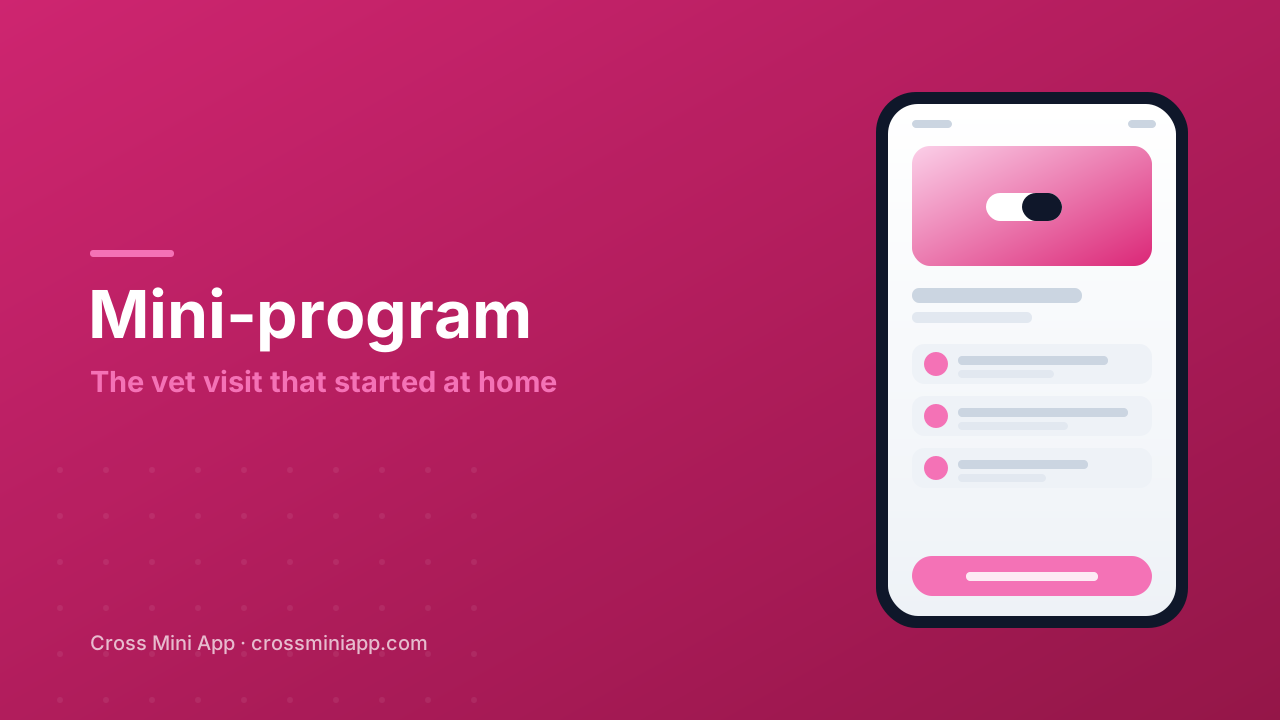
The vaccine was due and nobody phoned the clinic. The owner tapped once in the app they already use for everything, the pet's record was pulled from the existing profile, and the appointment landed on the calendar with a reminder. In Chinese cities, that's the default for routine pet care — vaccine schedules, weight logs, and the occasional tele-triage chat all live in one place. In the West, it's a wall of sticky notes, a separate clinic app, and a frantic search when the dog eats something weird. The vet visit that started at home is the one that actually happens.
Pet care is a quietly ideal mini-program surface because the need is local, recurring, and already mediated by a trusted app. You don't want a separate pet app for a cat you feed every day; you want the reminder, the record, and the booking at the moment you notice the calendar's empty. A mini-program that lives inside the host app meets that intent exactly — at the vaccine alert, in the map entry, in the chat where the family argues about whose turn it is. For the clinic it means captured appointments, fewer missed boosters in the neighborhood, and a service that doesn't depend on a phone that rings busy.
| Owner moment | What the mini-program does | Why it beats the website |
|---|---|---|
| Vaccine due | One-tap from the reminder | No phone tag, no "press 2 for reception" |
| Record pull | Auto-loaded from pet profile | No re-typing the microchip number |
| Tele-triage | Routes to vet chat | The question isn't a separate portal |
| Pickup | QR at the clinic desk | No "which pet was that" confusion |
Here's the pushback the pet-app vendors won't like. They sell a branded app as the engagement fix. But owners don't reopen a pet app on a random Tuesday; they reopen the app they already live in — the messenger, the super app, the one with the photos. The engagement wasn't in the app; it was in the reminder that met the moment. A portable mini-program runtime moves that reminder into the host app the owner already trusts, and the clinic keeps its practice backend. You didn't need a heavier app; you needed a lighter front door that travels with the household.
And the loop is the moat. One booking is easy. Remind, record, triage, and confirm is what turns a one-off visit into a retained patient. Pet care is a recurring-revenue business — boosters, check-ups, prescriptions — and the flow that shortens the gap between "it's due" and "it's done" is not a feature, it's the counter. The Chinese pet platforms that won at this didn't gamify treats; they removed the step between "the shot's overdue" and "we're booked."
The local angle is the part clinics underestimate. Pet care is hyper-local — you visit the clinic you can reach, not the cheapest in the country. Mini-programs are discovery-light: the owner finds the clinic through the host's map, a friend's share, or a QR at the groomer. That's a cheaper, stickier acquisition than a paid install for a pet app nobody asked for, and it already proved out in Chinese cities where vaccine schedules, health records, and local services share one surface.
The thesis worth stating plainly: the pet-care flow that already serves millions of animals in China doesn't need reinventing for Jakarta, São Paulo, or Lagos. The behavior is the same — remind, record, treat, confirm. What's missing is a runtime that runs the same logic inside whatever super app or messenger a market lives in, plus an open catalog of pet-care templates so a local clinic doesn't start from a blank screen. You don't ship a Chinese pet app overseas; you ship the proven pattern and let a universal runtime render it inside the local host.
I won't pretend the port is trivial. Localization isn't just language — vaccine schedules, prescription rules, and animal-health data rules differ by country, and a wrong dosage note in a pet context can still be a real welfare event. A template catalog helps only if someone maintains it; a broken record sync isn't a glitch when it's a ferret that missed its booster. The honest risk is treating pet care as a booking demo and skipping the medical-record and identity work real practice demands. We shouldn't.
But the direction is clear. The owner already has the app. The clinic already has the slot. The record already exists. The only missing piece is a runtime that carries a proven Chinese pet-care flow into the app a Jakarta or Lagos owner opens to manage their animal. Build that catalog, keep the clinical and data rules local, and the vet visit starts at home.
Sources
- StatCounter — Mobile market share — why a host app, not a new download, is the realistic front door.
- Think with Google — Consumer behavior — how pet owners discover and book local services on mobile.
- World Bank — Health and demographics — where household and local service demand actually show up.
- web.dev — Web platform guidance — the runtime and performance basics behind a portable mini-program.
- MDN Web Docs — Web tech reference — the standards a portable health UI should build on.