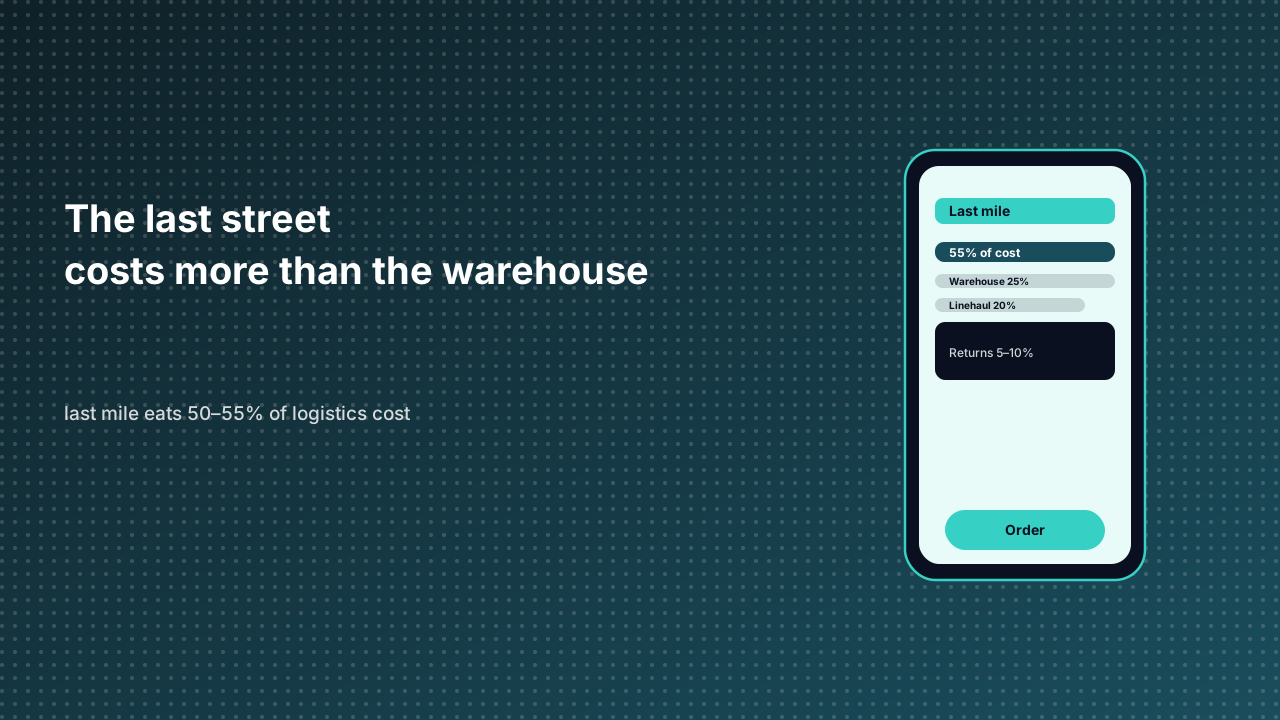
A parcel sitting in a sorted, automated warehouse has already consumed the cheap part of its journey. McKinsey puts total logistics at roughly 12–20% of e-commerce revenue, and within that budget the final leg from a local node to a doorstep accounts for more than half of fulfillment cost in many markets. One cost breakdown assigns last-mile delivery 50–55% of the total, warehousing 20–25%, line-haul 15–20%, and returns processing 5–10%. The most expensive segment is also the one with the least density and the most human judgment per stop.
The reason is arithmetic, not mismanagement. Residential addresses scatter across wide geography, delivery windows depend on somebody being home, failed attempts require a second trip, and each package carries a share of fuel and premium driver labor that a consolidated commercial route would spread across dozens of drops. Rural demand makes it worse: low order density and long distances make rapid delivery structurally inefficient, yet national marketing promises the same timeline everywhere. Urban cores swing the other way, where congestion raises cost but concentration makes same-day rational. Geography, not policy, sets the feasible promise.
| Fulfillment stage | Share of logistics cost |
|---|---|
| Last-mile delivery | 50–55% |
| Warehousing and fulfillment operations | 20–25% |
| Line-haul transportation | 15–20% |
| Returns processing | 5–10% |
Consumer expectations have turned this cost line into a revenue line. More than 60% of online shoppers treat delivery speed as a primary factor in choosing a retailer, and cart abandonment sits above 70% with extra costs and slow delivery among the most cited causes. The operational consequences are sharp: 91% of customers actively check tracking, WISMO — where is my order — drives 30–40% of support volume, and up to 30% of shoppers abandon a brand after a single failed or incorrect delivery. After two or three bad orders the figure climbs to 81%. A cheaper delivery that loses the buyer is not a saving.
The usual response is to move inventory closer to demand: regional nodes, store-based fulfillment, micro-fulfillment centers, and route optimization that trims 10–15% of miles driven. All of that works, and all of it requires capital. There is a cheaper layer that gets less attention — reducing the number of failed, uncertain, and unnecessary trips by improving the ordering surface itself.
This is where embedded ordering earns its keep. A mini-program inside a host app is not a better warehouse; it is a better front end for the same warehouse. It can pin the delivery location from the host's account rather than a mistyped address, surface a realistic time window before checkout instead of after payment, offer a pickup point or locker when the address has a history of failed attempts, and push a proactive delay notice before the support ticket exists. Photo proof of receipt and one-tap rescheduling settle the "never arrived" dispute that otherwise generates a second delivery for free. Each of those is a few points of density or a avoided re-trip, and re-trips are the most expensive kind.
Returns belong in the same calculation. Reverse logistics runs 5–10% of the budget, and a prepaid label plus an inspection queue turns one outbound cost into two. An embedded surface can steer an exchange instead of a refund, show the buyer the disposition status, and route the item to the nearest node that can actually resell it. It will not fix a bad network, but it stops the front end from manufacturing avoidable return trips.
Two cautions keep this honest. First, speed is a contextual norm rather than a universal demand: reliability and transparent timing often matter as much as raw velocity, and shoppers accept longer windows when they are communicated and met. A runtime that promises same-day everywhere imports the rural cost problem into the entire catalog. Second, the cost of the last mile is partly a carbon cost — 40–50% of supply-chain emissions in some estimates — so density improvements and consolidated windows pay twice.
The practical takeaway for a host platform is to treat fulfillment data as an input to the ordering experience, not a report printed afterward. Feed address quality, historical delivery success by zone, and real cutoff times into the mini-program at the moment a buyer commits. A merchant on the catalog then quotes a promise the network can keep, and keeps the margin that a failed promise would have consumed. The warehouse stays where it is; the promises get smarter.
Sources
- From national warehouses to local nodes — McKinsey logistics share and fulfillment cost breakdown.
- How e-commerce shipping works — last-mile cost drivers, tracking, and failed-delivery abandonment.
- E-commerce fulfillment efficiency and cost management — picker travel time and outbound freight.
- Last-mile delivery and customer satisfaction — 2025 cost and satisfaction figures.