

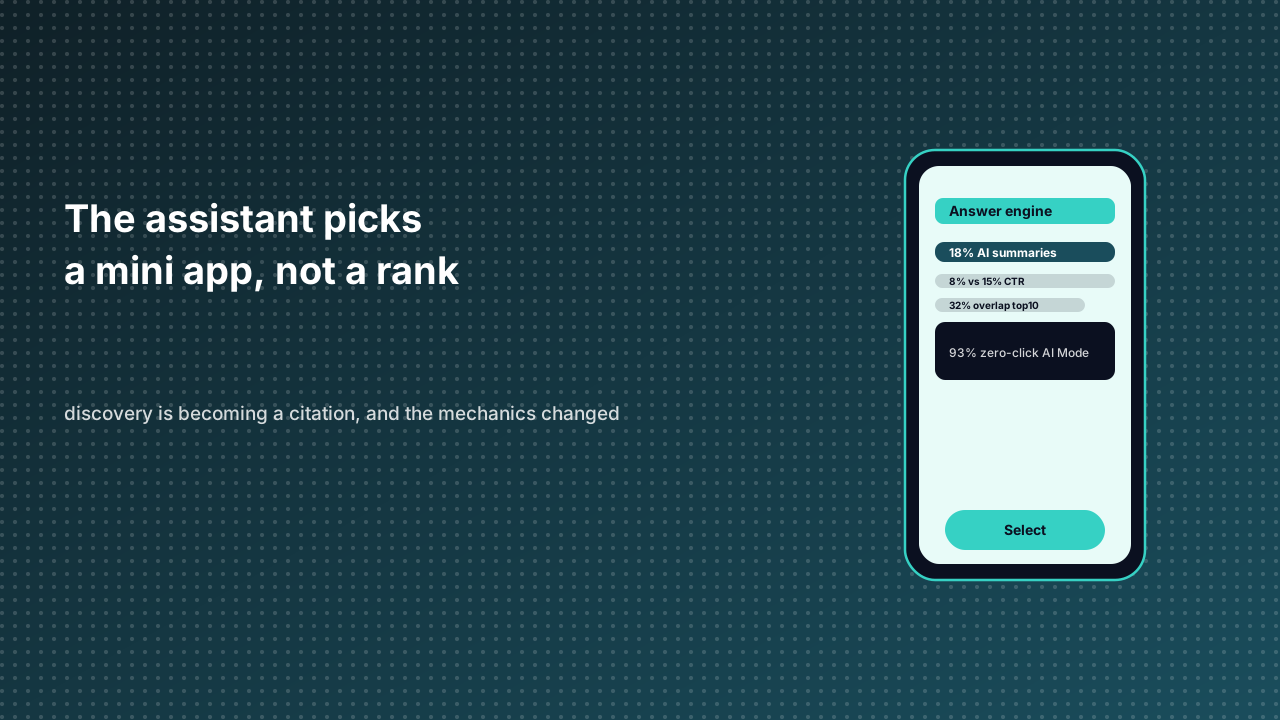
An operator opens the dashboard on a Monday morning and finds a thin sliver of referrals from assistant surfaces. The rank tracker shows no movement at all. Yet support tickets mention the mini app by name, and people describe arriving through a conversation rather than a results page. Nothing in the ranking report predicted any of it.
That gap is the real story of the past year. Search is turning from a list of links into a generated answer, and discovery is turning from a rank into a citation. An assistant that recommends a mini app has not ranked it in any familiar sense. It has selected it from a set of candidates and placed it inside a sentence. Being selected runs on different mechanics from being ranked, and most distribution playbooks still assume the old game.
The curves disagree with each other
The scale of the shift shows up in coverage before it shows up in clicks. Semrush analyzed more than ten million keywords and found AI Overviews on roughly 6.5% of them in January 2025, peaking near 25% in July, then falling back below 16% by November (reported by Inc.). A curve that rises, overshoots, and partially retreats is not the signature of a fad burning out. It looks like a system finding its level. The July peak made the headlines. The November floor is the number worth watching, because even at the low point roughly one query in six still produced a generated answer instead of a neutral stack of links.
Pew Research Center put a human scale on that floor. In a survey of 900 U.S. adults covering 68,879 searches (Pew Research Center), about 18% of searches produced an AI summary. With a summary present, clicks to traditional results dropped to 8%, against 15% without one. Sessions that ended without any website visit climbed to 26%, versus 16%. Longer queries triggered summaries much more often, reaching 53% for searches of ten words or more. The pattern is blunt: the more specific the question, the more likely an answer is assembled for the person instead of being fetched from a list.
Zero-click numbers need a health warning, because the figures in circulation are not measuring the same thing. In Google's AI Mode, the zero-click rate is 93% at the session level, compared with 60% for traditional search and 83% for queries carrying an AI Overview. A Semrush cross-device panel puts broader zero-click share near 59.7% in March 2025, against 44.2% a year earlier, with a different denominator, a different device mix, and a different idea of what counts as a click. The defensible conclusion is that zero-click is high and rising under every reasonable definition, while the exact percentage moves with the surface being measured. The 93% belongs to AI Mode sessions specifically; it is a statement about that surface, not about all search. By the end of 2025, AI Mode had reached 75 million daily active users and more than a billion queries a month.
More important than the click loss is what sits inside the answer. In AI Mode, only 32% of cited URLs came from Google's own top ten results. That one figure dismantles the comfortable assumption that ranking well and being cited are the same task. Two-thirds of the sources an assistant chose were outside the top ten. A team that optimizes only for the blue links is refining a list the answer engine mostly ignores.
Seer Interactive's 2025 Q3 analysis found that brands cited in AI Overviews had organic click-through rates 35% higher (0.70% versus 0.52%) and paid-ad click-through rates 91% higher. Those are associations. Calling them effects would overstate what the study shows, since citation and clicks travel together partly because both follow from existing brand demand. Reading the 35% as a dial to turn is how GEO reporting starts to look like alchemy. Princeton's generative engine optimization work (publication record), presented at KDD, found that GEO techniques could lift visibility in generative-engine answers by up to 40%. That is a ceiling observed under controlled conditions, and any catalog treating it as a forecast is guessing. Ahrefs' AI traffic study is a useful counterweight here, because it tracks how thin these referrals still look in ordinary analytics, which is exactly why rank-based reporting fails to see them.
A table worth arguing with
| Operator question | Rank-based playbook | Answer-engine reality |
|---|---|---|
| Where does discovery happen? | A ranked page of ten links | A generated sentence naming a few sources |
| What counts as a win? | Position and click-through | Being cited or recommended inside the answer |
| How crowded is the set? | Ten slots on page one | A fluid pool, only 32% overlapping the top ten |
| Do clicks follow visibility? | Treated as linear | Cited brands show higher CTR, as correlation only |
| How fast does it move? | Seasonal and fairly stable | Coverage swung from 6.5% to 25% and back below 16% in one year |
The temptation to overcorrect
There is a strong pull to treat all of this as permission to rewrite every catalog entry for machines. That is an overcorrection, and it usually produces the keyword-stuffed mush that answer engines are built to skip. The useful move is narrower and less glamorous: make the entity unambiguous. A stable identifier, an honest description, a clear relationship between the service and its category, and an answer-first opening on each entry give a machine something it can quote without guessing. Structure matters, yet structure only delivers the product; the product is a clear, trustworthy entity. The real tradeoff is that answer-first writing can read as blunt to a human audience. Teams that care about both audiences have to accept a little dryness in exchange for being selectable. That is a price worth paying for discovery, but it should be paid deliberately, not by turning a catalog into a wall of frequently asked questions.
Where an open catalog helps
This is where an open catalog earns its keep. A machine cannot recommend what it cannot parse, and it cannot trust a record that changes shape from one host to the next. A shared, machine-readable directory gives each mini app one canonical description that any assistant can read, compare, and cite, while a shared runtime makes sure the thing being recommended is actually openable wherever the host lives. The Cross Mini App project works on that combination of open catalog and common runtime, because being chosen by an answer engine only pays off if the recommendation lands on a working surface. The next distribution fight will not be fought over position one. It will be fought over which records are clear enough to be named out loud.


