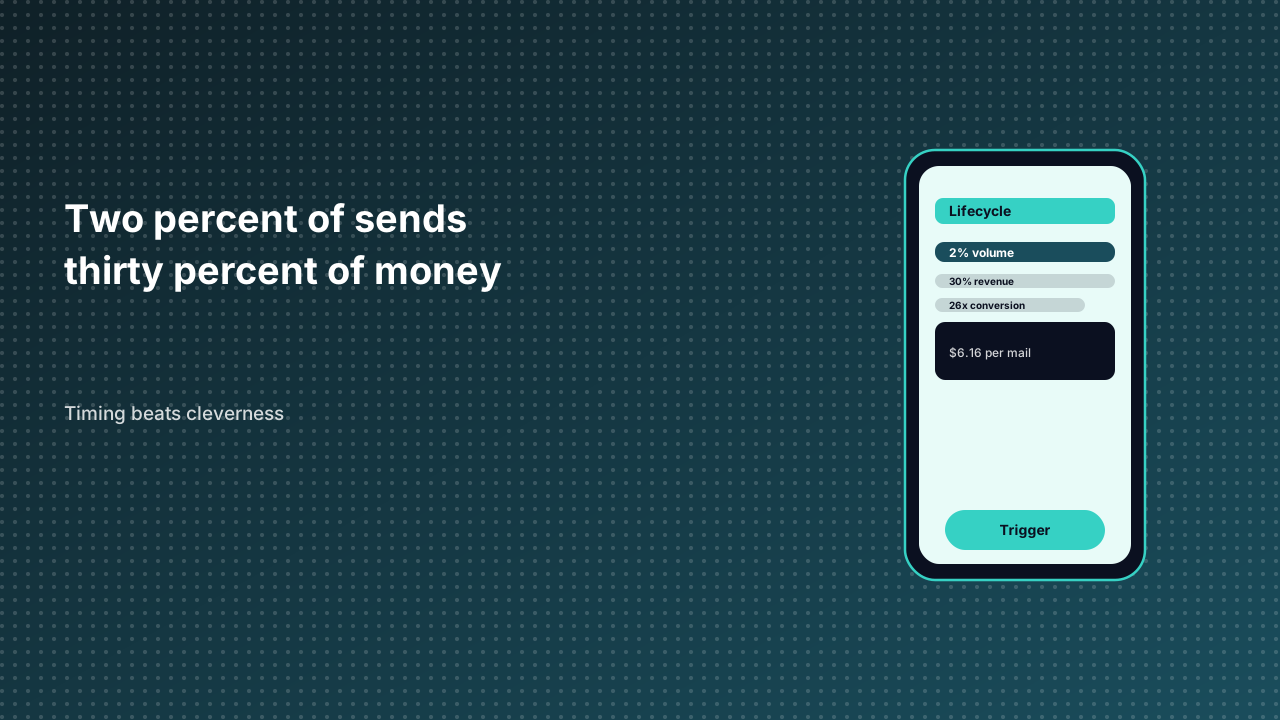
Omnisend's 2025 dataset is large enough to be uncomfortable: twenty billion campaign emails, four hundred and seventy million automated sends, twenty-seven thousand brands. Out of that mountain comes a ratio that ought to rearrange any lifecycle programme. Automated messages are roughly two percent of volume and about thirty percent of revenue. A single welcome email earns six dollars and sixteen cents; a scheduled blast earns fifteen and a half cents. Same channel, same list, forty times the distance.
The mechanism is timing, not copywriting genius. The welcome note arrives at the only moment when intent is at its peak and the brand is still a name the recipient chose to type. In that dataset the welcome email opened at 35.53 percent, clicked at 3.94 percent and converted at 2.11 percent. An ordinary scheduled campaign opened at 30.41 percent, clicked at 0.74 percent and converted at 0.08 percent. The open rates are nearly alike. The conversion distance is twenty-six times. Everything that happens between the open and the order is the difference between a message that was wanted and one that was tolerated.
| Message type | Open | Click | Conversion |
|---|---|---|---|
| Welcome email | 35.53% | 3.94% | 2.11% |
| Scheduled campaign | 30.41% | 0.74% | 0.08% |
| Three-email welcome sequence | — | — | About ninety percent more orders than one |
| Abandoned-cart recovery | — | — | Five to fifteen percent of carts |
Klaviyo's 2025 welcome benchmarks sit higher on the open side — fifty to sixty percent open, eight to twelve percent click, two to five percent conversion, with top performers reaching eight to twelve percent conversion. The spread between sources is a useful warning in itself. Open rate stopped being a clean external benchmark when Apple Mail Privacy Protection began preloading images and inflating the number. A team comparing a welcome email's open against a published figure is measuring privacy settings as much as interest. The comparison that holds up is internal to the sequence: message one against message three, this cohort against the last, the same measurement noise on both sides.
Here is the contrarian part that lifecycle vendors skip. More automation is not the goal; more relevant triggers are. A three-email welcome sequence produces about ninety percent more orders than a single note, not because three is a magic number but because each message answers a different question the recipient actually has. Abandoned-cart flows recover five to fifteen percent of carts, which sounds modest until the alternative is counted as zero. The programme that wins fires on a real event — a first open, a browse, a pause — rather than filling a send calendar and calling it nurturing. Seventy-five percent of welcome opens happen in the first fifteen minutes, so the useful work is in the first hour, not the following week.
For a host platform, the lifecycle surface already exists in a way a standalone app can only envy. The host owns the entry points that actually reach a person — a conversation, a wallet notification, a service tab — and a shared mini-program runtime can react to a native event without asking for another permission. The same trigger that sends a welcome note can light up a first-run path inside the app, where the action sits one tap from the message. That is the part the email benchmarks cannot show: the message is not the conversion, it is the door to the surface where the conversion lives. Build the door, measure the sequence against itself, and ignore the vanity open.
Sources
- Welcome email sequence — Thiscom — why a three-message sequence beats a single note.
- Five welcome emails that convert — Notice Me Senpai — the different question each message answers.
- Email marketing automation insights — Ignition Nova — how two percent of sends carry thirty percent of revenue.
- Welcome email sequence — Thiscom — a second look at trigger timing and the open window.