

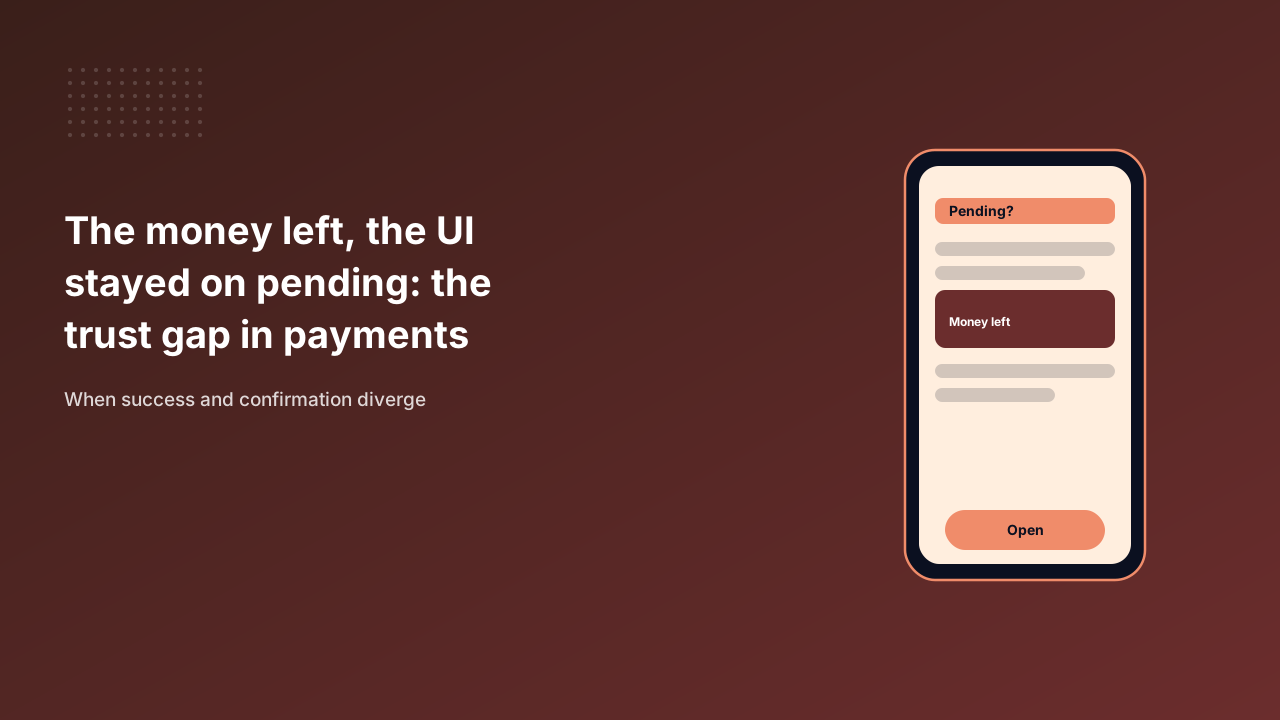
In 2025, a Brazilian ticketing mini-program received more than forty complaints in its first week after enabling Pix: the bank had debited, but the screen still said "processing." This is not an isolated case. Payments are the one subsystem where "looks done" and "actually done" are separated by a real settlement flow; the way it fails worst in a mini-program is not "payment failed" but "payment succeeded and nobody confirmed it."
The failure chain: how that callback got lost
The most common accident runs like this: the user taps pay, the native layer hands the request to the wallet, the wallet debits, and then a receipt has to hop across the bridge between the mini-program and native before it reaches the developer's JS — and that hop is lost. The user switches away, the network jitters, the bridge times out; any of these drops it. The result: the money is gone, the screen still says processing. The user comes back, sees the order unmoved, taps again; without idempotency on the backend, that is two charges.
What makes this counterintuitive is that the failure happens not on the "pay" action but on the "tell the frontend it paid" notification. The system actually succeeded, but the user interface is stuck in the failure state. Most teams test only the happy path in integration — clear network, user doesn't switch, bridge doesn't time out — so the bug ships safely to production.
Instant payments widened the crack
The 2025 payment landscape made this sharper. Brazil's Pix clears about 79 billion transactions a month, reaches 178 million users, and settles in under ten seconds; India's UPI ran 228 billion transactions in 2025, roughly half of all real-time payment volume globally. Users have been trained to expect the bank push to land instantly; they trust that bank notification, not the developer's "payment successful" page. When the screen says processing but the user's phone already shows the bank debit SMS, the trust crack is open: the user does not assume the bank erred, they assume the mini-program is scamming them.
Let the server decide, not the client
The only fix, with no shortcut: order state is always authoritative on the server, and the client is just a display. After the pay action starts, the order enters pending; it flips to paid only when the server has received and verified the gateway or webhook receipt; on timeout or failure it returns to failed and allows retry. The client must never mark success before a receipt arrives.
// client: after initiating, only pending, never fake success
const order = await createOrder(amount);
order.state = 'pending';
await pay(order.id);

// server: same idempotency key twice, one order
if (await seen(order.idemKey)) return existingOrder;
const paid = await gateway.verifyCallback(signedPayload);
if (!paid) return orderToFailed(order);
return markPaid(order, paid);
Webhook retries will double-charge you
The second, nastier trap fires after the team thinks it is done. To guarantee delivery, gateways resend the same receipt when the response times out or returns 5xx — sometimes several times. Without idempotency, that is a double charge, and mathematically the overcharge equals the number of "already confirmed" deliveries times the unit price. The idempotency key is not optional; it is the prerequisite for a balanced reconciliation.
| Current approach | On lost callback | On webhook resend | Verdict |
|---|---|---|---|
| Client marks success | Money gone, UI pending | — | Disaster |
| Server-authoritative plus idempotent | UI waits for real receipt | Same key, counted once | Correct |
| No idempotency | — | Double charge | Disaster |
An AI agent paid, and nobody reviewed it
The most dangerous new scenario in 2025 is an agent paying on a user's behalf. OpenAI and Stripe shipped the Agent Commerce Protocol; Visa and Mastercard followed with their own agent-payment frameworks; Ark projects a quarter of all transactions handled by AI agents by 2030. An agent that can complete a purchase holds a payment credential. If that credential's scope is "spend freely in this catalog," then an injected prompt or a broken agent is a blank check with no human reviewing it. The sandbox cannot tell "this agent was authorized to do this" from "this agent was induced to do this" — it only sees a valid credential. So an agent's payment credential must be issued with least privilege: one merchant, one amount window, not the whole catalog; anything above a threshold keeps a human in the loop.
The compliance boundary: card numbers do not cross the mini-program
One last boundary. Under PCI-DSS scope rules, any system that touches plaintext card numbers sees its compliance cost jump. The correct design is tokenization — the card number is swapped for a token at the gateway side, and the mini-program and the backend only ever move the token, never the raw PAN. This is not a performance note; it is what lets a team draw the responsibility line clearly when something goes wrong.
Payments cannot be faked. The money is either in the ledger or it isn't. Put the state machine on the server, weld idempotency shut, tighten the agent's privileges, and keep card numbers behind the boundary — then a mini-program can credibly claim "tap and pay."


