

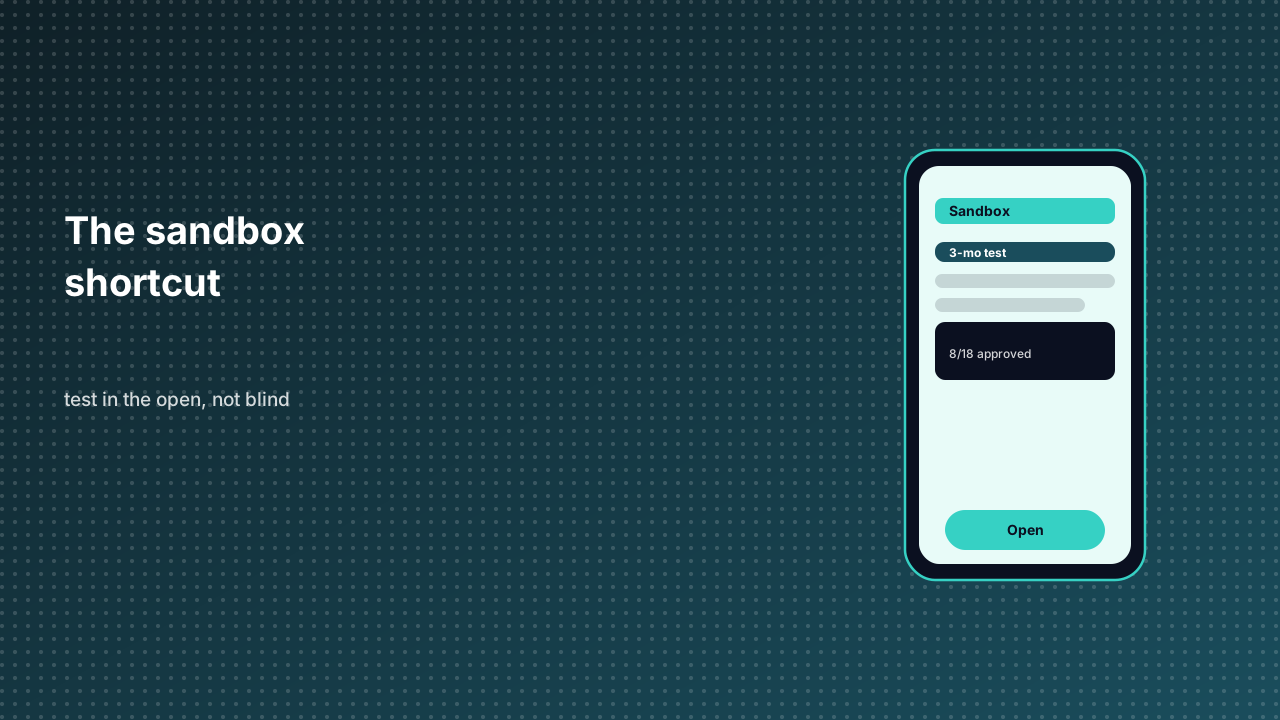
Most operators still treat a new financial service as a licensing project: pick a market, hire local counsel, apply for the relevant license, wait. The wait is the part that quietly decides whether the idea survives. In Singapore, the Monetary Authority's FinTech Regulatory Sandbox reports a median processing time of about three months from submission to outcome, according to a parliamentary reply published on 14 October 2025. In Indonesia, under OJK Regulation POJK 3/2024, the regulator had received 233 consultation requests and 18 sandbox applications by August 2025, approving eight. The United Kingdom's FCA, which launched the first sandbox in 2015, has processed more than 630 applications and seen roughly 30 percent of graduates secure venture capital, with average investment up 6.6 percent.
The numbers describe a pattern. A sandbox does not remove regulation. It compresses the uncertainty window. Instead of committing to a full license before a single customer is served, a firm tests with real money and real users inside a bounded perimeter, with the regulator's explicit carve-outs. Singapore's enhanced Sandbox 2.0, launched in the first quarter of 2025, cut reported time-to-market for participating startups by 30 to 40 percent. Hong Kong's HKMA offers funding support up to HK$1 million for sandbox participants. The point is not the money. The point is that the regulator accepts a trial phase as a legitimate stage of the product lifecycle.
A mini-program catalog produces a structurally similar benefit for a host app, minus the regulator in the loop. When a host opens a runtime to third-party services, each new mini-program is, in effect, a sandboxed trial of a new line of business. The host sets the perimeter: what APIs the mini-program can call, what data it can touch, what it may charge, and what happens when something goes wrong. A partner can launch a pilot financial product to the host's existing users without the host spinning up a new legal entity or a new license track for that specific experiment.
| Lever | Standalone license track | Sandbox / catalog model |
|---|---|---|
| Time to first real-user test | 3–18 months | Weeks to months |
| Capital committed upfront | High (legal, entity, compliance) | Low (runtime access only) |
| Perimeter control | Fixed by license scope | Configurable per partner |
| Exit cost if the pivot fails | High (entity wind-down) | Low (remove the mini-program) |
| Regulatory carve-out | Case-by-case negotiation | Host-defined policy |
The trap is treating the catalog as a compliance substitute. It is not. A host that lets a licensed lender run inside its runtime still inherits the lender's obligations in the eyes of users, even if not in the eyes of the law. The sandbox lesson applies directly: define the perimeter, disclose the participant to users, and keep the escape hatch. A mini-program removed in a day is a failed experiment that cost little. A standalone license unwound after a year is a write-off that the team will remember at the next planning meeting.
The cheaper path is to use the catalog for what it is good at — cheap, fast, reversible trials of new services — and reserve the heavy licensing for the few lines that prove out. Most operators over-license and under-experiment, because the license is the only instrument they have been handed. A runtime changes the shape of the problem. The operator can run ten micro-pilots for the cost of one license application, watch which one compounds, and only then commit the legal capital. That is the sandbox logic, applied where the regulator is not the bottleneck.
The second-order effect is cultural. When experiments are cheap, the organization stops defending bad ideas on the grounds that it already paid for the license. It starts shutting them down early, which is exactly what disciplined growth requires.
Sources
- MAS FinTech Regulatory Sandbox — Singapore's sandbox framework and fast-track lanes.
- OJK POJK 3/2024 sandbox statistics (Aug 2025) — Indonesian sandbox applications and approvals.
- FCA Regulatory Sandbox — the original 2015 sandbox and application volume.
- Singapore Sandbox 2.0 launch coverage — time-to-market reduction figures.


