Last month a friend in Jakarta needed a car to the airport. He didn't open a ride app. He opened the chat app he uses for everything, tapped a tile near the top, and twenty minutes later a driver was downstairs. That isn't a party trick — it's just where mobility has quietly moved.
The app you never installed
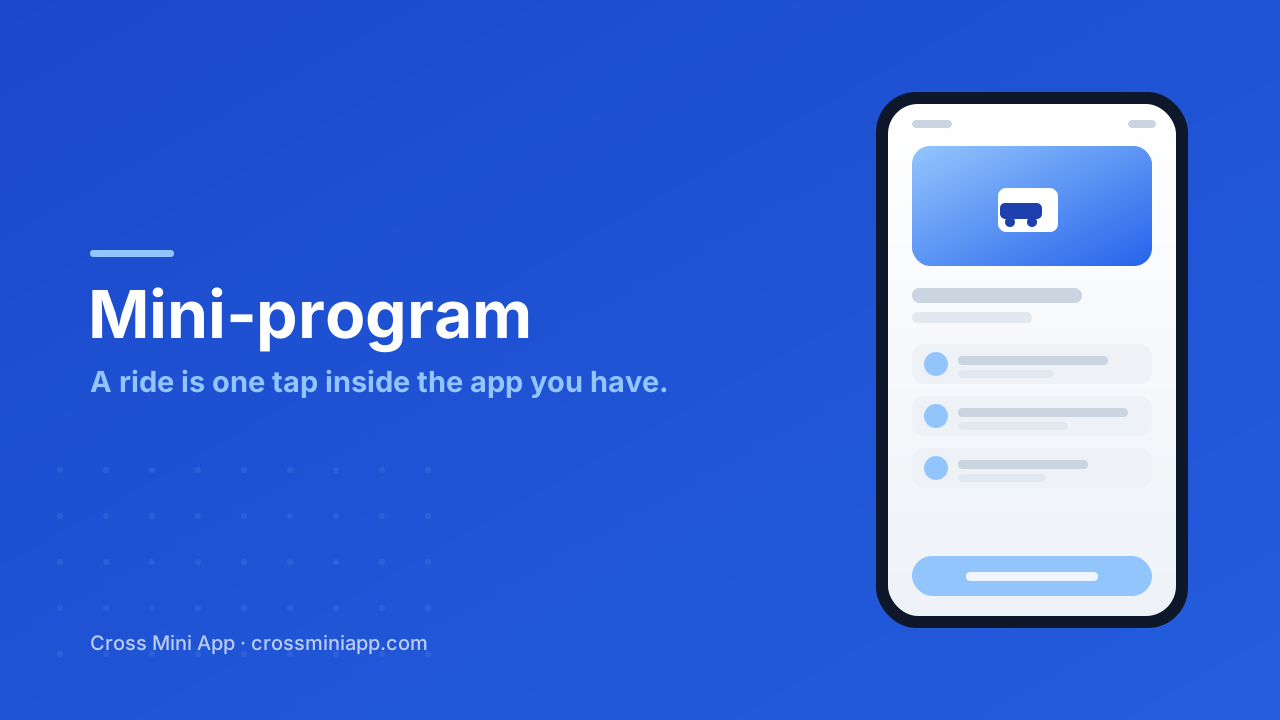
The old story was install, sign up, add a card, hope the car comes. Super apps broke that sequence by folding ride-hailing into something you already trusted with your messages, your money and your location. The ride is a mini-program: a lightweight surface that lives inside the host and borrows its login, wallet and map instead of standing up its own.
We've watched teams build both versions, and the gap isn't in the driving. It's in everything around the driving — the parts that used to eat months.
What the screen actually has to do
Open one of these mobility mini-programs and the job is narrow and physical. You see a map with your pin. You pick a car type — budget, comfort, shared. You get a fare estimate before you commit, not after. You pay with the host's wallet or a local QR code the driver scans. And once you're matched, you watch the car move toward you in real time, with the plate and a face you can check.
None of that is exotic. The point is that all of it was already half-built by the host.
| Surface inside the mini-program | What it would take standalone | Why it ships cheaper here |
|---|---|---|
| Map with pickup pin | A maps SDK, location permission, geocoding | Host already owns location and consent |
| Car-type selector | A second onboarding and saved-places flow | Reuses the host account and addresses |
| Fare estimate | A pricing UI and risk engine you'd build | Same backend, one reusable component |
| Local QR or wallet pay | A fresh payments integration per market | Host wallet is already reconciled locally |
| Live driver tracking | A real-time socket and fleet feed | Host push and presence do the heavy lifting |
| Share-my-trip and SOS | Trust UI built from zero | Borrow the host's identity and contact layer |
Distribution without the install wall
Here's the part the growth teams care about. A standalone ride app has to earn its icon on the home screen, and in most markets the cost of that install has quietly climbed past what a single ride is worth. A mini-program sidesteps it: the user is already in the host, the host already has them verified, and the ride is one tap from a feed they check constantly.
That doesn't mean growth is free. It means the acquisition problem becomes a placement problem — will the host surface your tile, and does the host's audience actually ride? Those are real negotiations, not magic.
A pricing surface that breathes
Dynamic pricing is where mini-programs earn their keep. Surge, off-peak discounts, airport flat rates, region caps — these change faster than any app store review cycle. Because the mini-program is just a view over the operator's backend, the fare logic and its UI can update the same afternoon a regulator or a rainy rush hour demands it. You're not waiting on a release train to change a number on the screen.
We'd push back on the industry line that surge pricing is purely algorithmic fairness. In a mini-program it's also a trust problem: if the estimate jumps and the user can't see why, they blame the host, not the operator. The good ones show the breakdown.
Trust has to be visible
Riding with a stranger is the original trust gap in this business, and a mini-program can't hide behind a separate brand. The safety UI has to be obvious: driver identity, live tracking, a shareable trip link, an emergency button that actually rings someone. The host's identity layer helps — you're not a random new account — but it also raises the stakes. A bad ride reflects on the super app, so the host tends to care more about vetting than a standalone clone ever did.
The overseas bet
The interesting move is the port. Chinese mobility mini-programs have run this exact flow at enormous scale for years — map, car type, estimate, local pay, live tracking, safety — and the patterns are proven. The thesis we're betting on is simple: a universal runtime plus an open catalog lets those proven programs land in overseas super apps without a ground-up rebuild. The ride logic travels; the wallet, the language and the local compliance stay with the host.
It won't be a copy-paste. Local payment rails, driver licensing and data rules differ enough that the catalog entry is a starting point, not a finished product. But starting from a shape that already works beats inventing the flow in a vacuum.
Where it still breaks
We won't pretend the model is clean. Hosts take a cut and a say. A mini-program is only as reliable as the host's runtime on a given device. And if the host's audience doesn't ride, no elegant tile saves you. The standalone app still wins when you need a deep feature set — scheduled fleets, business accounts, loyalty — that a host won't bend its shell to fit.
None of that kills the idea. It just means the win condition is specific: pick a host whose users already move, and ship a ride that feels like a feature of their life rather than a new thing to install.
Sources
- McKinsey — Mobility and on-demand transportation — how ride-hailing and micro-mobility shift as platforms mature.
- Think with Google — consumer behavior in super apps — why users consolidate services inside one trusted app.
- StatCounter — mobile and platform market share — the distribution reality super apps ride on.
- World Bank — urban transport and mobility — why affordable, app-based transport matters in growing cities.
- web.dev — web performance and runtime — what a universal runtime needs to stay fast on cheap devices.