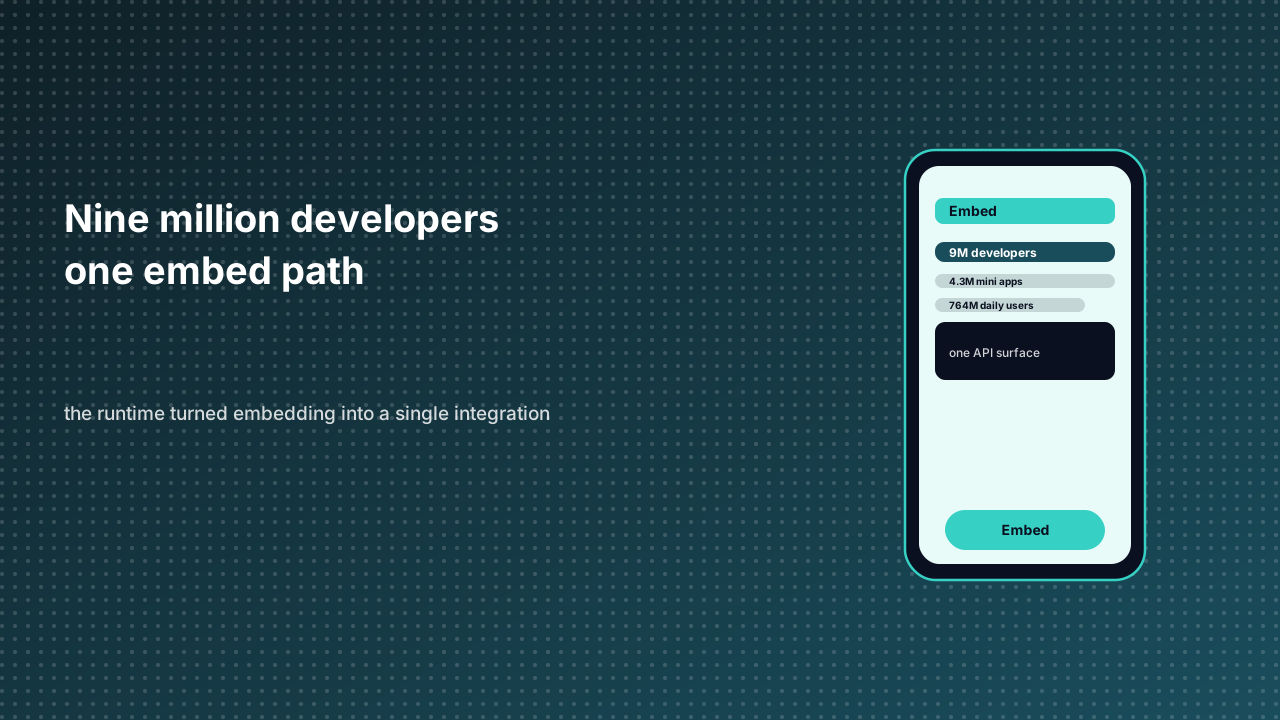
The most underrated number in the mini-program world is not a GMV figure or a monthly-active count. It is a headcount. By 2025, more than nine million developers had built for the WeChat mini-program ecosystem, according to Tencent Cloud's developer community. That is not an audience to market to. It is a labor pool that has already learned one way to embed a service inside somebody else's app — registration, sandbox, review, release — and a path that needs to be taught only once.
The scale behind that path is the reason it is worth learning. Tencent's June 2026 figures, reported by Digital in Asia, put WeChat and WeChat combined at about 1.44 billion monthly active users. WeChat itself hosts roughly 4.3 million mini programs with 945 million monthly users and about 764 million daily users. More than 70 percent of those users open a mini program at least once a week, and the average session runs 11 minutes. E-commerce accounts for 45 percent of mini-program GMV, which is running at around 2 trillion renminbi, or roughly 300 billion US dollars, per quarter. A developer who learns the embed surface once is learning the doorway to that traffic, not to a toy sandbox.
The pattern repeats well beyond one host. Grab operates in eight countries and more than 900 cities with over 50 million monthly transacting users, while Alipay connects more than a billion users to over 10,000 kinds of services. Analysts put the global super-app market near 134 billion US dollars in 2025, projecting 1.1 trillion by 2034 at a compound annual growth rate of 26.45 percent, with Asia-Pacific making up 44 percent. Sell the same skill into a dozen hosts and the marginal cost of each new host approaches zero, because the underlying grammar does not change.
| Layer | What the developer actually learns | Scale behind it |
|---|---|---|
| Authoring syntax | WeChat-compatible markup and API surface | ~9M developers (Tencent Cloud, 2025) |
| Container | Lightweight sub-app inside a host | ~4.3M mini programs on WeChat |
| Distribution | Host catalog, search, and entry points | 945M MAU / 764M DAU |
| Commerce | In-app payment and order flow | 45% of GMV from e-commerce |
| Release | Grayscale rollout and fast rollback | FIDE-compatible, near-zero code changes |
FinClip's 2025 projections describe the same shape from the tooling side: more than two billion monthly active users across its ecosystem, 15 million mini programs, 4.8 million developers, and 540 billion US dollars in transaction value. Its developer center is built around three pillars — efficiency, visibility, and control — and its FIDE layer accepts WeChat syntax, which turns migration into close to a zero-code-change exercise. Grayscale release lets a team ship to a small slice of the audience before opening the taps, so a bad build becomes a contained incident instead of a headline.
The catch is that a shared syntax is not a shared business. A nine-million-person talent pool is valuable precisely because it is portable, and portability means hosts cannot treat that pool as captive. If the embed path is identical everywhere, the winner is the host with the best distribution, settlement, and review rules, not the one with the cleverest SDK. Every promise of near-zero code changes is a gift to developers and a quiet warning to platform owners: differentiation has to live above the runtime, in catalog placement, payout speed, and the quality of the editorial layer. A runtime that is easy to enter is also easy to leave.
That flips the usual onboarding playbook. Instead of spending months courting developers with conferences and swag, a host can inherit an existing skill base and compete on the parts that cannot be copied by changing a config flag. The first mini program a developer ships on a new host is often a port of something that already works elsewhere, so the metric that matters is time to first transaction, not time to first hello-world. Cross Mini App sits at exactly that layer, giving hosts a shared runtime where an already-trained developer can land, and giving developers one embed path that travels across hosts rather than a fresh integration for each one.
Sources
- Tencent Cloud developer community article — nine-million-developer ecosystem figure for WeChat mini programs.
- How super apps work in Asia — Tencent 2026 user, catalog, session, and GMV metrics.
- FinClip mini apps product overview — ecosystem scale projections and the FIDE compatibility layer.
- Mastering developer experience with FinClip — developer-center pillars and grayscale release.