Platforms talk about their ecosystem in terms of reach. The supply side experiences the same ecosystem as a toll schedule. Every percentage point of commission is a percentage point of margin removed from a merchant who already runs on thin numbers, and the difference between a sustainable catalog and a shrinking one is often a single tier.
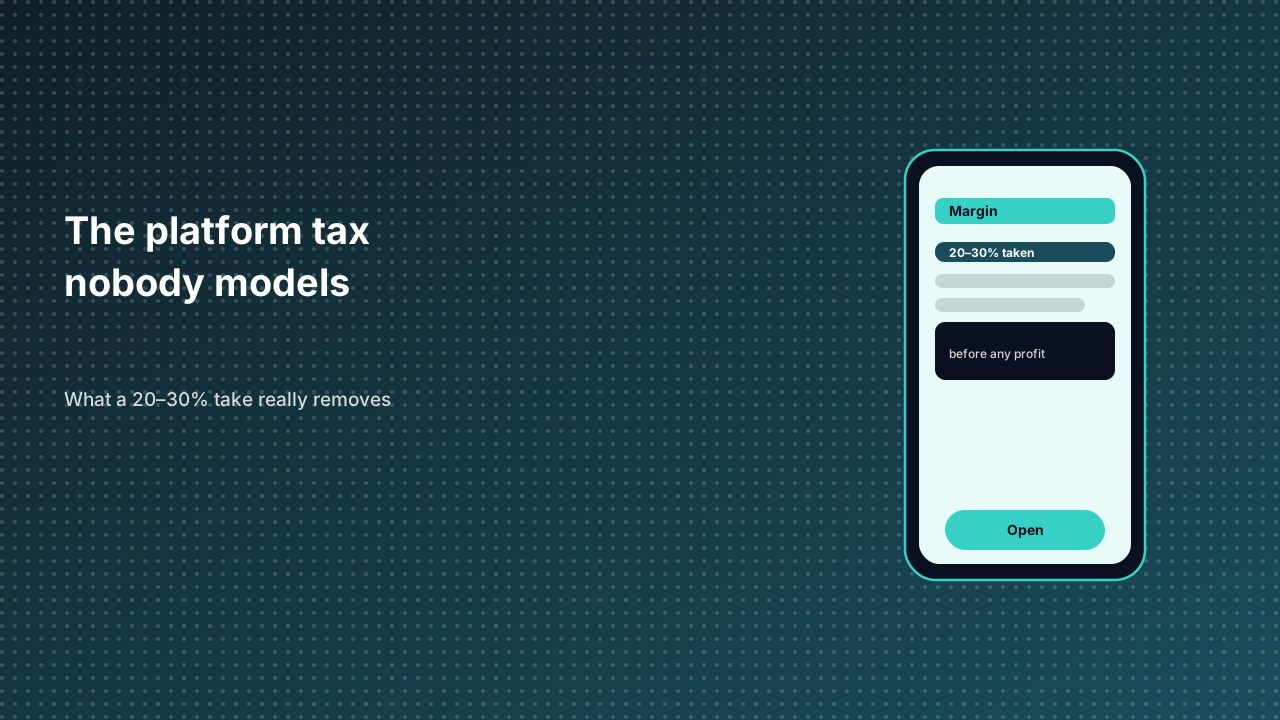
The clearest public data comes from Southeast Asia's super apps. Grab charged merchant commissions of 20–30% of sales in 2025 across deliveries, payments, and marketing, generating an estimated S$1.12 billion in commission revenue for the year. Gojek's food delivery commission sits at 15–20% per transaction. GoFood and ShopeeFood run at 25–30% and 22–27% respectively. These are not marginal fees — they are the largest single cost line for a small merchant after the food itself.
Where the tax actually bites
A worked example from F&B cost analysis shows the mechanism. On a typical order, the platform commission is the dominant cost: a 27% take on a VND 60,000 order leaves the shop with under VND 44,000 before ingredients, packaging, and labor. After food cost, packaging, and staff, the realistic net margin lands between 5% and 12%. Push the commission to 30% with a promotion attached, and the merchant is losing money on every order.
This is why smaller merchants describe the commission as an "access tax." They pay it because the platform owns the demand, but the payment changes their behaviour: they mark up app prices 10–15% versus dine-in, build separate delivery-only menus, and avoid running discounts they cannot math. The catalog keeps filling, but the quality of what is offered degrades as margin-sensitive sellers exit or shrink.
| Platform (2025) | Commission range | Net merchant margin after cost | Effect on supply |
|---|---|---|---|
| GrabFood | 25–30% | 5–12% | Highest traffic, highest toll |
| ShopeeFood | 22–27% | 6–13% | Lower fees, lower order value |
| GoFood (Gojek) | 20–25% | 8–15% | Lowest of the big three |
| Self-delivery | 5–10k/order | 12–18% | Cheapest, limited radius |
The counterweight: tiers and multi-service lock-in
Mature platforms have learned to modulate the tax. Grab introduced tiered commissions in 2025 — as low as 15–18% for basic listings and 25–30% for promoted placements and full marketing bundles. The intent is to keep price-sensitive merchants on the platform at a lower rate while extracting more from those who buy visibility. Gojek segments merchants into premium dining, mass-market, and SMEs with tailored ad packages and commission structures.
The retention counterweight is multi-service usage. Grab's internal data shows multi-service users transact 3–4x more than single-service users, and that breadth reduces churn. A merchant or rider embedded across multiple services is harder to pull away, which lets the platform hold commission levels higher than a single-service model could survive.
What a mini-program catalog changes
A catalog that the host does not fully tax changes the supply calculation. When the entry point is provided by a host app but the commercial terms are set by the developer, the toll is transparent and contestable rather than imposed. The host still wins through retention and cross-sell — the same dynamics that make super-app commissions work — but the supply side is not forced into the 5–12% margin trap that pushes margin-sensitive sellers out.
The lesson from the super-app data is not that commissions are wrong. It is that the supply side models them precisely, and the breaking point is lower than platform optimism assumes. A catalog designed around a lighter, contestable toll builds a deeper and more durable supply than one that maximizes take at the top tier.
Sources
- Digital in Asia — Grab's Business Model — Grab segment revenue, commission ranges, multi-service transacting data.
- F&B Validator — Delivery App Costs — platform commission tables and net margin worked examples.
- Canvas Business Model — Grab Marketing Mix — S$1.12B commission revenue and tiered commission structure.
- Miracuves — How Gojek Makes Money — Gojek provider-side fee bands and ad/visibility charges.