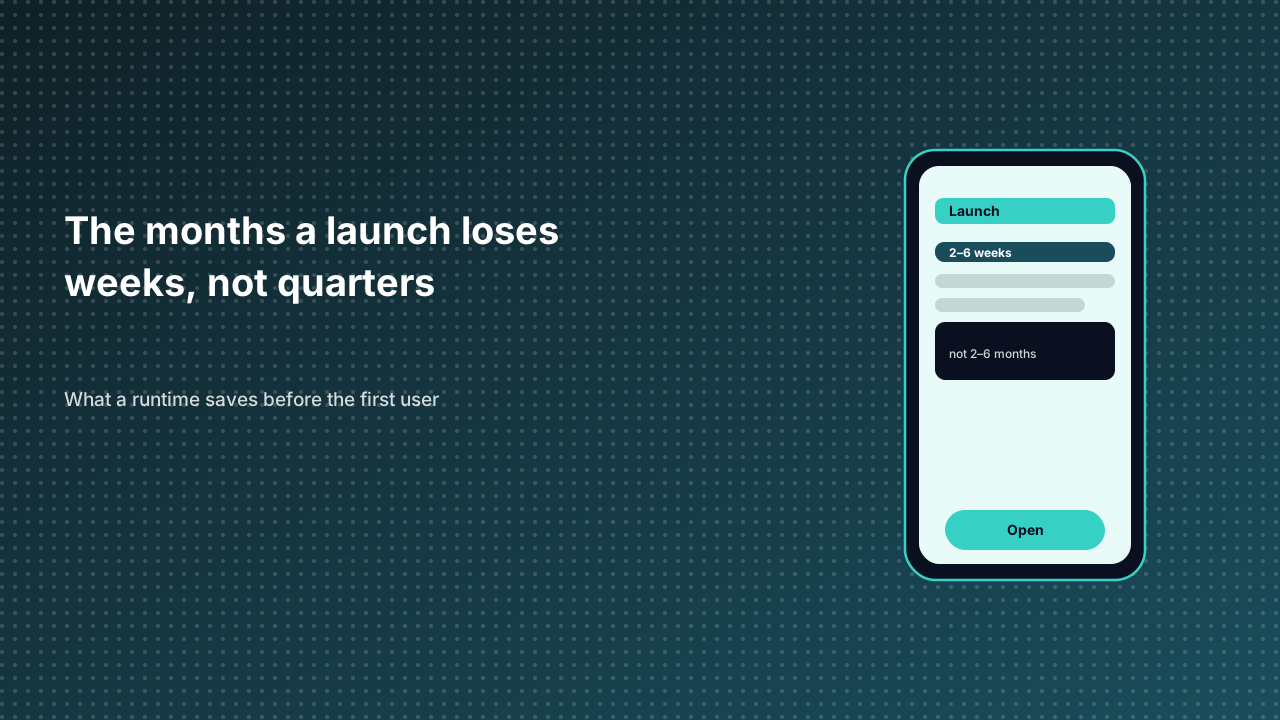
WeChat reported 650 million daily active users across its mini-program surface in 2025, and the platforms that replicate the model abroad consistently cite one advantage before any revenue number: the launch happens in weeks, not quarters. The gap is not cosmetic. A team that budgets a native app launch at 2 to 6 months and $20,000 to $150,000, against a mini-program launch at 2 to 6 weeks and $500 to $70,000, is not comparing two ways to ship the same thing. It is comparing two different opportunity costs for the same market window.
The clock starts before the code
A native launch forces a team to build two separate front ends — iOS and Android — each with its own payment integration, push system, and store approval cycle. WeChat's own review process is a single path, and the build underneath is smaller because it inherits login, payments, and notifications from the host. The result, documented by firms shipping into the China market, is a 60% shorter development cycle and a 40–50% cut in labor cost for the same functional module. For a team racing a seasonal demand spike or a regulatory opening, those months are the product.
What the deferred launch actually costs
The cost of a slow launch is rarely modeled as a line item. It shows up as a competitor capturing the category first, or a pilot that lands after the partner integration window closes. A 2025 iResearch whitepaper puts the infrastructure saving higher still: teams using cloud-development models cut initial IT spend by up to 80%, because they do not stand up a server cluster to handle launch-day traffic. The deferrable cost is the option value of being present when intent forms — and intent in emerging markets forms around events, not roadmaps.
Retention is the offset, not the excuse
Critics point out that mini-programs average a 12% seven-day retention against an app's 25% plus, and that is true at the surface level. But the same research shows mini-program customer acquisition cost runs at roughly one-fifth of a native app's. The two facts belong in the same model: a host that uses a catalog to cross-sell an existing user is not paying the full acquisition cost for the second service. The time-to-market argument is not "ship something worse faster." It is "ship the trigger fast, then compound through retention the catalog enables."
The table operators skip
| Launch dimension | Native app | Mini-program runtime |
|---|---|---|
| Time to first user | 2–6 months | 2–6 weeks |
| Upfront build cost | $20k–$150k | $500–$70k |
| Front ends to maintain | iOS + Android | One runtime |
| Initial IT spend | Full stack | Up to 80% lower (cloud) |
| Acquisition cost | Baseline | ~1/5 of native |
The pattern repeats across regions. QuestMobile data shows users are 3.2x more willing to try a service through a mini-program than to download a new app — which means the speed advantage compounds at the top of the funnel, not just in engineering.
Where the speed claim breaks
A runtime is not a free pass. The 180ms session latency budget that WeChat holds across 1.2 trillion daily launches is an engineering commitment, not a default. Teams that treat the runtime as a thin web view discover, at scale, that catalog governance and latency are the price of the speed. The months saved are real only if the host invests in keeping the surface fast. A portable runtime like Cross Mini App carries that latency discipline across host apps without each team relearning it.
Conclusion
The evidence is consistent: the launch clock is a strategic variable, not a technical detail. Hosts that adopt a mini-program runtime convert a 2–6 month, $20k–$150k native build into a 2–6 week, $500–$70k launch — and they capture demand while it is still live. The teams that win emerging markets are not the ones with the longest roadmaps; they are the ones present when the window opens.
Sources
- Fooyo — WeChat Mini Program vs Native App cost and timeline — launch windows and cost ranges.
- iResearch — 2025 mini-program development cost whitepaper — cycle and cost reduction figures.
- QuestMobile — super-app user behavior reports — willingness-to-try and retention data.
- Tencent — WeChat ecosystem annual report — DAU, launch volume, latency budget.