A brand that was seen but never visited
A consumer electronics label noticed an odd pattern last quarter. Its name began appearing inside Google's AI Overviews more often, yet organic sessions stayed flat. The growth team read the zero-click headlines and prepared for the worst, while the brand was in fact being read by more people than before — just not followed out of the results page. That gap, between being seen and being visited, is the real subject of zero-click search. The usual coverage gets it backwards.
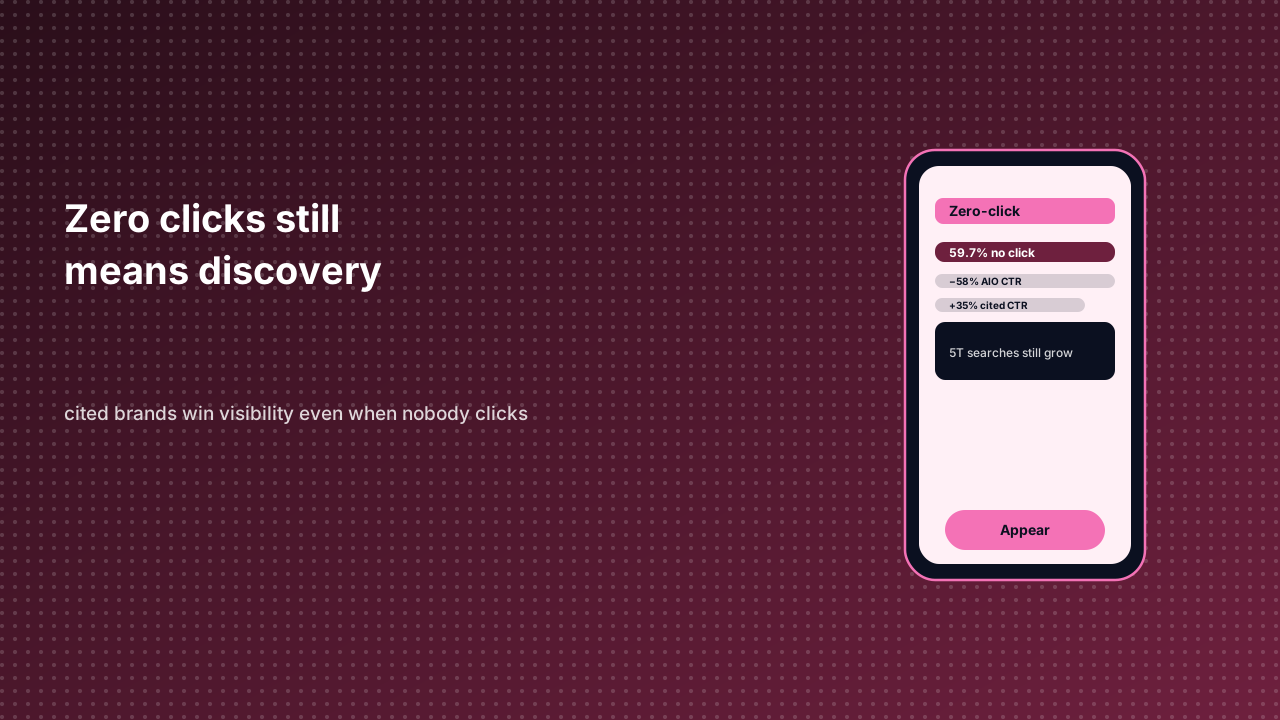
Semrush's cross-device panel puts only 40.3% of U.S. Google searches in March 2025 producing a click on an organic result, down from 44.2% a year earlier — about 59.7% zero-click (Semrush). That figure gets quoted everywhere. On its own it is nearly useless for deciding what to do next, because it measures one narrow outcome and calls it the whole story.
Four studies, four different measuring sticks
| Study | What it actually counted | Headline figure | Why the number shifts |
|---|---|---|---|
| Semrush, 2025 | U.S. Google searches ending in an organic click | 40.3% in March 2025 vs 44.2% a year earlier | Cross-device panel; counts clicks, not visibility |
| Ahrefs, 2025 | Organic CTR when an AI Overview appears, across 300,000 keywords | −34.5% year over year; −58% by December 2025 | Position one fell from 0.073 to 0.016 — a squeezed top slot, not a vanished one |
| Pew Research Center, 2025 | 68,879 searches, with and without AI summaries | 8% click a traditional result with a summary, 15% without | 26% of visits end on the summary page |
| Seer Interactive, 2025 | CTR for brands cited inside AI Overviews | +35% organic, +91% paid | Correlation, not causation — cited brands skew strong already |
| Industry reporting, 2025 | Traffic at named publishers | HubSpot −70–80%, Forbes −50%, CNN −27–38% | Secondhand figures from a handful of sites |
The quoted brand and the clicked link are not the same thing
The doom posts skip the most interesting finding in this whole body of research. Seer Interactive's analysis of 3,119 queries across 42 organizations found that brands cited inside AI Overviews showed a 35% higher organic CTR and a 91% higher paid CTR (Inc). That deserves a careful reading, because it is a correlation. The brands engines cite tend to be the ones with the strongest overall footprint, so a citation is partly a signal of existing authority rather than a lever that manufactures demand. Anyone selling "+35%" as a guaranteed outcome of an optimization project is selling a misunderstanding.
And yet the direction still matters. Pew's survey found that only 1% of visits clicked a link inside the AI summary, and that 26% of visits ended right on the summary page, compared with 16% when no summary appeared. A brand named in that summary occupied the last thing a person read. A brand missing from it did not exist in that session. Discovery and traffic came apart: the click is one outcome, the mention is another, and the mention survives even when the session never leaves the results page.
Ahrefs makes the same point from the other side. Its 300,000-keyword study found organic CTR down 34.5% year over year when an AI Overview appeared in March 2025, widening to 58% by December 2025 (Ahrefs). But the first organic position did not drop out of existence — its click-through rate fell from 0.073 to 0.016. Attention compressed into the answer rather than evaporating. That is a very different problem from "nobody searches anymore," and it calls for a very different response.
Stop treating one percentage as a verdict
Different studies put the zero-click share anywhere from roughly 60% to well above 90%, depending on whether the sample is a cross-device panel, a logged-in desktop session, or AI Mode in particular. Those figures are not interchangeable, and stacking them into a single scary statistic is lazy. Choose one methodology, say which one, and reason from it. The honest reading of the Semrush and Pew numbers is that zero-click is high and rising — that part is consensus — while the precise rate is a moving target that depends on the measuring stick.
The publisher losses are real and should not be waved away: industry reporting puts HubSpot down 70–80%, CNN 27–38%, Forbes 50%, Business Insider 40–48%. They are also secondhand figures covering a handful of sites, not a law of nature. Set against them, Google stated in 2025 that the platform handles more than five trillion searches a year, and Alphabet reported Search revenue up 17% year over year in 2026 Q2. Total query volume is still growing. The fight is over where attention lands inside that volume, not over whether the volume exists.
Where discovery now happens
The practical response for a catalog of mini-programs is not to chase back a click that the interface no longer offers. It is to make each entry legible to the machine assembling the answer: a stable identity, a plain description of what the program does, and structured facts that can be quoted without a visit. CrossMiniApp's open catalog and shared runtime give a service one governed surface that can be read, cited, and launched from wherever the answer is formed, instead of betting everything on a single results page. Zero-click does not erase discovery; it relocates it. The services that get found are the ones a machine can name accurately in one sentence.