The border a WebView can't see
Load an H5 page inside a WebView and its data flows to whatever origin serves the document. There is no enforced boundary between the page and the network it calls; a third-party script, a misconfigured endpoint, or a silent redirect can send personal data somewhere the operator never intended and the regulator cannot trace. For cross-border commerce, that ambiguity is a liability.
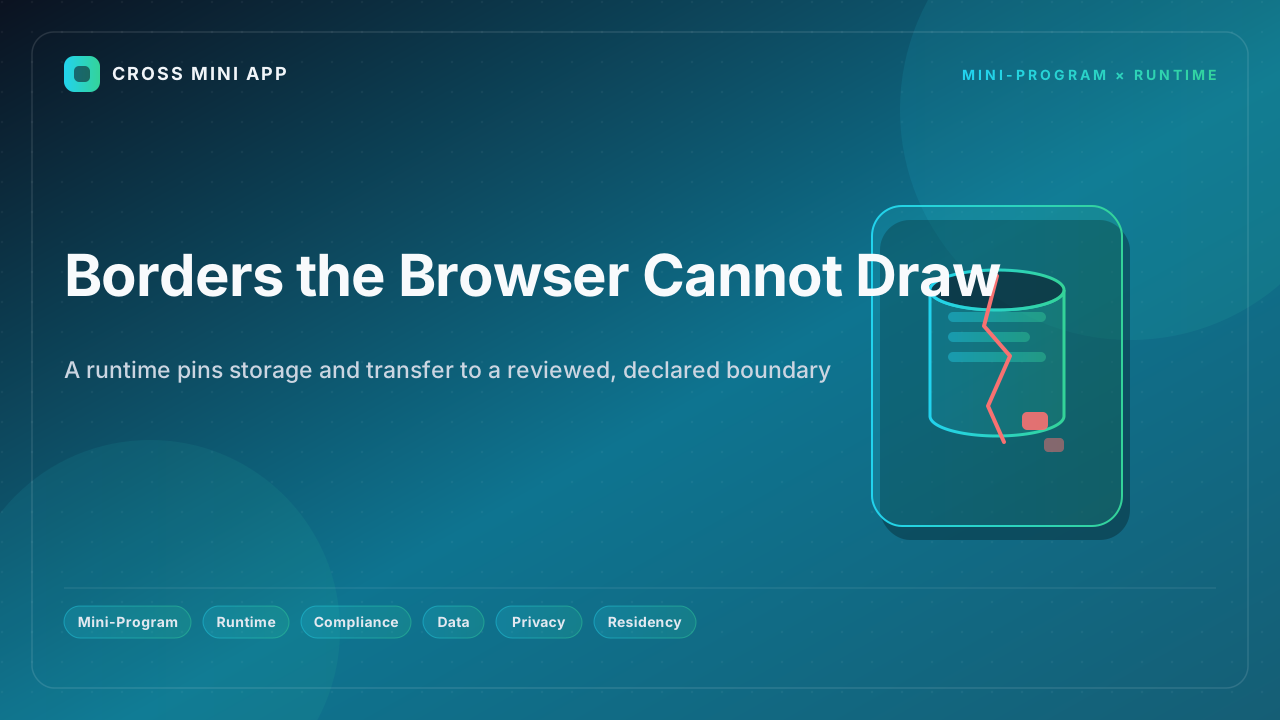
A mini-program runtime draws the border before code runs. Storage, network egress, and capability calls are declared and reviewed up front, so the path personal data takes is something you can name, show, and audit — not something you discover after a breach.
What a declared boundary actually is
The runtime treats data handling as a first-class, reviewable surface. Where the program may store data, which endpoints it may call, and which capabilities may touch personal information are part of the declared manifest, validated before execution. The platform can therefore enforce residency and transfer rules at the boundary instead of hoping every page behaves.
This matters because the laws are explicit. The EU General Data Protection Regulation requires a lawful basis and safeguards for cross-border transfer. Singapore's PDPA and Brazil's LGPD impose similar obligations on how personal data is collected, stored, and moved. A runtime that makes the data path visible turns those obligations from a hope into a control.
Where the gap shows up
| Concern | H5 in WebView | Mini-program runtime (declared boundary) |
|---|---|---|
| Storage location | Page chooses, often unseen | Declared and reviewed |
| Network egress | Any endpoint the script reaches | Allow-listed by manifest |
| Third-party scripts | Full access by default | Scoped by policy |
| Audit trail | Accidental | Declared and inspectable |
| Transfer compliance | Hard to prove | Enforced at boundary |
The difference is not whether the technology can send data — both can. It is whether the operator can prove where it went.
Why a boundary beats a hope
A single declared boundary means a developer states the data path once and the runtime enforces it across every host and device. It also lets the platform apply regional policy consistently: the same program can respect residency rules in one market and a different rule set in another, without the page author hand-rolling compliance.
How Cross Mini App applies it
Cross Mini App gives programs a runtime that treats data handling as a reviewed boundary: storage, egress, and capability access are declared in the manifest and validated before execution. Your program states where data lives and where it may travel; the runtime enforces it on every device it runs on. You meet regulators with evidence, not assumptions.
That is the difference between data that drifts wherever the document points and data that stays where the law says it should.