The tax of per-platform native code
Build a mini-program natively for each platform and you pay a tax on every line. WeChat uses WXML and WXSS, Alipay uses AXML, other hosts bring their own dialects, and each one demands its own IDE, its own build, and its own review clock. A team that wants to reach three hosts maintains three codebases, three mental models, and three sets of bugs. The cost is not just duplication; it is the cognitive overhead of never settling into one way of working.
What a cross-platform runtime gives you
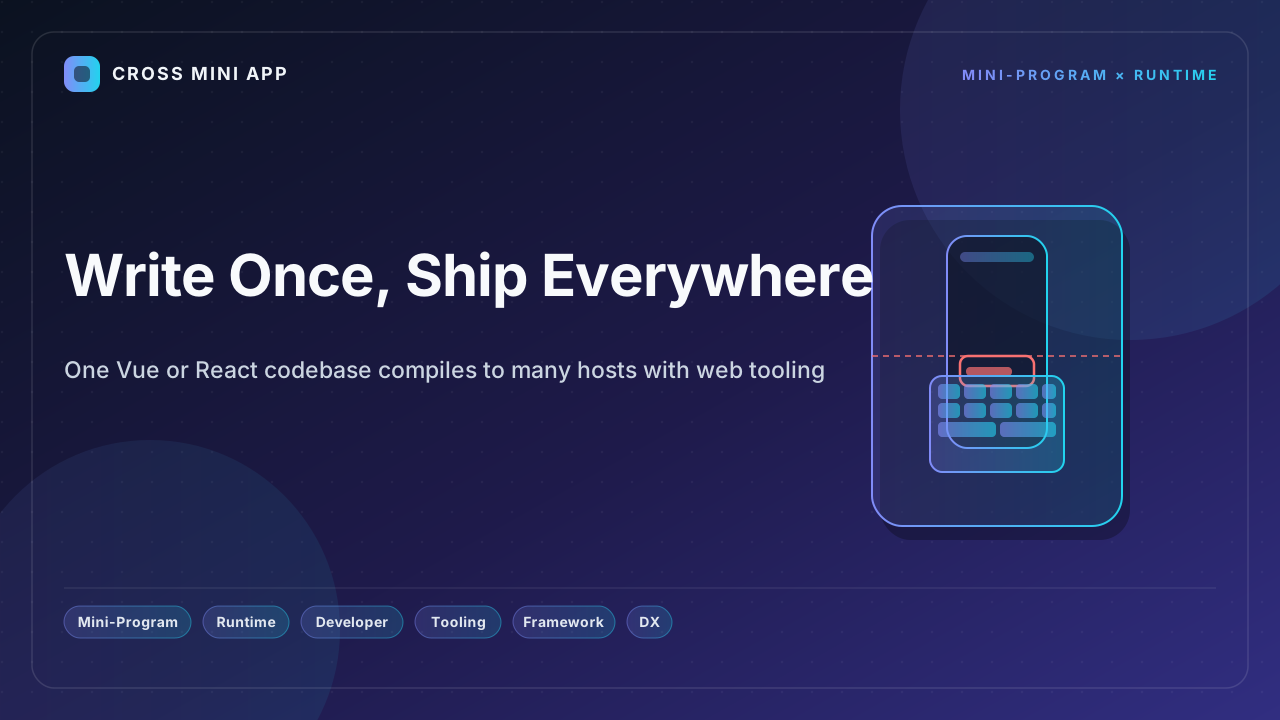
A universal runtime compiles one familiar codebase — Vue or React, TypeScript, Pinia or Zustand — into the native format each host expects. You write wx.requestPayment once and it resolves to the right native call on whatever device the program runs on. The runtime absorbs the per-host differences so your team writes web-shaped code and ships to many apps without rewriting.
The ergonomics compound. Because the output is web-shaped, you keep the entire web engineering toolchain: hot reload, unit tests, ESLint, type checking, and CI/CD that already exists in your pipeline. Over 80 percent of logic and interaction testing can run in a standard browser, away from the proprietary dev tools. You hire from the large pool of front-end engineers instead of hunting for rarity per-platform specialists.
Where the gap shows up
| Dimension | Native per-platform | Cross-platform runtime |
|---|---|---|
| Codebases | One per host | One shared |
| Language | WXML/AXML per host | Vue or React + TypeScript |
| Tooling | Proprietary IDE per host | Standard web toolchain |
| Delivery cycle | 3 to 6 months | 2 to 4 months |
| Relative cost | 100 percent baseline | 50 to 80 percent |
| Testing | In-host only | 80 percent in browser |
Industry delivery data puts cross-platform cycles 30 to 60 percent shorter than native, with cost at roughly half to four-fifths. The saving is not magic; it is the elimination of parallel maintenance.
Why one codebase beats three
Three codebases mean three places for the same feature to diverge, three review queues, and three chances for a fix to land in one and miss the others. A single codebase keeps behavior consistent across hosts and turns a multi-platform release into one build. When the platform ships a new API, you adapt once; the compiler carries it to every host.
How Cross Mini App applies it
Cross Mini App gives programs a universal runtime that takes a standard web codebase and runs it across host apps, mapping wx.* calls to the right native module on each device. Your team works in the stack it already knows, tests in the browser it already has, and ships to many apps from one repository. You stop paying the per-platform tax and start spending that time on the product.
That is the difference between rewriting the same app three times and writing it once where it matters.
Sources
- DCloud — Why uni-app beats native mini-program development: one codebase, web tooling, diff-based updates
- Xiyue Design — Mini-program selection guide: native vs cross-platform cycles and cost
- Yaotu — 2026 native vs framework: 30 to 60 percent faster delivery, modern stack
- Taro Documentation — Compile React or Vue into native mini-program formats