The door WebView leaves open
A WebView is not a sandbox — it is a full browser engine dropped into your app with your app's privileges. Android documents WebView plainly as essentially a full-featured browser engine (Chromium) with a significant memory footprint and a complex multi-process architecture. Because the page runs with the embedding app's identity, any capability the host grants — file access, stored credentials, the native bridge — is reachable by whatever JavaScript the page loads. The bridge that lets web call native is, by construction, an open door: the page is both the untrusted content and the privileged surface.
That is the crux of the WebView sandbox problem: there is no hard wall between the web document and the native app. A malicious or simply buggy page can reach across the bridge, read shared storage, and abuse the host's permissions. This is exactly why browsers isolate each site into its own renderer process, and why iOS assigns every app its own container enforced by a kernel-level MAC sandbox — the platform knows untrusted code must be fenced.
Isolation as a first-class property
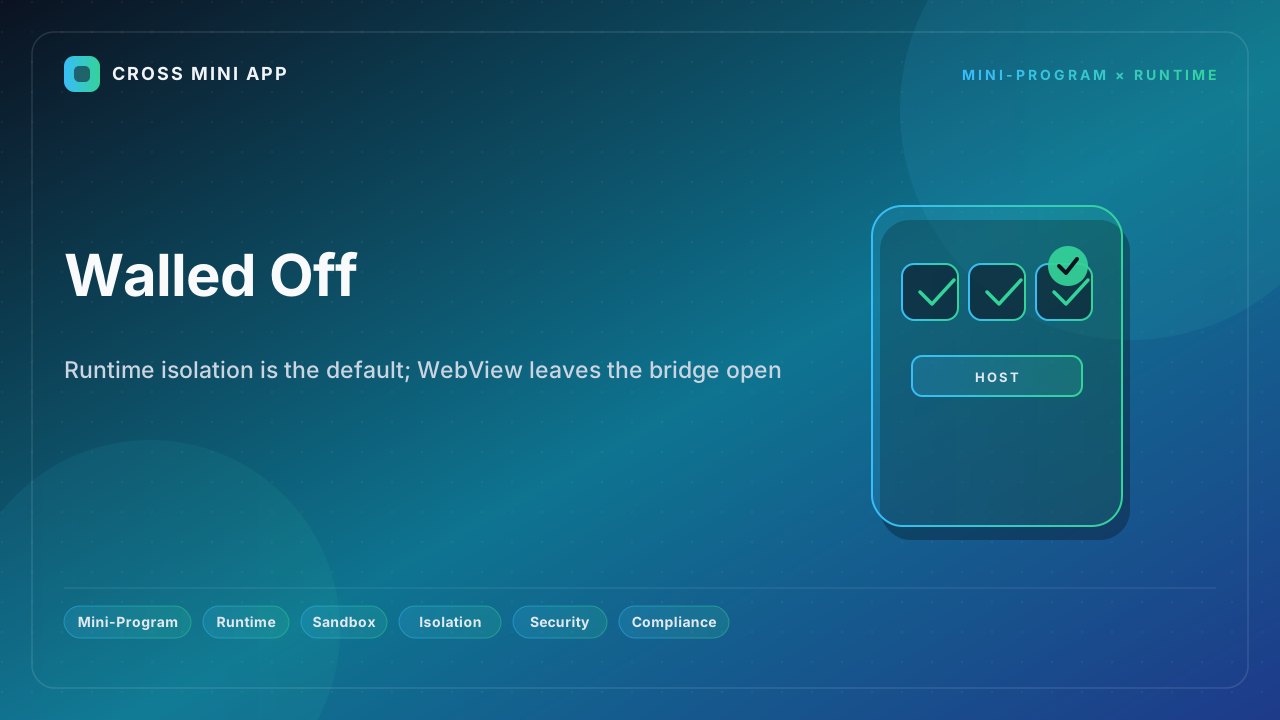
A mini-program runtime flips the default. Instead of granting the embedded document native power, it places each mini-program inside its own execution sandbox and brokers every privileged call through the platform. WeChat's model — the one the whole ecosystem copied — splits a program into a logic layer and a view layer, both running under the client's control, with no direct DOM and no direct native handle. As platform-engineering write-ups describe it, the logic layer has no DOM access and cannot read or modify the page tree, while the view layer does not execute developer-written business logic. They meet only through a serialized message bridge.
From a security standpoint that boundary is the whole point: a program's JavaScript cannot touch another program's data, cannot reach into the host, and cannot call a sensitive API without the platform's explicit, declared mediation. Isolation is not a setting the developer remembers to turn on — it is the shape of the runtime itself.
What the walls actually block
Concretely, a runtime-enforced sandbox stops three things a WebView cannot:
| Risk | WebView | Mini-program runtime |
|---|---|---|
| Cross-program data | One shared web context | Per-program isolated storage |
| Native power | Open JS bridge | Capability brokered by platform |
| Dynamic execution | eval / remote code | Removed at the runtime level |
The logic layer typically removes document, window, and dynamic-eval style execution entirely, so the classic XSS-to-native escalation path does not exist. Network requests are forced through the platform's domain allowlist over HTTPS, which removes the silent exfiltration route. Sensitive APIs — location, camera, payment, file — are declared in a manifest, reviewed at submission, and brokered, so a third-party program cannot quietly grab what the host never intended to share.
The compliance dividend
This is the property that makes opening the app to partners fundable. Without isolation, inviting third-party code into your most trusted surface means inheriting every third party's risk and liability. With isolation, the host keeps the account, the wallet, and the notification channel, while each mini-program lives in a fenced box it cannot escape. Content security, data residency, and abuse controls become platform responsibilities rather than hope.
It mirrors the same principle OS vendors already enforce: Apple's App Sandbox and iOS kernel MAC policies give every app a private area of the filesystem and block cross-app access at the kernel level, precisely so a vulnerable or malicious app cannot move laterally. A mini-program runtime applies that same discipline one level down — not just app-versus-app, but program-versus-program inside a single app.
How Cross Mini App enforces it
Cross Mini App is built as a generic runtime with isolation as a primitive. Every mini-program gets its own sandboxed execution boundary, a uniform wx.* API surface that is capability-gated, and a governed distribution path — submission review, content security, and abuse controls — before any code reaches a user. A program written once runs across every host that ships the runtime, but it runs inside the wall, never outside it.
That is the difference between embedding web and embedding a runtime: web brings the open door; a runtime brings the fence — and the fence is what makes an open catalog safe to operate.
Sources
- Android Developers — WebView is a full browser engine (Chromium) with significant memory and multi-process cost
- DEV Community — Mini-program dual-thread architecture and sandbox isolation model
- Apple Developer — App Sandbox protects user data by limiting app capabilities
- Apple Platform Security — iOS sandbox restricts each app to its own container
- OWASP — Mobile Application Security Testing Guide and MASVS