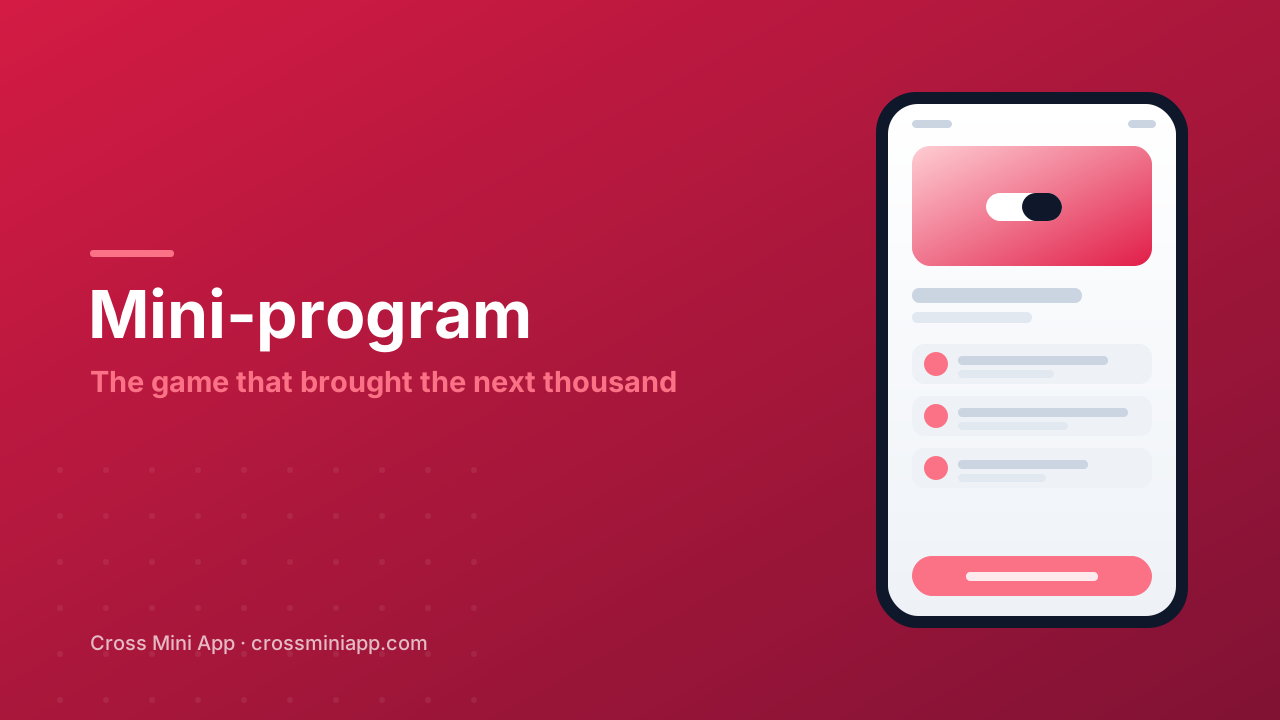
Acquiring a user used to mean buying a home-screen slot they'll forget. Mini-games flip the unit: the acquisition is the entertainment, not an ad for it. A lightweight game that runs inside a host app — shareable, no install, no login wall — pulls a thousand users through play, and the ones who stay meet your real service on the way out. The cost per acquired user drops because the bait was fun, not a banner.
The mechanic is the share, not the store. A mini-game travels as a chat link or a forwarded card; the next player opens it in two seconds inside the app they already trust. No App Store detour, no "download to continue." Each session is also a data point — what they tapped, where they bounced — that your real product can act on. The game is the top of a funnel you didn't have to buy media for.
| Acquisition lever | What the mini-game does | Why it beats paid UA |
|---|---|---|
| First open | Share link, instant play | No install, no store detour |
| Viral loop | Forward to a friend in-chat | The user does the distribution |
| Warm handoff | Game ends on your service | Acquisition meets retention |
| Signal | Play behavior is opt-in data | You learn before you pitch |
Here's the pushback the paid-acquisition teams won't like. They'll say games don't convert to revenue. Sometimes true — a viral game with no handoff is a vanity spike. But the games that worked in China weren't trophies; they were the front door to a payment, a ride, a reorder. The acquisition was real because the handoff was. A portable mini-program runtime lets you ship a game that ends on your actual service, so the thousand you pulled are the thousand you keep.
And the loop is the moat. A good mini-game is cheap to run and endless to remix — seasonal skins, leaderboards, a tournament for the local festival. Each refresh is a reason to come back and a new share. Chinese apps didn't buy their way to hundreds of millions of users; they played their way there, one forwarded card at a time. The mini-game is the cheapest distribution you'll ever run, and the one your competitors can't copy by outspending you.
The local angle is the unlock. In Indonesia, Brazil, Kenya, the Philippines, the entry point is a chat and the currency is a forwarded message. A mini-game built for a local festival — a Ramadan countdown, a Carnival bracket, a matatu leaderboard — spreads through the exact network your service needs. You don't buy the audience; the game earns it from the block, and the host supplies identity and wallet for the handoff.
I won't pretend the channel is automatic. A fun game is hard to make and a manipulative one is a reputational landmine. The honest risk is shipping a game that goes viral for the wrong reason, or a handoff so abrupt it feels like a bait-and-switch. The acquisition only counts if the game respects the player and the service delivers on arrival. We shouldn't fake either.
But the direction is clear. The players are already in the chat. The share is already one tap. The only missing piece is a runtime that carries a proven Chinese mini-game acquisition model into the app your next thousand users already open. Build the game, keep the handoff honest, and the next thousand show up to play.
Sources
- StatCounter — Mobile market share — why a chat surface, not a store, is where users actually gather.
- Think with Google — Gaming behavior — how mobile users discover and share lightweight games.
- World Bank — Digital adoption data — where young, mobile-first audiences concentrate by market.
- web.dev — Web platform guidance — the runtime and performance basics behind a portable mini-program.
- MDN Web Docs — Web tech reference — the standards a portable game UI should build on.