Accessibility Is the Cheapest Reach You Are Not Buying
Most teams file accessibility under "nice to have" and then wonder why a slice of their audience churns for reasons no dashboard names. Color-blind players, players on small screens with fat fingers, players who cannot hear the one cue that matters — they do not file a complaint, they just leave. Accessibility is not charity. It is reach you are already paying to acquire and then letting slip through a crack you could have sealed for almost nothing.
Q: Why is accessibility reach, not a courtesy?
Because the numbers are not niche. Roughly one in twelve men and one in two hundred women has some color-vision deficiency, and that is before you count low-vision, hearing, motor and cognitive needs. On mobile, the friction is universal: a tap target that is too small fails the player with a tremor and the player on a crowded train alike. None of these people send you a survey saying "your game excluded me." They quietly drop to a lower session count or uninstall, and your retention curve absorbs the hit without ever naming the cause. The players you lose to poor accessibility look exactly like the players you lost to "weak product-market fit."
Q: Which accessibility changes have the best return — color-blind mode, subtitles, touch targets?
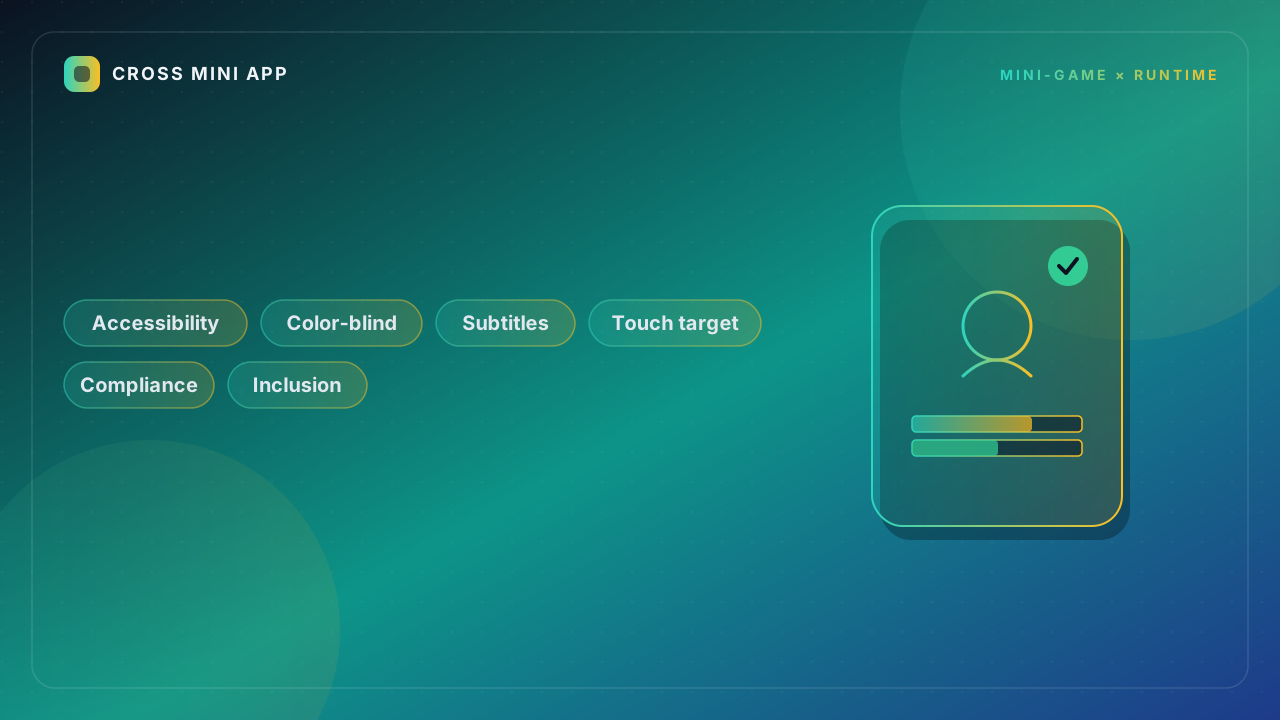
The three that cost almost nothing and touch the most players. A color-blind safe palette and a shape or icon redundant cue (not color alone) fixes the largest single group and is a one-time art decision. Subtitles and a text alternative for any audio-critical cue keep players who are deaf or hard of hearing, and they also help the player in a noisy room — a far bigger group than the label suggests. Larger, spaced touch targets reduce mis-taps on every device. None of these requires engine surgery; they are palette, text and hitbox work. The expensive items — full screen-reader navigation, remappable controls — matter, but they are not where the easy reach lives.
Q: Where does accessibility overlap with compliance, and when does it stop being optional?
The moment a regulator or a store says so. The EU and several US jurisdictions now expect WCAG-aligned accessibility, and app stores have tightened review on inclusive design. More directly, a game that communicates only through color or sound is fragile in exactly the markets where you want scale, because those are also the markets with the widest range of devices and conditions. The compliance upside is real but secondary; the primary case is that you are already paying to acquire these players through UA, and every one you lose to a fixable friction is money spent twice. Treat the legal floor as the starting line, not the goal.
Q: How do you measure whether an accessibility change actually kept more players?
Same as any retention lever: segment and compare. Tag the cohort that got the color-blind palette or the larger tap targets and watch their session frequency and day-7 retention against the prior build. The effect is rarely a spike; it is the removal of a quiet leak. Look for the players who previously bounced in the first session and now stay, and for the subtle lift in completion of audio-dependent moments once subtitles exist. If you cannot run an A/B, compare the same cohort across the build before and after. The win is small per player and large in aggregate, which is exactly why teams miss it.
| Change | Who it reaches | Cost | Signal it fixed |
|---|---|---|---|
| Color-blind safe palette | ~8% of men | Low, one-time art | Cues no longer color-only |
| Subtitles / text cues | Deaf, noisy-room players | Low | Audio-dependent moments kept |
| Larger tap targets | Small screens, motor needs | Low | Fewer mis-taps, lower bounce |
| Screen-reader nav | Blind players | High | Full navigation, remap |
The reach is already in your funnel. Accessibility is just the part you stopped charging for.