You Cannot Improve What You Do Not Instrument
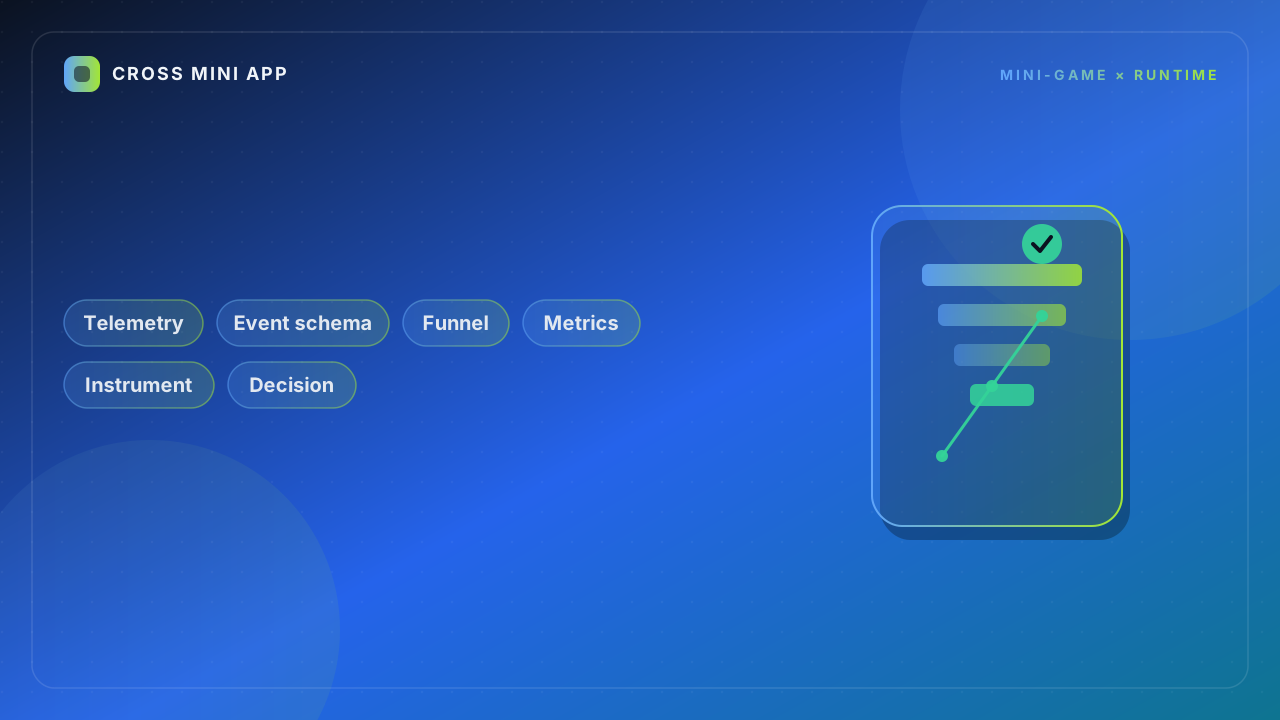
Every game team argues about what players do. The ones that win the argument are the ones that recorded it. Telemetry is not a dashboard you bolt on at launch; it is the nervous system of the product, and if you wire it late you spend months guessing at a body you cannot feel. The good news: the events that matter are boring and predictable, and you can decide them on day one.
Q: What events should every mini-game track from day one?
The ones that describe the loop, not the vanity. At minimum: session start and end with duration, the core action completed (the loop tick), a failed attempt, a level or stage reached, a purchase attempt and result, and a rage-quit signal — app close mid-session, or a level replay with no progress. Layer on acquisition context: source, campaign, locale, build. The mistake is tracking page views and ignoring the action that is the game. If you can draw the funnel from "opened" to "did the core loop" to "came back tomorrow," you have the spine of every decision. Everything else is decoration until that spine exists.
Q: How do you design an event taxonomy that doesn't rot?
Name events by what happened, not by the screen. A taxonomy rots when it mirrors UI: rename a button and half your reports break. Instead, define a stable verb-noun schema — loop_tick, purchase_attempt, level_fail — with properties as separate fields, not baked into the name. Version the schema, keep old events firing during transition, and never delete; archive. The discipline that saves you is a single owned registry: one file, one owner, one place where "what do we track" is answered. Teams without it end up with three events meaning the same thing and none meaning it cleanly, and then nobody trusts the numbers.
Q: Which funnels actually predict revenue versus vanity?
The funnel from first loop to first purchase predicts. The funnel from install to open does not, beyond a sanity check. The ones that matter: activation (did they reach the second session, because day-one is mostly luck and day-two is intent), the loop-to-purchase conversion by segment, and the win-back funnel after a churn signal. Vanity is raw DAU and total downloads — big numbers that move while revenue sits still. The test: would changing this metric change a decision you would actually make? If the answer is no, it is a vanity metric wearing a chart. Track it smaller, and put the predictive funnels on the wall.
Q: How do you keep telemetry from becoming a privacy and cost problem?
Two guards. Privacy first: never ship a raw user identifier in an event, hash or tokenize it, respect regional law like GDPR and the age rules for kids' games, and give players a real way to opt out. Cost second: telemetry is a tax per event at scale, and a team that logs "everything" discovers the bill before the insight. Sample the boring events, sample by cohort, and set a retention window so you keep decisions, not petabytes. The trap is treating telemetry as free because it is invisible — it is the most expensive thing you forget you are paying for.
| Event | Predicts | Belongs in | Guard |
|---|---|---|---|
| loop_tick, level_fail | Retention, balance | Core taxonomy | Cheap, keep |
| purchase_attempt | Revenue | Core taxonomy | PII-free |
| session_duration | Engagement | Core taxonomy | Sample |
| raw DAU, downloads | Vanity | Decorative | Don't over-trust |
| user_id raw | Risk | Never | Tokenize |
Instrument the loop first. The rest of the dashboard earns the right to exist.