Push Is a Knife, Not a Megaphone
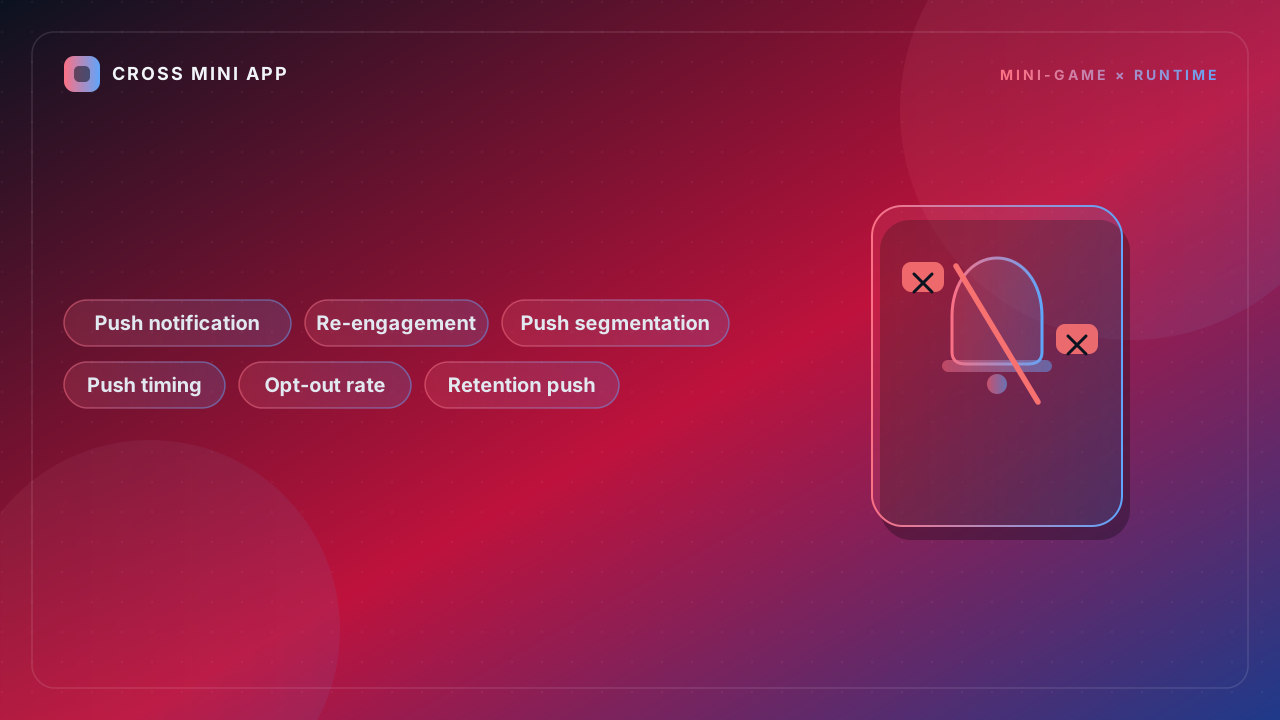
Push is the highest-leverage, lowest-cost re-engagement tool you have, and the easiest one to torch your audience with. One mistimed blast and a player who loved your game swipes "turn off" forever. For mini-games, where the relationship is light and the churn is fast, push is less a marketing channel and more a trust account you withdraw from every time you send.
Q: Why is push so powerful yet so dangerous for mini-games?
Because it's free and it's intimate. A push lands on the home screen of someone who already installed you — no algorithm, no bid, no feed to fight. That's exactly why it's dangerous: the same message that brings a lapsing player back can feel like spam the moment it's mistimed or irrelevant, and the cost of that mistake is permanent opt-out, not a low CTR. Mini-game players opted in lightly; they'll opt out lightly too. Every send is a withdrawal from trust you can't redeposit.
Q: What timing actually drives re-engagement?
Send when the player would naturally think about you, not when your dashboard is quiet. The two windows that work: a few hours after a player's first session lapses (catch the drop before it becomes a quit), and a personalized "your energy refilled" or "your streak is at risk" nudge timed to their own play rhythm, not a fixed 9am broadcast. The timing that kills you is the batch blast at a single global hour — half your audience gets it asleep, and it reads as noise. Tie the clock to the player, not the campaign.
Q: How should I segment push audiences?
By behavior, never by demographics. Segment on lapsing risk (last session 3/7/14 days ago), on spend (never push a whale the same "come back" message you send a free user), and on lifecycle (new players need onboarding nudges, veterans need event invites). The cardinal sin is the one-size blast to everyone — it maximizes sends and minimizes trust. The teams that win push small, targeted, and rare: a message a player would genuinely want, sent to the slice of people it's actually for.
Q: How do I avoid the opt-out cliff?
Two rules. First, cap frequency hard — most mini-games should not exceed two to three well-targeted pushes a week, and lapsing-recovery messages should be the bulk, not promotional spam. Second, make every push earn its place: if a message doesn't change behavior or deliver value, don't send it. Watch opt-out rate like it's churn, because it is churn with a lock on the door. When your opt-out curve bends up, you've already lost the players who mattered — the rest were about to leave anyway.
| Push done right | Push that kills you |
|---|---|
| Timed to the player's rhythm | One global blast hour |
| Segmented by behavior | One-size blast to everyone |
| 2–3 targeted a week | Daily promotional spam |
| Earns its place or doesn't send | Sent because the dashboard is quiet |
Push works because it's personal, and it dies because it's personal. Treat every notification as a withdrawal from a trust account with no overdraft, segment by what players do instead of who they are, and stop the moment the opt-out curve turns up. The mini-games that keep their audience are the ones that learned to send less and mean it.