The embedded-finance market was valued at $127.46 billion in 2025, and the reason is not a technology fad — it is a unit-economics gap. A standalone financial app carries the full cost of acquisition, build, and compliance, and earns thin margins on the core service. A service embedded inside a host rides the host's existing users, rails, and compliance shell, and monetizes at multiples the core service cannot reach.
The margin gap
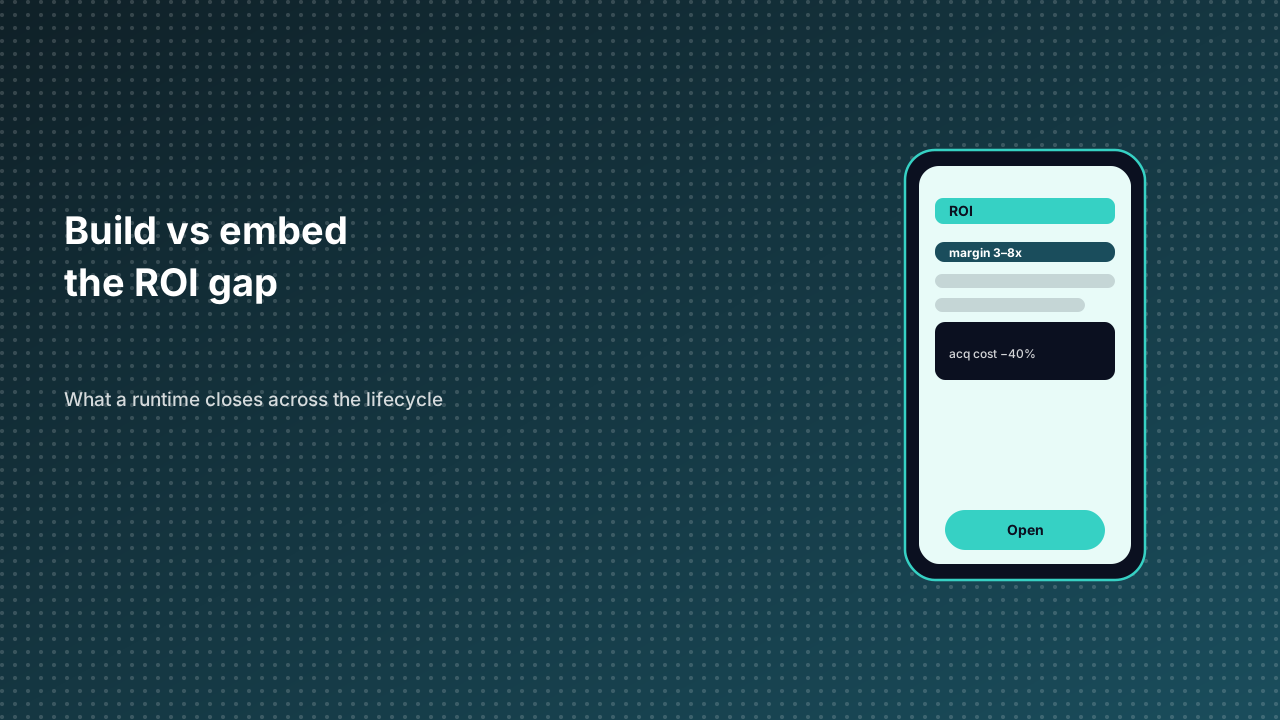
Across emerging-market super-apps, the financial services layer runs at 3–8x the margin of the core service. Lending margins on micro-credit embedded in super-apps run 15–35% APR against near-zero margins on food delivery. The core service is the acquisition hook; the embedded financial layer is where the economics converge with profitability. For a host deciding whether to build a financial surface natively or embed it, this gap is the entire argument.
What embedding returns
The operating evidence is concrete. DBS's Digibank marketplace integration raised customer transaction values by 32% while cutting acquisition cost by 40%. ICICI's iMobile Pay, integrated with 250+ merchant services, lifted average revenue per user by 14% per integrated service at minimal marginal cost. Standard Chartered's Africa platform cut acquisition cost by 67% through ecosystem partnerships. Maybank's MAE SuperApp converted 28% of customers to premium subscription tiers. Kasikorn's K PLUS turned its platform model into 17% of total bank revenue, growing above 40% annually.
The build cost the model hides
A native build pays twice: once for the service, once for the rails and compliance it must stand up independently. Embedded finance abstracts those away through API-first infrastructure and compliance-as-a-service. The switch is not just faster; it removes a recurring cost line that a standalone never escapes. Banks that built super-apps discovered the revenue came from the ecosystem layer — referrals, marketplace fees, data insights — not from the original product.
The ROI table
| Metric | Standalone build | Embedded in host |
|---|---|---|
| Acquisition cost | Baseline | −40% to −67% (DBS, SC) |
| ARPU lift | Slow | +14% per service (ICICI) |
| Subscription uptake | Baseline | 28% premium tiers (Maybank) |
| Platform revenue share | N/A | 17% of total (Kasikorn) |
| Margin on finance layer | N/A | 3–8x core (super-apps) |
Where embed underperforms
Embedding trades control for margin. A sponsor bank or host can offboard a dependent service with 30 days' notice, and the embedded product cannot set its own funds flow or roadmap. For money-movement-core businesses, building may still win on durability. The gap a runtime closes is for the long tail of services — the booking, the loyalty, the content purchase — where the build cost is never recovered and the embed return is immediate.
Conclusion
The evidence is consistent: embedding converts a full-lifecycle build problem into a revenue-share relationship against an audience that already exists. The margin multiples — 3–8x on the finance layer, 14% ARPU per service, 40% lower acquisition — are not theoretical; they are reported operating results. A portable runtime such as Cross Mini App lets a host capture that embed economics without rebuilding the rails or rerunning the licensing clock. The teams that win are the ones that build the hook and embed the margin, rather than building both from scratch.
Sources
- MobiFin — How banks leverage super-apps for revenue — DBS, ICICI, SC, Maybank, Kasikorn cases.
- Algeria Tech — Super apps embedded finance blueprint — margin multiples and sequencing.
- The TechMaster — Embedded finance as US default model — API-first and compliance-as-a-service.
- London Business News — Mobile banking 2025 — super-app market size.