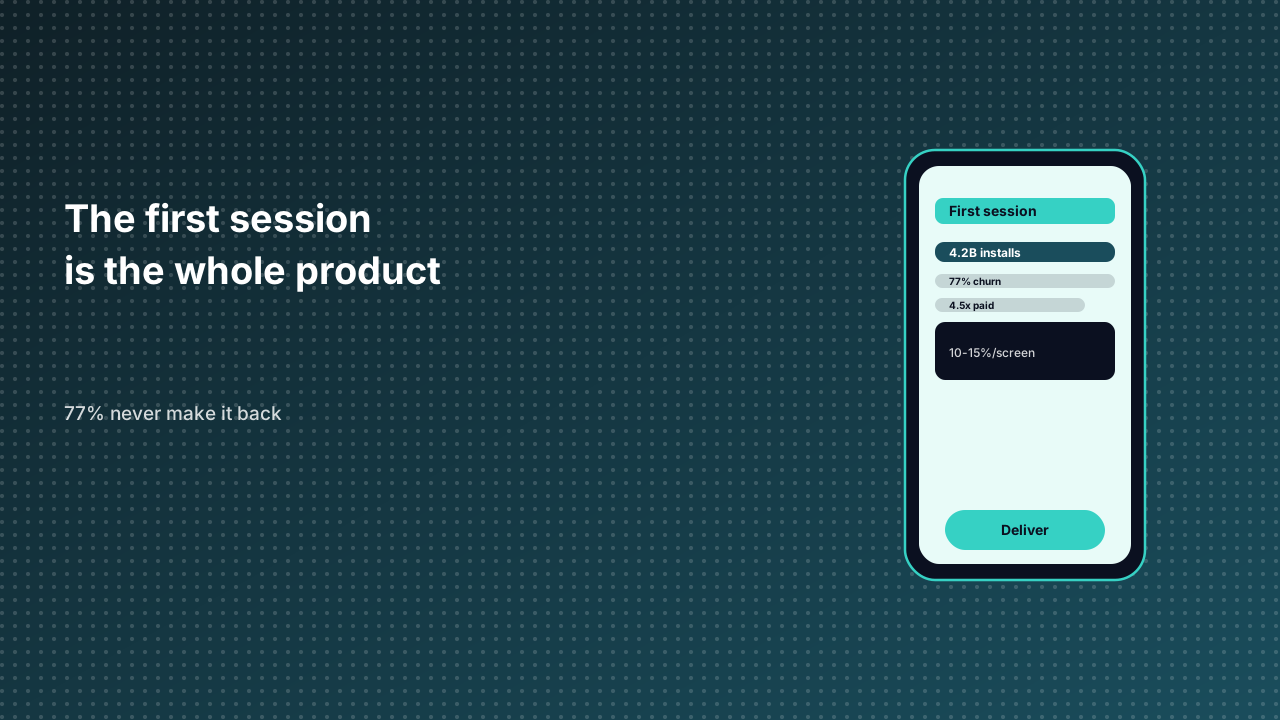
Four point two billion installs across thirty countries. AppsFlyer's late-2025 readout found that about seventy-seven percent of those apps were opened once and never returned within twenty-four hours. Day-seven retention settled near twenty-six percent. The first session is not a warm-up for the real experience. For the majority of downloads, it is the entire experience.
That statistic is uncomfortable because it reframes every later effort. Retention campaigns, re-engagement pushes, loyalty programs — all of them are working on the twenty-three percent that survived the first day. The larger group never entered the funnel at all. They arrived, saw a gate, and left before the product had a chance to make an argument.
| Signal | Measured figure | What it tells the team |
|---|---|---|
| Installs observed | 4.2B across 30 countries | The pattern is global, not local |
| Opened once, no return within a day | about 77% | The first session is the filter |
| Day-seven retention | about 26% | Survivors are a small minority |
| Registration wall | 40–60% lost at one screen | The costliest single step |
| Each extra screen before value | 10–15% of remaining users | Friction compounds quietly |
| Aha moment in first session | 4.5× more likely to pay | One session sets the trajectory |
The registration screen deserves its own line of criticism. Heap's 2024 work put losses at forty to sixty percent on that single surface, which makes it the most expensive tile in most onboarding flows. Baymard's 2025 figure of 70.19 percent cart abandonment rhymes with it: the moment a flow asks for commitment before demonstrating value, a large share of the audience declines the trade.
Amplitude looked at 1,200 SaaS products in 2025 and found that users who reached the aha moment in the first session were about 4.5 times more likely to become paying users. That multiplier is not a correlation to file away. It means the first few minutes determine how much every later campaign has to spend to correct an early impression. A weak opening makes acquisition more expensive downstream, even when the acquisition channel itself is efficient.
Here is the pushback that runs against instinct. The common response to a leaking first session is to add guidance: a tour, a checklist, a set of tooltips explaining every button. More explanation rarely fixes a problem caused by distance to value. Every extra screen between install and a meaningful result costs roughly ten to fifteen percent of the users still present, and those losses stack multiplicatively. Guidance that postpones the payoff is friction wearing a helpful costume. The better move is usually to delete a step rather than annotate one.
Read-only access before signup shows the alternative. Mixpanel's 2025 data put bounce reductions of fifteen to twenty-five percent when people could explore a product before creating an account. Expedia removed a single optional field from a form and reported twelve million dollars in additional annual revenue. Neither change added a feature. Both removed a small act of trust that had been demanded too early. Slack's familiar benchmark points the same way: teams that send two thousand messages almost always convert, because the product let them experience the payoff before asking for anything.
The deeper lesson is about sequence. Identity, payment, and preferences can be collected after value has been demonstrated, and they are collected more willingly then. A flow that asks first is optimizing for database completeness at the cost of the relationship. A flow that delivers first treats the account as a consequence of a good experience, not a precondition for one. The second approach looks slower on a signup-conversion chart and wins on almost every other measure.
Mini-programs have a structural advantage here that install-based apps cannot copy. A host surface already carries identity and payment, so a first tap can land on a real action instead of a registration form. A shared runtime lets the chain from first open to first meaningful event live in one event model, across a merchant's service and the host's own surface. The team can see exactly which screen loses people and whether the survivors reached value in that same session.
The practical target is not a beautiful onboarding sequence. It is the shortest honest path from curiosity to a result worth returning for. A host that removes the gate, keeps the context, and measures the chain from first tap to first payoff gives a product the one chance most installs never get.
Sources
- Improving app conversion rate — install and first-open drop-off benchmarks in context.
- Getting users to the aha moment in minutes — why the first session sets later conversion.
- Why users drop off during onboarding — registration walls and incremental friction.
- First-session activation patterns — a second read of the same funnel data for product teams.