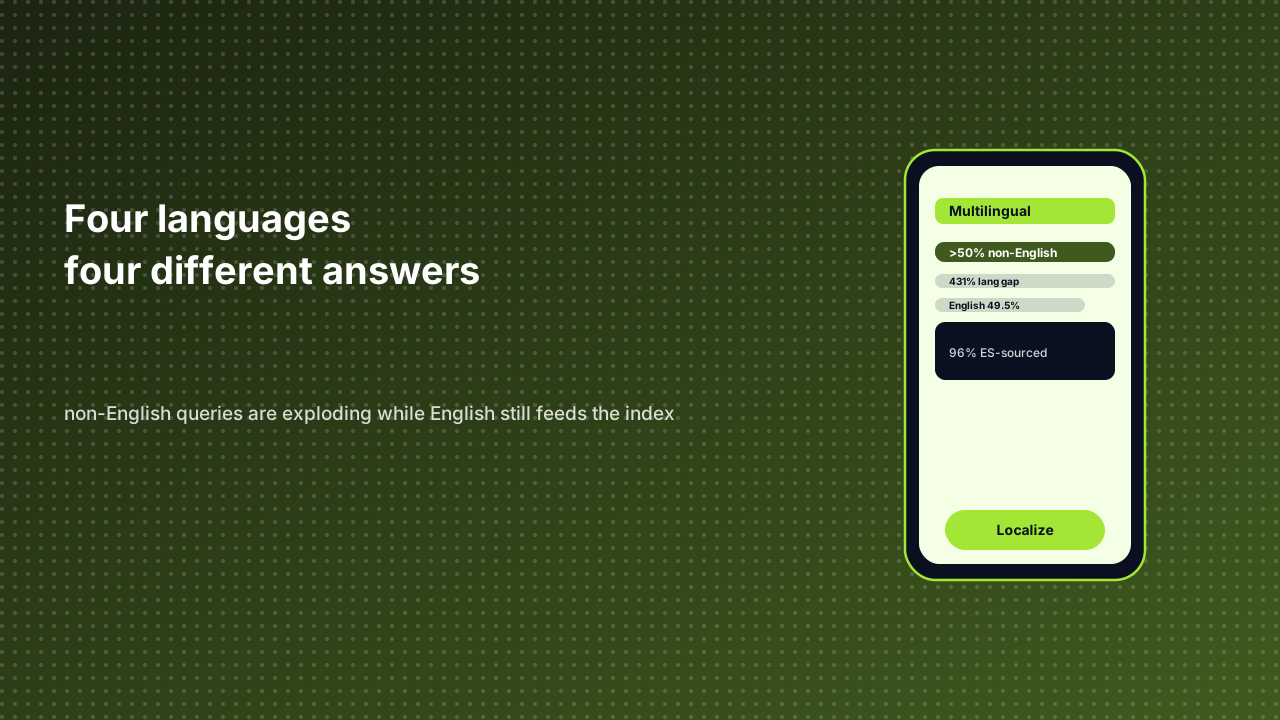
A Spanish-language query inside Google's AI Overviews pulled 17,094 citations of a site that had never been translated into Spanish. The same site collected 2,810 citations from English queries — a 431% gap. The figure comes from Weglot's analysis of more than 1.3 million citations, vendor research from a translation company with an obvious commercial stake, so it reads as a strong signal rather than a neutral benchmark. Taken plainly, it says the answer engine kept reaching for Spanish even when the page refused to speak it.
That asymmetry is the whole story of multilingual GEO in one line. Assistants increasingly answer in the language of the question. The retrieval underneath is still, to a surprising degree, an English operation. Demand and supply rarely fail to line up this neatly, and the gap is where catalog owners either lose visibility or find an edge.
OpenAI's Signals report, dated 2026-06-30, put the demand shift into plain numbers: more than half of ChatGPT's personal-account active users mainly use a language other than English. Spanish, Portuguese and Arabic led that list, while Uzbek, Kazakh and Burmese were the fastest-growing. This is a vendor describing its own product, so the exact shares deserve caution, but the direction ends the old habit of treating "AI search" as shorthand for "English search." The default user of an assistant is no longer an English speaker, and that changes what a catalog is for.
Peec AI observed more than 10 million prompts and roughly 20 million fan-outs in 2026-02. Every non-English session in that sample contained at least one English sub-search; nearly 78% pulled in additional English research; 43% of research steps happened on English-language pages. Language switching ran highest in Turkish at 94% and lowest in Spanish at 66%. Observational data, not a controlled experiment — yet the pattern is stubborn. The answer arrives in the local language, while the evidence behind it frequently does not.
Supply tells the other half. W3Techs measured the known content language of websites on 2026-09-12 and found English at 49.5%, Spanish at 6.0%, Portuguese at 4.1%. English sits nearly eight times above Spanish. Millions of people asking in Spanish, Portuguese or Arabic are being served by a web that overwhelmingly publishes in English, and the assistant has to bridge that gap on every answer.
| Signal | What was actually measured | What it means for a catalog |
|---|---|---|
| Weglot citation analysis (1.3M+) | Spanish versus English queries on untranslated Spanish sites | 17,094 vs 2,810 citations — a 431% gap, vendor-reported |
| OpenAI Signals (2026-06-30) | Primary language of personal-account active users | Over half non-English; Spanish, Portuguese, Arabic lead |
| Peec AI observation (2026-02) | 10M+ prompts, 20M+ fan-outs | Every non-English session includes an English sub-search; 43% of steps on English pages |
| arXiv study (6 chatbots, 12,600 instances) | Multi-select accuracy by language and citation sources | Hindi 79% vs 89–91% elsewhere; English Wikipedia cited more than Indian news |
| W3Techs (2026-09-12) | Known content language of websites | English 49.5%, Spanish 6.0%, Portuguese 4.1% |
Translation alone, though, is a weak moat. The arXiv paper behind the fourth row tested six commercial chatbots across 2,100 questions and 12,600 instances. The best system cleared 90% multi-select accuracy overall, yet every model dipped to 79% on Hindi against 89–91% elsewhere, and the systems reached for English Wikipedia more often than any Indian news source. More than 70% of the errors were retrieval failures, not reasoning slips. That detail carries the real weight: a page written in the right language still cannot be cited if the retriever never surfaces it. Weglot's reported +327% gain in English visibility and +24% in total citations after translation are encouraging, and 96% of AIO citations on localized Mexican queries came from Spanish sources — but those are one vendor's measurements on its own customer base, and the relationship is correlation, not proof that translating a page causes citations to rise. A cautious reading keeps the upside and drops the magic.
So the practical move is narrower and more durable than "translate everything." Publish each language version as a first-class entry, with its own language-tagged metadata and its own clean structure, then check whether answer engines actually cite it. The four-language catalog that Cross Mini App maintains is a small example of that bet: four independently retrievable surfaces instead of one English page with three translations bolted on. On a shared runtime those entries load fast enough to be read as well as crawled. In a market where the question is local and the fetch is global, having the answer already in the local language is the closest thing to a moat a catalog can own.
Sources
- Deepsmith — AI search's non-English majority shift — aggregation of the OpenAI Signals and Peec AI findings cited above.
- Weglot — AI search and language — vendor analysis of 1.3M+ citations and translation outcomes.
- arXiv — Multilingual chatbot evaluation — six commercial chatbots, 2,100 questions, 12,600 instances.
- W3Techs — Content language distribution — measured language shares of websites with known content language.