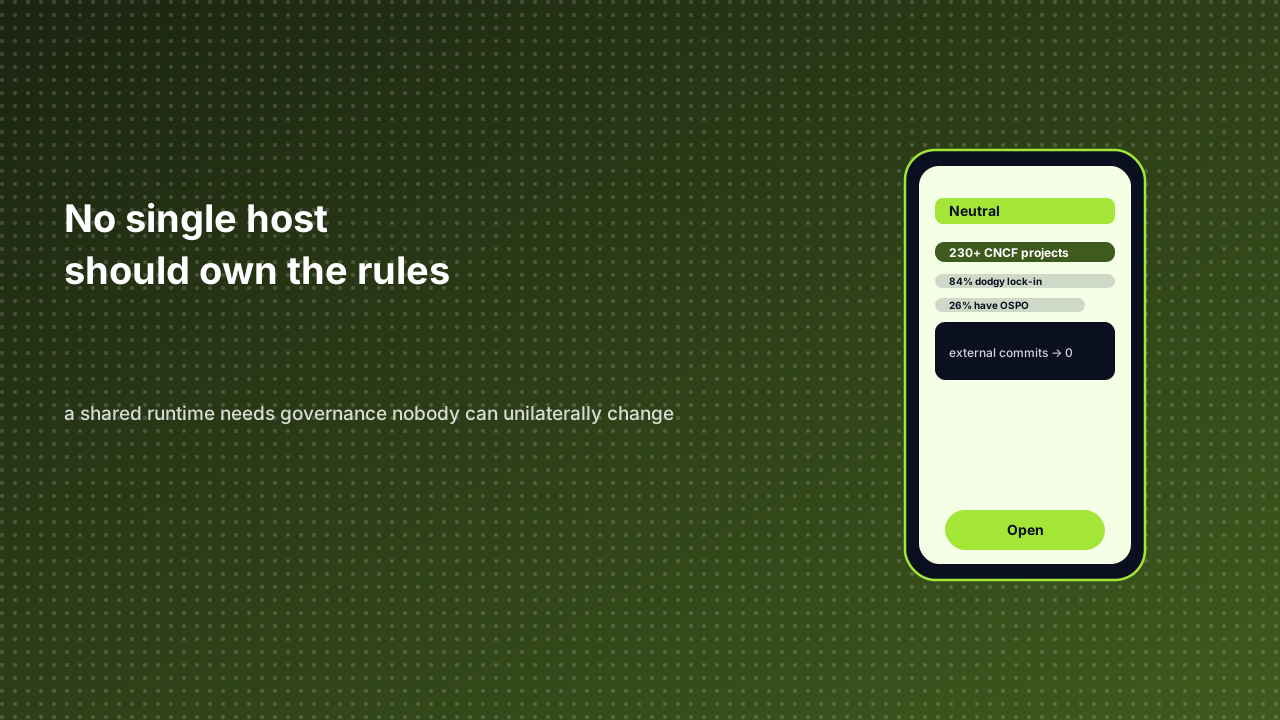
84% of enterprises say they choose open source to reduce vendor lock-in, and an equal share cite lower software holding costs. Only 26% have built an OSPO, the office that would turn that preference into an enforceable position. That gap says more about the governance of shared runtimes than any manifesto. The appetite for neutral rules is close to universal; the machinery that defends them is rare.
The same contradiction surfaces wherever a runtime stops being a library and becomes infrastructure. 72% of enterprises running large language models worry about supplier lock-in, while only 30% have written clear exit terms into their contracts. Anxiety costs nothing. Exit terms cost something, and they need a counterparty willing to sign. A component whose rules one company can rewrite in an afternoon is the opposite of an exit path, however open its source code looks on paper.
Redis makes the pattern concrete. After the 2024 license change, outside contributors with more than five prior commits saw their involvement drop to zero within six months, by CHAOSS measurement. Valkey was forked under the Linux Foundation; in May 2025 Redis restored AGPLv3. Terraform produced OpenTofu, Elasticsearch produced OpenSearch. Each fork tells the same story from a fresh angle: once the rulebook has one owner, the most capable outside contributors stop improving the project and start building the replacement.
Across a shared runtime, governance shows up in a handful of concrete decisions.
| Governance pressure point | One company holds the pen | A foundation holds the pen |
|---|---|---|
| Rule changes | Track one product roadmap | Require cross-host agreement |
| Outside commits | Dry up after a license shift | Become the growth engine |
| Exit terms | Rewritten unilaterally | Fixed in a public charter |
| Host embedding | Rivals refuse the dependency | Rivals can depend on it |
| Security budget | One balance sheet | Pooled and shared |
Scale does not make the problem disappear; it raises the stakes. The CNCF marked its tenth anniversary in 2025 with more than 230 projects and over 300,000 contributors from 190 countries. Its live counters later read 235 projects, 352,000 contributors, 41 graduated projects, 38 incubating and 156 in sandbox. None of that matters if one vendor's legal team can rewrite the rules around those projects. A foundation earns trust by turning rule changes into a deliberate process rather than an announcement.
Here is the honest reservation. Neutral governance is slow. Foundations can become rooms where nothing ships, and a charter is only as strong as the people willing to enforce it. Neutral never means free of corporate influence; the same giants fund the CNCF and the OpenSSF. The difference is procedural. A decision reached in a working group where no single employer holds a veto is far harder to reverse unilaterally than a decision posted on one company's blog. Slowness is the price of a rulebook that other hosts can rely on for a decade.
Only 34% of organizations have a clear open-source strategy, and that number is the quiet reason governance gets treated as paperwork until a license change lands. A neutral body solves a specific coordination problem: it gives engineers who compete for customers a place to cooperate on the substrate they all stand on. Technical oversight committees, published charters and working groups are not ceremony. They are the mechanisms that let a rival's pull request land without a rival's lawyer clearing it first.
Security is where pooled governance proves its worth fastest. The OpenSSF grew to 117 member organizations, driven by more than 267 active contributors from 112 organizations across 10 working groups and 32 technical initiatives. Members collectively directed 12.5 million dollars through the OpenSSF and Alpha-Omega in 2026. No single host could justify that spend alone, and no single host should decide how it gets allocated. Shared funding only works when the allocation is shared too.
For a runtime meant to be embedded by competing host apps, the governance model is the product. A runtime like the Cross Mini App one earns a place inside rival hosts only when outside engineers can inspect the rulebook and find no single company's fingerprint on it. That means a published charter, a seat at the table for other hosts, exit terms written before anyone asks for them, and a security budget that sits under a neutral roof. These are the unglamorous mechanics of adoption. Shared infrastructure becomes trustworthy at the moment its rules stop being any one owner's private property.