A design review puts two versions of a subscription screen on the table. The aggressive one pre-checks the consent box, buries cancellation three menus deep, and labels the button Continue. The mild one merely writes the choice clearly. On the dashboard, the aggressive version wins by a factor approaching four against the neutral control. Someone in the room calls it unethical; someone else points at the conversion curve and says nothing. Both are right, and that is the uncomfortable part. The aggressive variant did not fail. It worked almost four times as well. Then the complaints arrived.
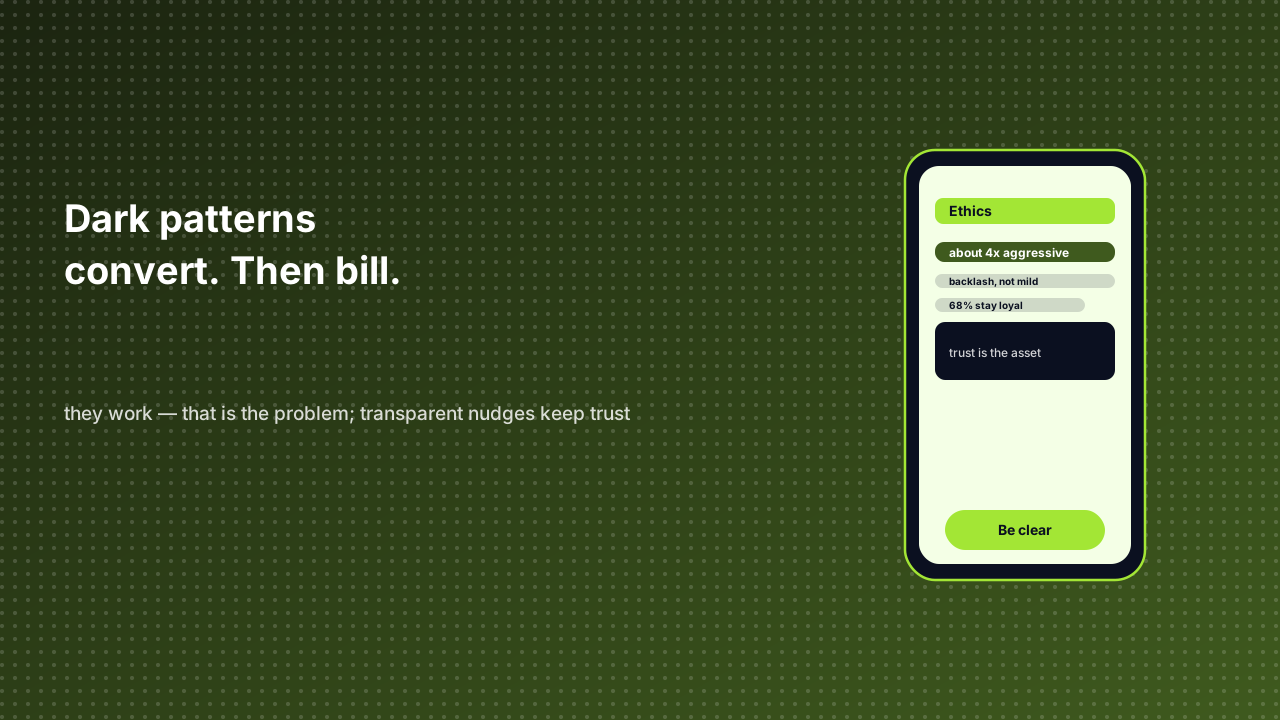
In 2021, Luguri and Strahilevitz published "Shining a Light on Dark Patterns" in the Journal of Legal Analysis. Across a series of experiments, an aggressive dark-pattern subscription flow raised the likelihood of subscribing to almost four times the control condition. A mild version — equally manipulative, only quieter — raised it to more than twice. The finding that tends to vanish from the slide is the remainder: only the aggressive version produced what the authors called a "powerful backlash." The mild one did not. The extra conversion came bundled with a reaction; the milder lift did not carry the same price. That asymmetry is not a footnote. It is the whole argument about the ethics of growth compressed into one experiment.
Set the wider evidence base beside it and the conversion side and the bill side become visible at once:
| Evidence anchor | Source and year | What was measured | Reported figure | What the figure does not prove |
|---|---|---|---|---|
| Aggressive vs. mild subscription | Luguri & Strahilevitz 2021, Journal of Legal Analysis | Experimental subscription likelihood | Almost 4× aggressive, >2× mild | That only the aggressive version triggered a powerful backlash |
| Consumer exposure survey | European Commission 2025, Consumer Conditions Scoreboard | Share reporting encounters over the past year | 66% fake reviews, 61% misleading discounts, 93% worry about targeted ads, 45% online scams | Survey perception, not measured behavior or causality |
| Post-purchase reaction | REBR 2025, Romania | 70 participants, self-report | 61.4% regret, 47.1% abandoned the store, ~70% annoyance, manipulation or distrust | A small, correlational sample |
| Trust premium | UserTesting 2025, global | 4,000 respondents, stated willingness | 68% would stay with a trusted brand through a price rise, +25% average willingness to pay; a second group 60% would pay more, 82% tolerate at most two bad experiences | Stated intent, not revealed preference |
| Transparent-nudge meta-analysis | Bruns et al. 2025, ScienceDirect | 23 papers, 117 effect sizes | Positive on behavioral outcomes, none on non-behavioral; 88% of the effect from default nudges, 89% from online studies | A general victory for transparency, rather than gains concentrated in defaults |
Two of those rows deserve a slow reading. The Commission's 66% is the share of consumers who reported encountering fake reviews, not a finding that 66% of reviews are fake — a distinction that blurs fastest inside a deck. The REBR study ran on 70 people in Romania, so its 61.4% regret rate is a signal about how a dark pattern feels after the click, not a population estimate. The UserTesting numbers are stated willingness, the kind that reliably sits above what a checkout actually shows. None of that makes the reaction imaginary. It makes the measurement honest, and an honest measurement is the only basis for a decision worth defending.
The Bruns meta-analysis is the most useful of the set and the most easily misread. Transparent nudges did move behavior, but did nothing for non-behavioral outcomes such as attitudes, and 88% of the behavioral effect came specifically from default nudges. Put plainly, the gain lives in making the default legible, not in appending a paragraph of disclosure. The ethics review attached to the same paper is equally telling: across 23 frameworks, autonomy appeared in 22 (95.7%), and reflection-based nudges were better received than covert defaults. Transparency is not a feature that costs conversion. In the data it reads more like a precondition for the nudge to be defensible at all.
The temptation is to stage this as a morality play — dark patterns bad, transparency good. The evidence will not carry that. Luguri and Strahilevitz showed that the aggressive version wins on the metric a growth team is paid against. Calling it ineffective would be the comfortable lie. The honest position is that it converts and then invoices: the bill arrives as regret, abandonment, and the attention of a regulator. A mild nudge that is fully legible keeps more of the conversion than a purist expects while sidestepping the backlash the aggressive version bought. That is a tradeoff worth taking seriously, not a sermon. The literature cannot price the bill exactly, but it can stop a team from hiding behind a claim that the aggressively designed flow does not work.
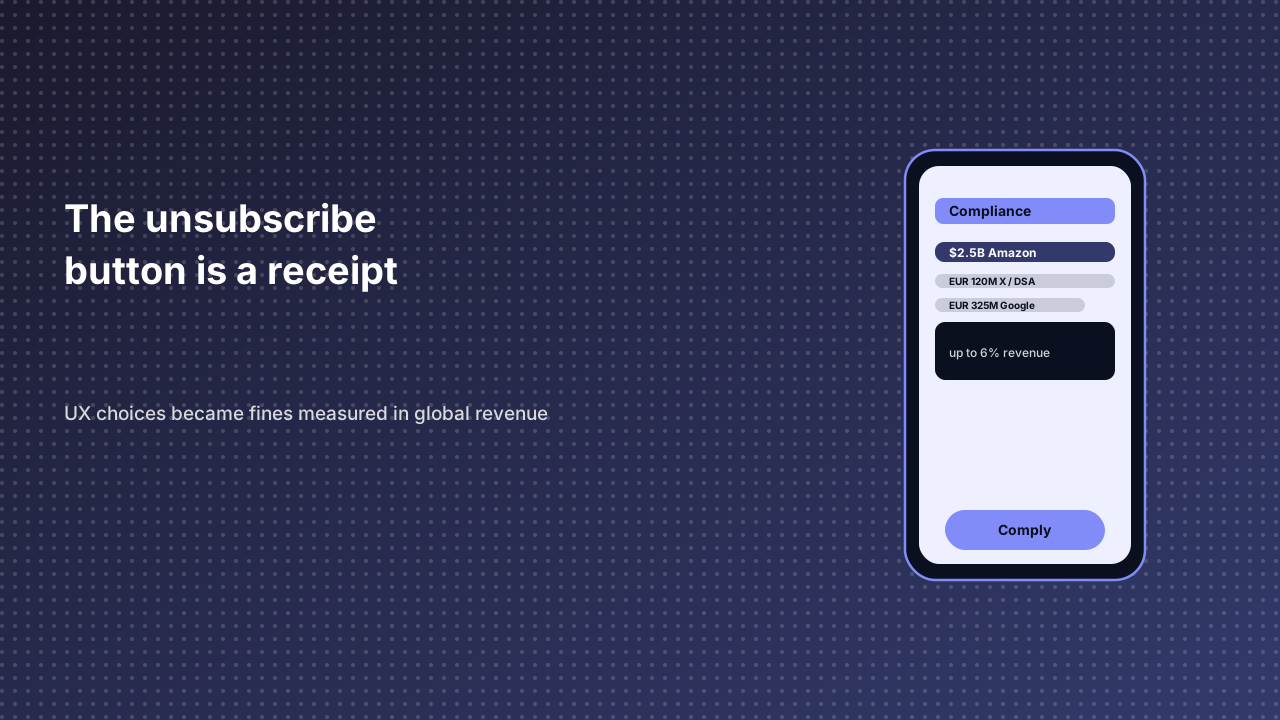
The bill is also becoming literal. A Digital Fairness Act cleared the committee stage on 11 November 2026 with a proposal to ban dark patterns outright, estimated to save EU consumers up to €13.7 billion a year — a projection, not a measured saving. A revision to the CPC framework contemplates fines of up to 6% of global turnover. Those figures turn what used to be a design-review argument into a line in a risk register.
For an organization running an open directory, the practical move is unglamorous. Make the choice architecture itself inspectable: which surfaces arrive pre-selected, which defaults are opt-out, how many steps separate subscribing from stopping. Keep those surfaces versioned in the shared runtime so a mild, legible variant can be tested against an aggressive one on the same footing, and so the backlash shows up in the same dashboard as the conversion. Cross Mini App keeps that comparison reproducible from the directory side, which is the only way a claim about trust survives contact with a growth target. The aggressive flow will still win the first week. What matters is what the second week looks like.
Sources
- Luguri & Strahilevitz — Shining a Light on Dark Patterns, Journal of Legal Analysis — 2021; aggressive patterns nearly quadrupled subscription likelihood, mild patterns more than doubled it, and only the aggressive version produced a powerful backlash.
- European Commission — Key consumer data, Consumer Conditions Scoreboard — 2025; 66% reported fake reviews, 61% misleading discounts, 93% concern about targeted advertising, 45% online scams.
- UserTesting — Brand loyalty trends — 2025; global survey of 4,000 respondents on stated willingness to stay with trusted brands and pay a premium.
- Bruns, Fillon, Maniadis & Paunov — transparent nudge meta-analysis, ScienceDirect — 2025; 23 papers and 117 effect sizes, with 88% of the behavioral effect attributed to default nudges.