The trial people chose to repeat
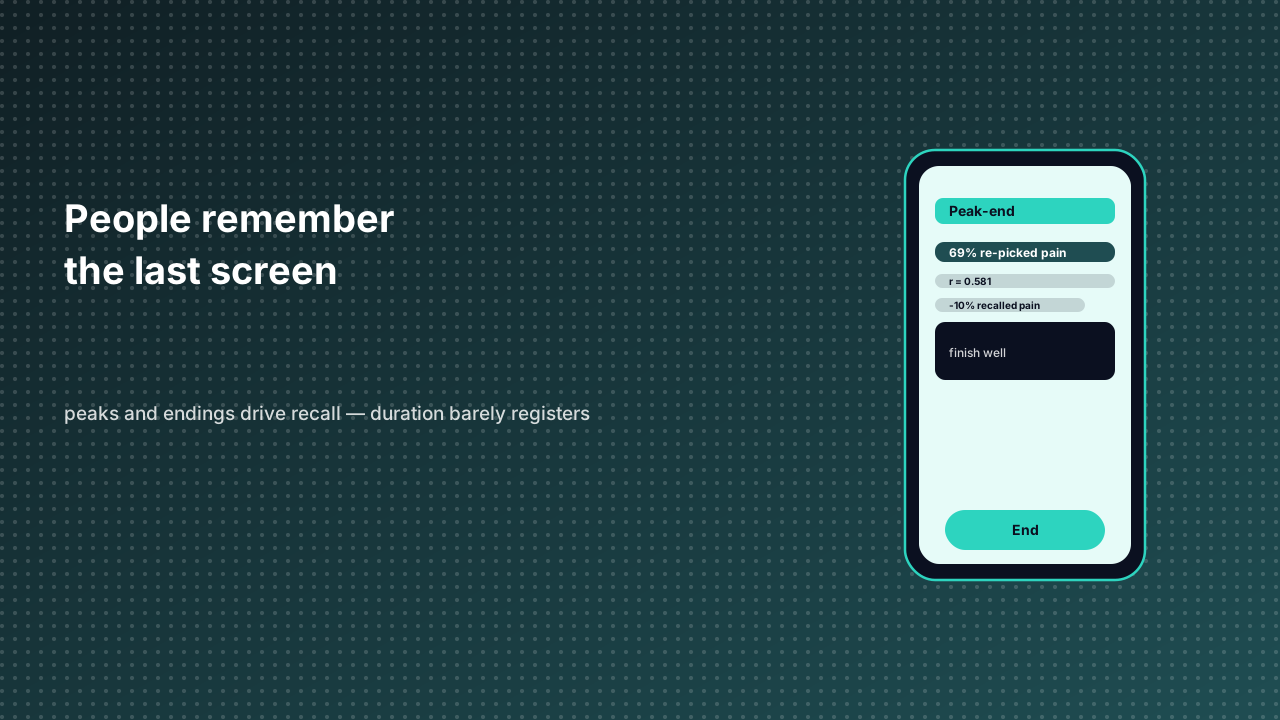
In 1993, Kahneman, Fredrickson, Schreiber and Redelmeier ran an experiment that still sounds like a typo. Participants immersed a hand in 14°C water for 60 seconds, then repeated the exercise under a different condition: 60 seconds at 14°C followed by 30 seconds while the water warmed to 15°C. The second trial was objectively worse — thirty extra seconds of discomfort. Yet 22 of the 32 participants, roughly 69%, said they would rather repeat the longer one. The cold moments were identical. Only the ending differed.
Teams tend to evaluate a flow with averages: average satisfaction, average time on task, average drop-off, as if summing every second were the same as measuring the experience. The cold-water result is strange precisely because that default arithmetic is wrong. Memory does not behave like a spreadsheet.
What the evidence actually says
| Evidence | Setting and sample | Result worth keeping | Boundary |
|---|---|---|---|
| Cold-water experiment (1993) | 32 participants, two hand-immersion trials | 22 of 32 chose the longer trial with the warmer finish | Lab pain, measured in seconds, not a product journey |
| Colonoscopy trial (2003) | 682 patients, randomized, one extra calm minute at the end | recalled pain down 10%, willingness to repeat up 10% | A separate rendering uses a 10-point scale, 4.4 vs 4.9 — do not merge the two |
| Peak-end meta-analysis (2022) | 174 effect sizes across domains | peak-end r = 0.581 (95% CI 0.487–0.661); duration effect near zero | An average tendency, not a per-session guarantee |
| Repeated-procedure study (1996) | 154 colonoscopies and 133 lithotripsy cases | duration vs overall rating r = 0.03 | Older and narrow; best used as a contrast |
| Journey analytics (2025) | 126,425 visitors, 3,376 experiences, 522 brands | top vs bottom experience tier: NPS median 97 vs 82 | Correlational — the ranking did not cause the score |
Why the last screen carries the whole memory
The 2003 colonoscopy trial is the easiest finding to translate into product terms. Researchers gave 682 patients one additional minute of calmer experience at the end of the procedure. Recalled pain fell by about 10%, and willingness to return rose by about 10%. Nothing about total duration changed in a way that explains that shift; what changed was how the final stretch felt. A 1996 study of 154 colonoscopies and 133 lithotripsy patients had already found a correlation of just r = 0.03 between duration and overall rating. Across 174 effect sizes, the 2022 meta-analysis by Alaybek, Dalal and colleagues placed the peak-end correlation at r = 0.581 (95% CI 0.487–0.661), stronger than first impressions, troughs or trends, with the duration effect essentially zero.
For a mini-program, this reads as a design instruction disguised as a psychology result. The confirmation after payment, the receipt, the completion state, the exit animation — those seconds are over-weighted in recall relative to their share of the session. A flow can be bumpy at the front and slow in the middle, yet if the peak is vivid and the ending is clean, the story people tell about it later sounds better than any average of its parts. The reverse is just as true: one stutter at the finish, one vague error message, can erase forty seconds of smooth operation.
The reservation
Here the story gets less comfortable. Duration neglect is a finding about memory, not about cost. A flow that wastes four minutes still wastes four minutes — support tickets, abandoned carts and drained batteries do not vanish because the final screen is attractive. The meta-analysis describes an average tendency; it does not promise that every user, in every session, will encode the ending the same way.
The journey data is weaker still and deserves honesty. AnyRoad's 2025 longitudinal study covered 126,425 visitors across 3,376 experiences and 522 brands: new visitors who became Promoters converted at 61%, versus 16% for those who became Detractors, and the top and bottom experience tiers had median NPS of 97 and 82 (p < 0.001). Those are associations, not effects — the study did not assign anyone to a bad ending and watch what happened. An undated Assurant journey analysis reported associations rather than effects: 88% of initial Promoters remained Promoters at the end, while only 50% of initial Detractors stayed dissatisfied and 30% became Promoters; final Detractors churned by up to five percentage points more over ninety days. Read carefully, that cuts both ways: endings matter, but one bad early moment is not a permanent sentence.
The temptation is to treat the research as permission to polish the finale and neglect the middle. That is a poor trade. Confetti on top of a broken checkout buys a slightly better story about a worse product. The defensible allocation is to make the peak real, make the ending clean, lift the shortest plank in the middle until it stops catching attention, and stop feeding the average.
Where to spend the effort
The practical move is to budget unevenly on purpose. Map the two or three peaks of a session — the moment of highest effort, the moment of highest value — and then map the final ten seconds. Give the ending a real job: state what happened, confirm what was saved, and make leaving easy. If one step cannot be fixed this cycle, at least make sure it is not the last thing anyone sees.
There is a detail that is easy to miss: the ending is not just a page, it is a stretch of time. Whether the receipt lingers long enough to read, whether the success state shows the fields that matter, whether exit needs a second confirmation — each of those choices rewrites the weight of the final seconds. Treating them as one closing design rather than a chain of default redirects is cheap, and the return lands in memory.
In an open catalog, that ending is shared infrastructure. One mini-program may run inside several host apps, and the closing moments are exactly where host trust and service reputation meet. A shared runtime gives a team a single place to define that closing contract — confirmation, receipt, exit — so the last screen behaves the same wherever the program is embedded. CrossMiniApp is built around that idea: the memory of a session is written at its end, and in a distributed catalog the ending should not be left to chance.