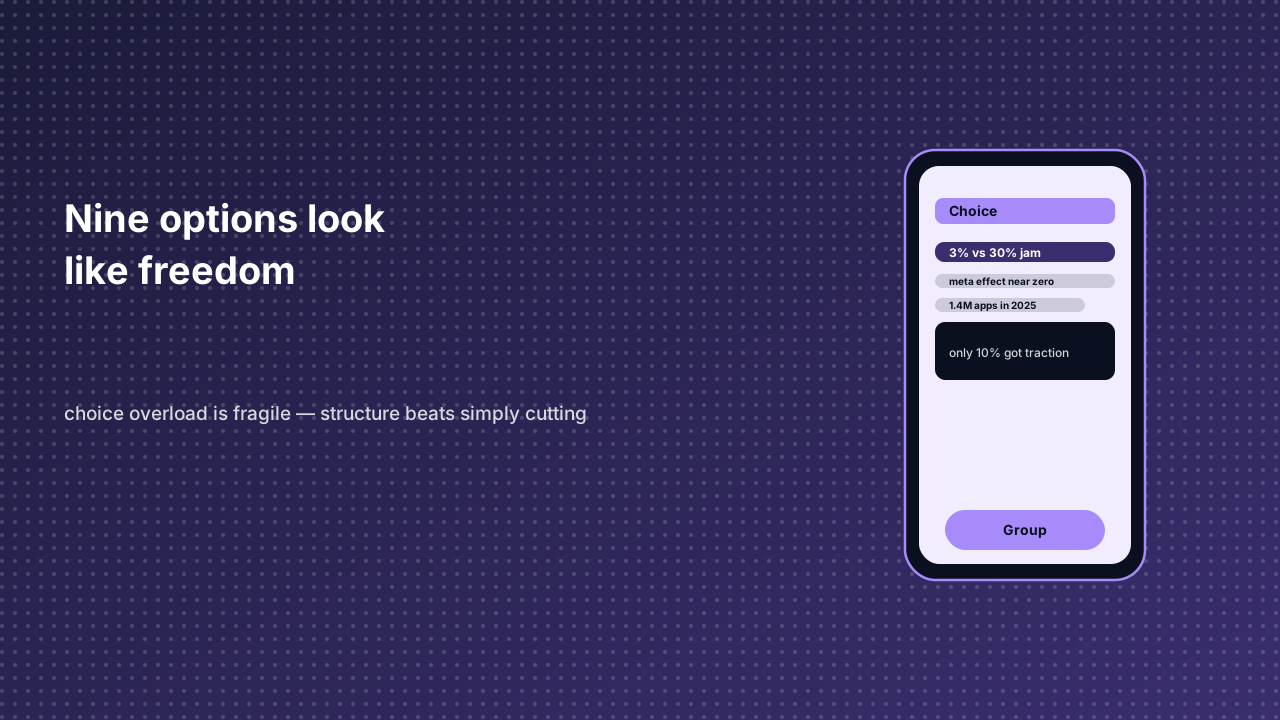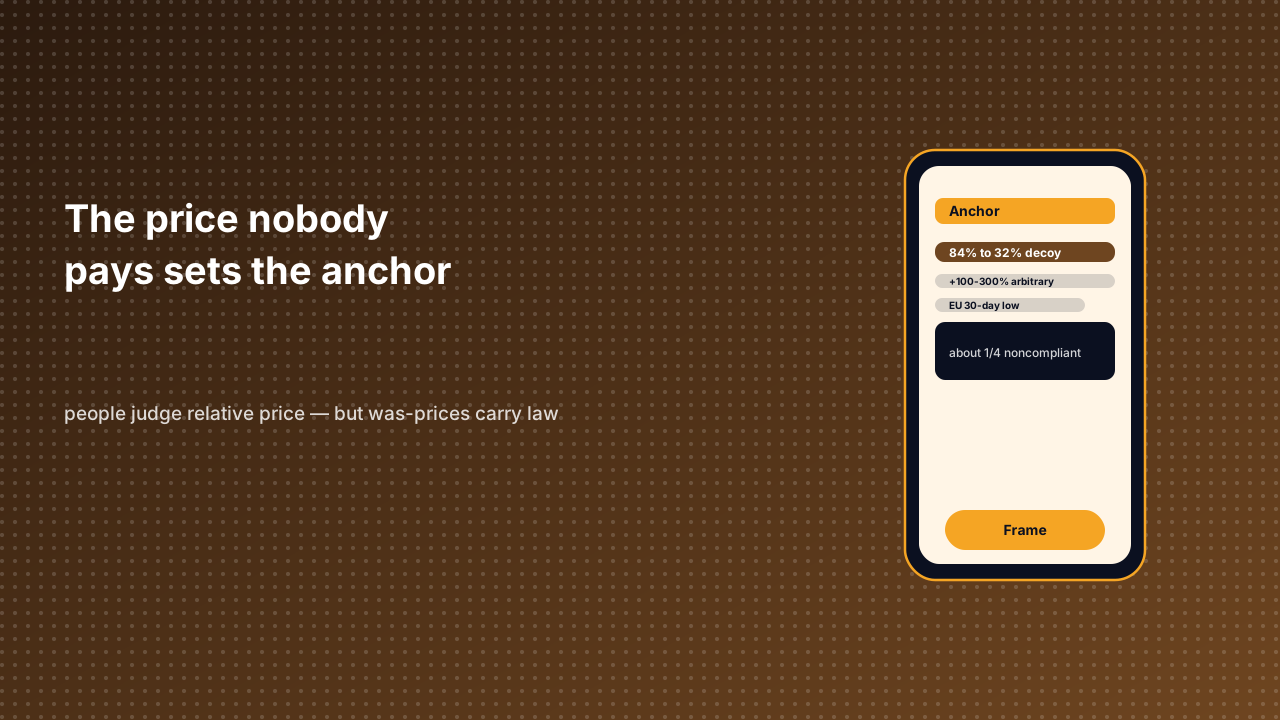
A subscription page shows three plans, and the middle one exists largely so that it gets declined. In Dan Ariely's version of the Economist subscription experiment, a print-only option sat beside a print-plus-web bundle at the same price, with a web-only option priced lower. With all three on screen, 84% of participants chose the bundle and nobody chose the print-only option. Remove that apparently useless third option and the same bundle fell to 32%, while 68% took the web-only plan. The product did not move. Only the set of choices moved.
There is a caliber worth flagging before those numbers travel further. The published prices differ by account: $59 and $125 in one telling, $50 and $100 in another. The proportions hold in both, so the effect is reported here as ratios rather than as a pricing prescription. The same caution applies to a second finding from the same line of work. Ariely, Loewenstein and Prelec, writing in the Quarterly Journal of Economics in 2003, asked participants to name a random two-digit number — the last two digits of a social security number — before bidding on goods under an incentive-compatible bidding procedure. Those with high digits were willing to pay 100% to 300% more than those with low digits for identical items. The researchers called it coherent arbitrariness: the anchor had no relationship to the product, yet the internal ranking of what the goods were worth stayed consistent.
| Signal | Reading | Origin and year | Consequence for a catalog |
|---|---|---|---|
| Decoy choice share | 84% bundle with the decoy, 0% decoy; 32% bundle and 68% web-only once removed | Ariely, Economist subscription experiment | A third option rewrites the comparison; report ratios, not prices |
| Arbitrary anchor | High random digits raised willingness to pay by 100–300% | Ariely, Loewenstein & Prelec, QJE 2003 | An irrelevant number can set the perceived range |
| Struck-through price rule | The was price must be the lowest applied in at least the 30 days before the reduction; discount percentages must use that price | EU Directive 98/6/EC plus Omnibus (EU) 2019/2161, applicable 28 May 2022; CJEU C-330/23, 26 September 2024 | A reference price is a legal record, not a styling choice |
| US standard | No minimum number of days; the former price must be one at which the item was genuinely offered | FTC Guides Against Deceptive Pricing, 16 CFR Part 233 | One badge can pass in one market and fail in another |
| Black Friday sweep | 176 sites, 16,000 products; roughly 50% advertised a reduction; about one in four price claims non-compliant; violations on at least 43% of sites | European Commission / CPC network, 2022 | Regulators already check the arithmetic |
| Per-item pricing | Highlighting per-item price raised small-pack sales by 12–24%; campus trail-mix per-item priced 90% above per-pound | Whitley, Sevilla & Isaac, JMR 2025, 62(5):876–894 | Unit framing shifts share; the 90% figure is one small sample |
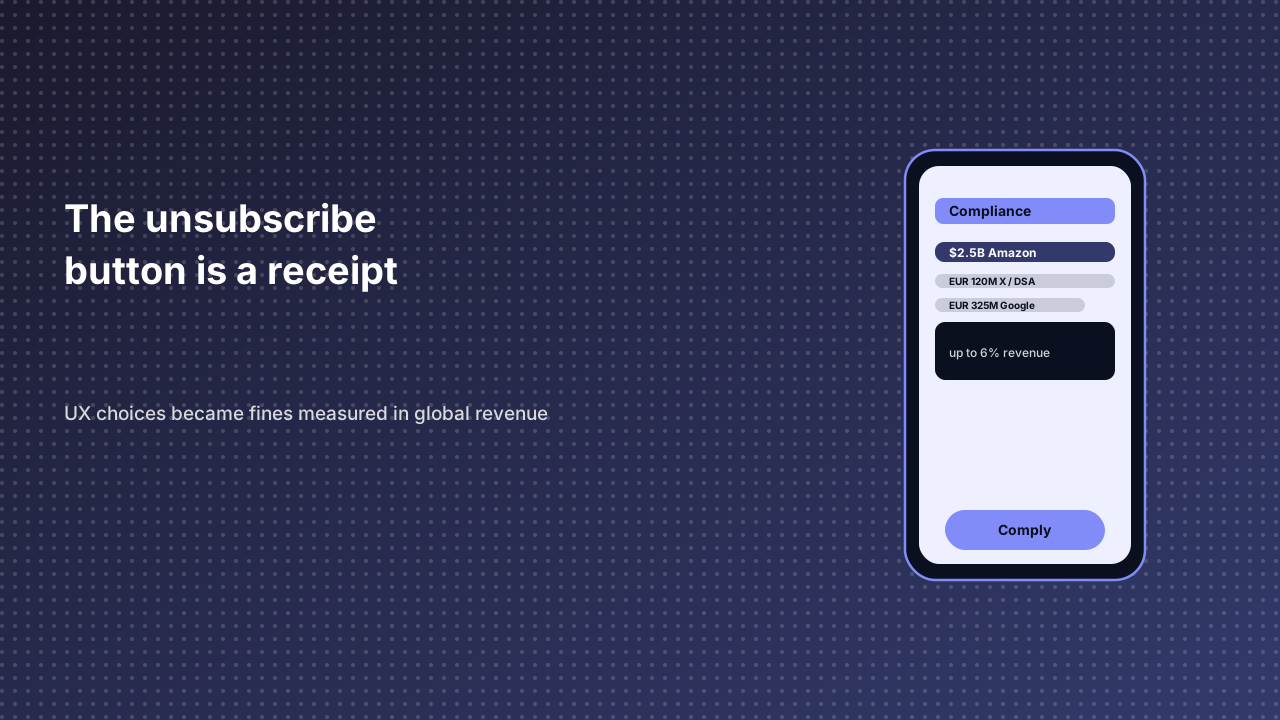
The temptation is to read those numbers as a licence to arrange prices however converts best. That reading skips over what a struck-through price actually is. In the EU, the Price Indication Directive 98/6/EC, reinforced by the Omnibus Directive (EU) 2019/2161 from 28 May 2022, requires the crossed-out was price to be the lowest price applied during at least the 30 days preceding the reduction. In September 2024, CJEU Case C-330/23 added that any advertised discount percentage must be calculated from that same price. The fine floor is 4% of annual turnover in the relevant market. The 2022 Black Friday sweep makes the exposure concrete: across 176 sites and 16,000 products, roughly half advertised a reduction, about one in four price claims was non-compliant, and at least 43% of sites carried some violation. One recurring pattern was raising an item to 39.99 euros and then cutting it to 23.99 euros with a 40% discount badge. The United States applies a different test. The FTC's Guides Against Deceptive Pricing (16 CFR Part 233) set no fixed number of days but require a former price to be one at which the item was really offered. A banner that passes in one market can be a violation in the next.
None of that means reference frames are dishonest by nature. Showing a unit price genuinely helps comparison. The 2025 Journal of Marketing Research study by Whitley, Sevilla and Isaac found that making the per-item price prominent raised sales of small packages by 12% to 24% without changing the price itself. The catch is that the same framing that helps a fair comparison can also be arranged to mislead. In the study's small campus sample, a per-item price for trail mix sat 90% above the per-pound price. That figure came from one small sample and should be treated as a caution rather than a general rule. The honest position sits between the two reactions. A frame is a tool with two edges: it can make a fair price legible, or it can make a mediocre one look reasonable. The difference is not in the arithmetic but in whether the reference being displayed is real.
For an open catalog showing prices across hosts and markets, the practical consequence is architectural. The reference price should be stored as data with a timestamp and a jurisdiction, not painted into a banner by each storefront. The same record should drive the strikethrough, the discount percentage and the unit-price label, so a rule change in one market does not turn into a hunt through every template. A shared runtime of the kind Cross Mini App provides makes that a single governed field instead of a per-surface chore. Machines and regulators can then read the same reference the shopper sees, and the catalog can prove where it came from.