The first order proves the product works. The second order proves the business works. Repeat purchase rate — the share of customers who return to buy again — is the single metric most correlated with long-term unit economics, and a mini-program runtime is built to move it.
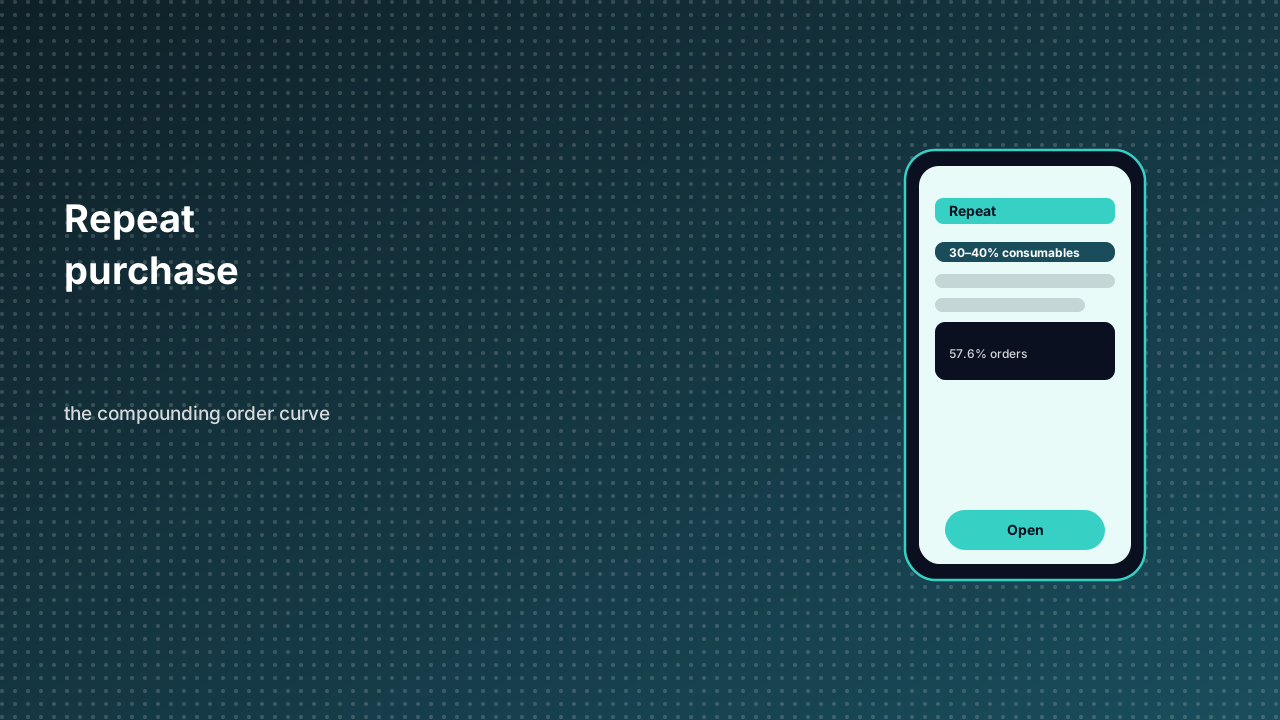
Benchmarks vary by what the customer consumes. Blended retail repeat purchase rates sit around 16.5 to 18.8 percent; consumables reach 30 to 40 percent because the product runs out, while electronics and durables sit near 10 to 15 percent because the product lasts years. The pattern is clear: frequency follows the buying cycle, not the quality of the app.
| Category | Repeat purchase rate | Revenue from repeat buyers |
|---|---|---|
| Consumables | 30–40% | Up to 66% of revenue |
| Fashion / apparel | 12–25% | 12–19% of revenue |
| Electronics / durable | 10–15% | Low share |
| Blended retail | 16.5–18.8% | Varies |
What matters more than the rate is what repeat buyers do. Across a large retailer panel, active buyers placed 57.6 percent more orders and spent 69.2 percent more than new buyers in 2023, and the highest-repeat consumables brand earned 66.5 percent of revenue from customers who came back. Repeat customers are also cheaper to reach — owned channels replace paid acquisition — which is why a store with a 40 percent repeat rate can fund a higher CAC than one stuck at 15 percent.
A mini-program raises the second order through structure, not luck. Subscription and replenishment flows, loyalty stamps, and saved carts live inside the runtime, so the reminder arrives in the same place the purchase happened. A scan-to-reorder in a restaurant or a one-tap refill in a retail app turns intention into a second order with one action. The data the runtime collects — last item, last interval, last abandoned cart — feeds the exact prompt that brings the customer back.
The caution is mistaking program members for retention. Loyalty members repeat more because they were already loyal; comparing them to non-members measures selection, not the program. The honest read tracks cohort repeat rate against the customer's own prior behavior, not against a self-selected group.
The strategic point is that repeat purchase is an architecture decision. A host that treats the mini-program as the relationship layer — with subscriptions, loyalty, and reorder primitives native to the runtime — is choosing to own the second order and every order after it. That choice is what turns a one-time acquisition cost into a compounding asset, and it is made once, at build time, then earned on every return.
The measurement that matters is cohort repeat rate, not blended rate. A blended number falls automatically as a store grows, because each new cohort dilutes the base of established buyers; reading it as a decline misleads. Tracking repeat rate by acquisition month shows whether the runtime is actually improving the second order or merely acquiring more first orders. The two move differently, and only the cohort view reveals which one the host is winning. The cohort view is also the honest defense against celebrating a blended number that is quietly deteriorating as the base expands. A flat cohort repeat rate alongside a falling blended rate is a sign of healthy retention under rapid acquisition, not of a problem.
Sources
- Ecommerce benchmarks 2026 — repeat rate by category, 57.6% more orders from active buyers.
- Repeat customer rate benchmarks — 16.5–18.8% blended, consumables 30–40%.
- Repeat purchase rate guide — Klaviyo 20–30% good, Bain 25–95% profit from 5% retention.
- Repeat purchase rate calculation — category bands, 25–40% for consumables.