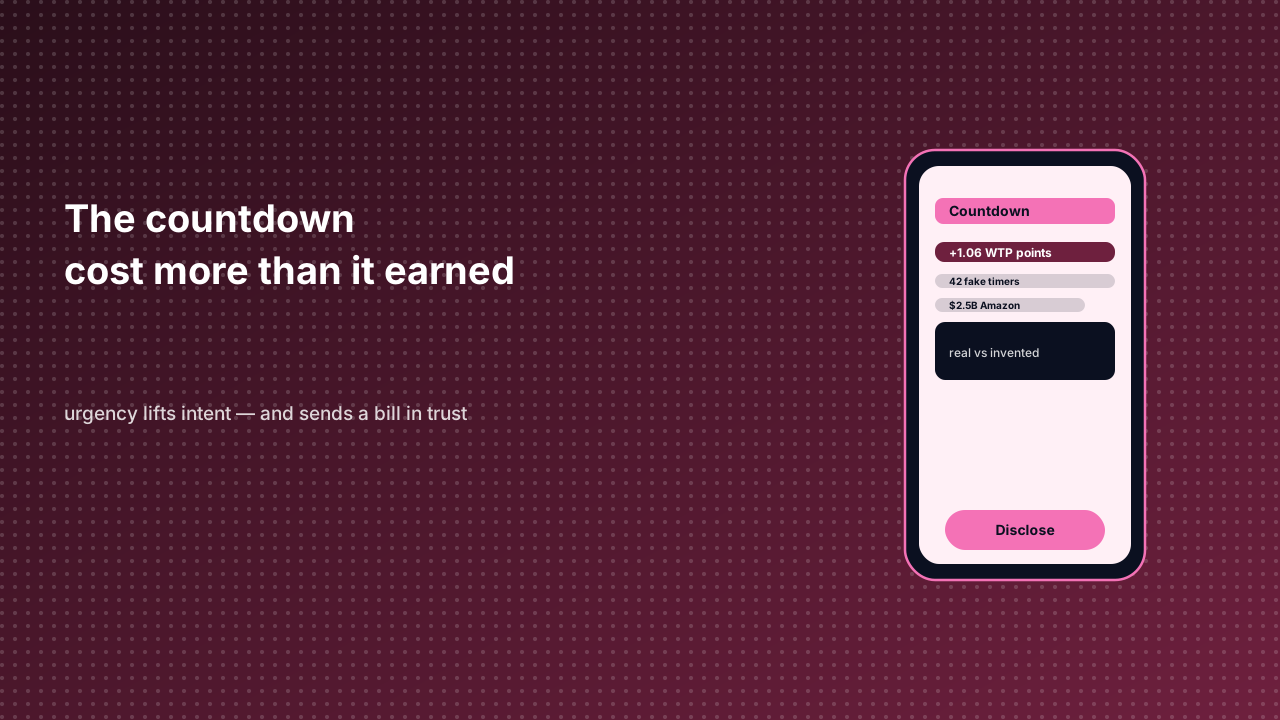
A notice that a livestream would end in three minutes produced the largest single jump in willingness to pay in a randomized experiment with 519 shoppers in China: 1.063 points on a five-point scale. The same cue added 0.304 points to a reported decision-difficulty measure. Both figures come from the same treatment, and neither cancels the other. The clock worked, and the act of deciding felt heavier. That pairing is a more useful starting point than either the celebratory version of scarcity design or the stern one.
The study, "Social Proof, Scarcity, and Discounts," appears in the EWA proceedings (2026) and reports an experiment run in 2025. Across the digital nudges tested, willingness to pay rose by 0.775 points overall. Social proof and discount frames lifted willingness to pay without adding cognitive load; the urgency cue lifted it most and was the only one that also raised decision difficulty. Read charitably, that is a clean result: different levers do different jobs, and the deadline buys its extra point by making the choice feel more consequential. Read less charitably, it describes a small tax collected at the moment of purchase.
Six other measurements put a price on that tax:
| Signal or case | Source and year | Sample or design | Reported result | What it does not prove |
|---|---|---|---|---|
| Livestream ending cue | EWA, 2026 (experiment 2025) | 519 shoppers, randomized survey experiment in China | WTP +1.063 on a 5-point scale; decision difficulty +0.304 | That the stream really ended in three minutes |
| Nudge bundle | EWA, 2026 | Same experiment | Overall WTP +0.775; social proof and discount frames added no cognitive load | A lift that survives after the deadline passes |
| Website sweep | European Commission / CPC network, 2022 | 399 sites inspected | 148 with at least one dark pattern; 42 with false countdowns; 37% possibly breaching the UCPD | How many countdowns were truthful |
| Timer versus stock bar | The Decision Lab review, citing a 2023 study | Roughly 200 participants | Countdown sites drew the most frustration and the worst experience; stock bar did not significantly cut trust | That every scarcity cue backfires |
| Flash-sale FOMO | Jurnal Perspektif (BSI), 2025 | Qualitative study | Short-term impulse buying alongside regret and anxiety; no effect size reported | A numeric trust penalty |
| Prime settlement | FTC, September 2025 | Enrollment and cancellation flows; about 35 million consumers | $2.5B = $1B penalty + $1.5B refunds, roughly $51 each | A fine for deceptive countdowns |
The sweep is the awkward line. An authority that opened 399 sites and found 42 false countdowns is not describing a fringe tactic. The 37% is a "possibly" — a screening judgment, not a court finding — and the 54 sites using false hierarchy alongside the 70 hiding information suggest the timer belonged to a broader habit of arranging interfaces against the person looking at them. False countdowns look rare only when compared with how often the trick gets written into growth playbooks.
The enforcement figure needs its label attached. The September 2025 FTC settlement with Amazon Prime concerned subscription enrollment and cancellation, not a bogus clock. It remains the right scale anchor: $2.5 billion, split into $1 billion in civil penalties and $1.5 billion in refunds spread across roughly 35 million consumers at about $51 each, shows what choice architecture costs when a regulator decides the architecture was the product. Quoting it as a false-timer fine is exactly the kind of error that lets the whole ethics conversation get waved away.
Not every deadline is a trick, and the evidence says so. A review from The Decision Lab citing a 2023 study with roughly 200 participants found that countdown sites produced the most frustration and the worst reported experience, while a stock progress bar did not significantly reduce trust. A stock bar reports a constraint that already exists. A countdown invents a boundary in time and then asks the shopper to act before it closes. That distinction is not philosophical; it is the difference between information and pressure. The 2025 qualitative work on flash-sale FOMO points the same way — impulse buying in the short run, regret and anxiety afterward, and no quantified effect size to lean on.
Then there is shelf life. Earlier timer cases were reported at +8–17% conversion; more recent tests summarized by Fix My Store in 2024 are as likely to come back neutral or negative. The effect declines as time passes and as shoppers learn to recognize the pattern. That is awkward for a tactic whose whole premise is that the urgency is immediate. It also means the +1.063-point result should be read as a snapshot under experimental conditions, not as a rate that compounds. The honest position is that urgency converts and that conversion consumes something. Whether a particular clock is spending trust or simply reporting a real ending cannot be settled from the lift alone.
A team could reasonably decide that some of that spend is worth it. A genuine deadline carries information: a cohort starts on a date, a batch is finite, a price really does revert. Removing those signals would make planning harder, not easier. The trouble starts when the constraint is decorative and the only thing being managed is the shopper's pulse. Real scarcity and invented scarcity are different objects that happen to wear the same interface. Saying so is not an argument for removing every timer; it is an argument for knowing which one is on the screen.
An open catalog has a plainer option available. Make scarcity claims a versioned, inspectable field in the shared runtime instead of a line of copy tucked inside each third-party program. A deadline tied to real inventory or a published schedule can carry its source stamp; a decorative one can be labelled as decorative, or refused by the directory. Cross Mini App keeps that surface in the open catalog so an auditor can compare what a timer promised with what actually happened, and so a program that outlives its campaign cannot keep displaying a clock that stopped years ago. The timer will still convert on plenty of screens. The useful question is whether the directory can prove the clock was telling the truth.
Sources
- EWA — Social Proof, Scarcity, and Discounts — 2026; experiment run in 2025 with 519 participants; urgency cue +1.063 WTP and +0.304 decision difficulty.
- European Commission — 2022 dark patterns sweep — 399 sites; 42 false countdowns; 37% possibly breaching the UCPD.
- FTC — Settlement with Amazon Prime — September 2025; $2.5B over enrollment and cancellation practices, not countdown timers.
- The Decision Lab — Persuasion reference guide — review citing a 2023 study on countdown frustration and stock-bar trust.