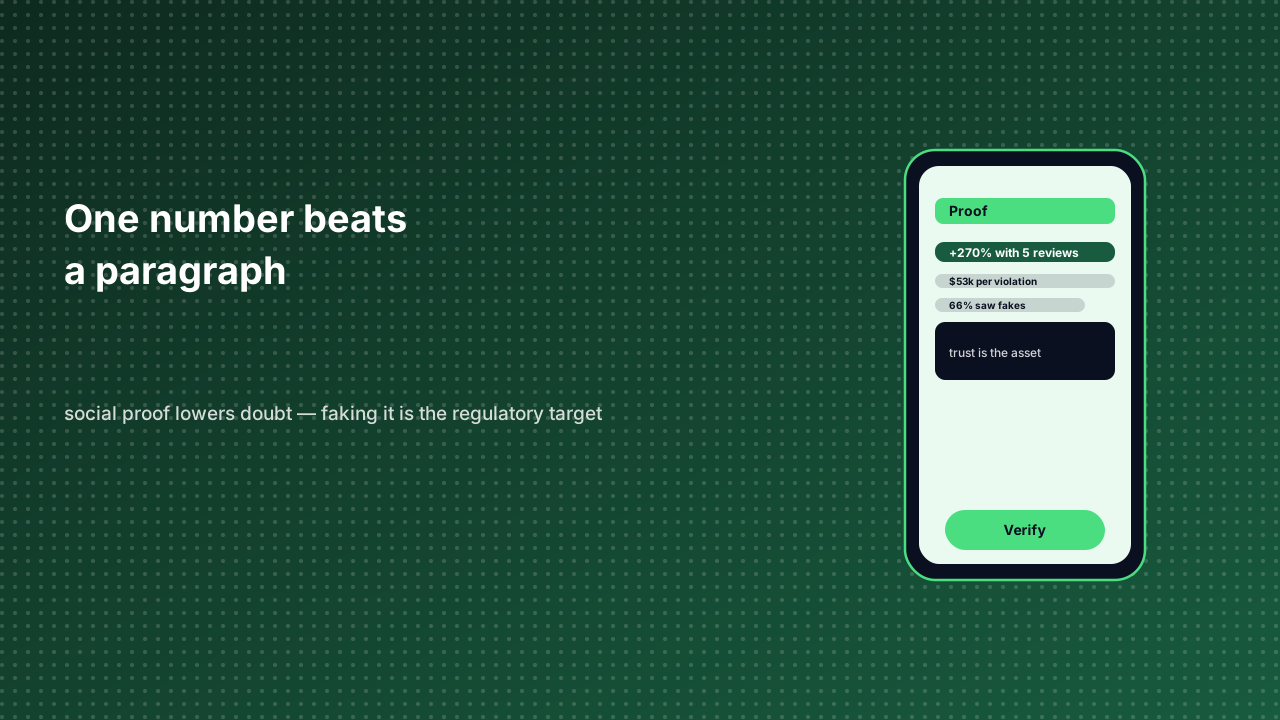
A catalog card has room for two lines of description and one small line underneath: an install count, a star rating, a phrase saying how many people already use it. The paragraphs were written by someone with a budget. The number is what gets believed. In an observational study from Northwestern's Medill Spiegel Research Center (2017, roughly 15 million page views at one high-end gift retailer), products with five reviews were 270% more likely to be purchased than products with none; the lift ran about 190% for low-priced items and 380% for high-priced ones. Those are correlations, not causes, and later work suggests the true effect is much smaller than 270%. The direction still holds: a small number beside a button does work a paragraph cannot.
What the catalog is really displaying
Strip a listing down and the social proof is a handful of fields, each one read as a shortcut to safety. The table names what each field appears to say, what has to be true for it to say that, and the ordinary way it breaks.
| Signal on the card | What a visitor reads into it | What must be true | Typical failure |
|---|---|---|---|
| Install count | This has been chosen many times | Counts map to real installs | Inflated installs, refunds still counted |
| Star rating | Other people were satisfied | Reviews came from genuine users | Bought reviews, conditioned five stars |
| Active-user line | Demand is current, not historical | The number is measured, not invented | Fabricated activity, stale snapshots |
| Verified-buyer badge | The reviewer actually used it | The badge is earned and auditable | Insider reviews, badge inflation |
| Review volume | Experience is well documented | Reviews are independent of each other | Suppressed negatives, review gating |
The number works, which is exactly the trouble
A 14-day proof of concept by Taggstar with retailer BrandAlley (November 2025) put 13 kinds of real-time social-proof messages into the funnel and reported 831 incremental orders, £67,895 incremental revenue, a 5.91% conversion lift, and an annualized ROI of 1,417%. Those are vendor-reported, projected figures, not an independently audited result; the direction is the finding, not the magnitude. An experiment in Chinese ecommerce (EWA, 2026, n=519) points the same way with a cleaner design: social-proof and monetary frames raised willingness to pay without adding cognitive load, while urgency cues produced the largest lift but also raised decision difficulty. Social proof is unusual among nudges in that it can move behavior without making the choice feel harder.
That effectiveness is why regulators treat it as a fraud surface. The United States Federal Trade Commission's Consumer Review and Testimonial Rule took effect on 21 October 2024. It bars buying or selling fake reviews, conditioning incentives on five-star ratings, insider reviews written by people with a stake, suppressing negative reviews, and buying fake followers or views. Civil penalties reach $51,744 per violation under the 2024 rule, and $53,088 in the inflation-adjusted figure the FTC cited in a December 2025 warning letter to ten businesses. Every one of those prohibited practices is a way of manufacturing the number on the card.
A survey result that is easy to misquote
Europe's Consumer Conditions Scoreboard, published in March 2025 from a November 2024 survey, reported that 66% of European consumers had encountered a fake review in the previous year; 61% reported misleading discounts and 45% online scams. The precise reading matters: 66% is the share of consumers who encountered something, not a claim that 66% of all reviews are fake. Turning it into the second statement would be the same category error as reading the Medill 270% as a guaranteed sales lift. Both numbers describe a climate of suspicion, not a law of conversion.
The tradeoff an operator has to name
Here is the uncomfortable part. A truthful install count is often smaller than an invented one, and it converts worse in the short run. A rating held below five stars by genuine critical reviews looks less polished than a curated wall of praise. Teams optimizing the quarter will feel the pull to smooth those edges, and the rule exists because that pull is predictable. The other side of the ledger is less visible: a signal that survives an audit keeps working after a regulator arrives, while a padded one becomes a liability that has to be unwound, sometimes at the cost of the catalog's reputation. Honest numbers compound slowly and then all at once. Fabricated ones start to decay the moment anyone checks.
Where the number comes from matters
An open catalog can make the number a property of the system rather than a claim attached to a listing. In a shared runtime, install counts can be emitted by the same telemetry that gates execution, ratings can be bound to verified distribution identities, and the active-user line can be a measured snapshot with a timestamp instead of a marketing adjective. That is the practical case for building catalog signals into the CrossMiniApp runtime layer: the badge and the count are produced by the infrastructure that also enforces the rules, so a claim and its evidence travel together. A number beside a button stays persuasive only while it remains true.