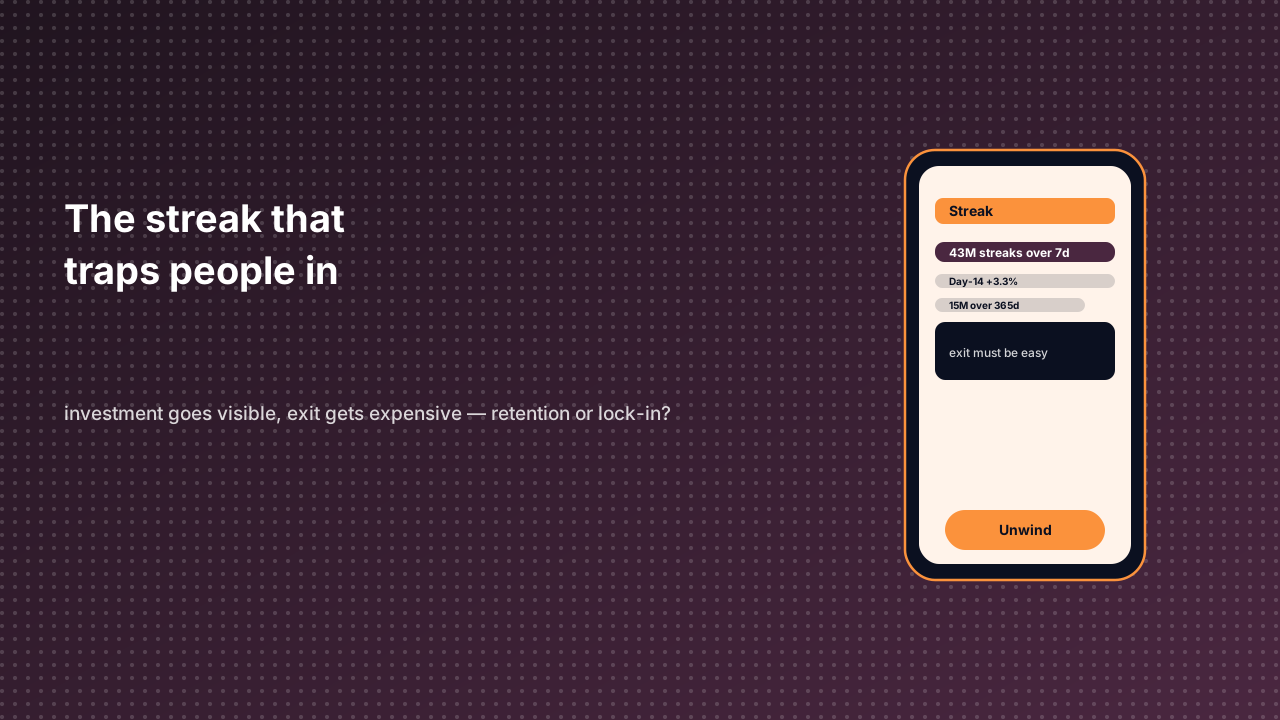
At 11:40 on a Sunday night, a language learner opens an app not to study but to keep a number from resetting. The number reads 214. The lesson that follows will barely be remembered; what matters is that tomorrow it reads 215. In the annual filing that Duolingo published after 2025 closed, the company reported roughly 15 million daily active users holding a streak of 365 days or more, and about 43 million at seven days or more. Those are not vanity counters. They are a ledger of daily deposits that has quietly become expensive to abandon.
That is the uncomfortable thing about a streak: it turns showing up into an asset that accumulates, and it turns missing a day into a withdrawal. Sunk cost theory predicts what happens next. The more a person has invested, the harder it becomes to stop, even after the original reason for starting has faded. A 2025 OSF preprint pooled four preregistered experiments with 1,481 participants to test how far that logic travels. Sunk cost borne by someone else raised commitment too; in experiment two, another person's prior effort pushed commitment higher than the participant's own investment, which the authors read as possibly driven by social expectation. Two of the experiments reproduced the personal sunk-cost effect under a wasted-free condition. The preprint has not completed peer review, so it should be treated as a signal rather than a settled result — but the direction deserves attention in any product that displays accumulated effort.
Here is what the available evidence says, and where each number stops:
| Evidence anchor | Source and year | What was measured | Reported result | What the number does not settle |
|---|---|---|---|---|
| Others' effort and escalation | Four preregistered experiments, OSF preprint 2025, N=1,481 | Commitment after prior effort by self and by others | Others' prior effort exceeded own investment in experiment two | Peer review status; whether the effect holds outside the lab |
| Streak decoupled from daily goal | Company A/B test, 2022-01-31 | Day-14 retention, daily actives, share of actives on a streak | +3.3%, +1%, +10.5% over 20 days (+19% for new learners) | A baseline-independent lift; company self-reported |
| Streak as a habit signal | Form 10-K, year ending 2025-12-31 | Course completion among learners with streaks | 3.6 times more likely; correlation, company self-reported | That streaks cause completion |
| Endowed progress and its reverse | Nunes & Drèze 2006, JCR; Motivation Science 2025 | Stamp-card completion; late-stage effort | 34% versus 19%; effort +34% near the end | That visible progress is a loss effect |
| The cost of making exit hard | FTC settlement 2025-09; DSA Article 25 | Cancellation flow and dark-pattern rule | $2.5B settlement; roach-motel designs prohibited | That a hard exit alone explains churn |
Every row in that table describes something that works. The decoupling test is the most revealing, because it lifted retention by making a streak easier to keep rather than harder to lose. Once the daily goal was separated from the streak, day-14 retention rose 3.3%, daily active learners rose 1%, and the share of actives carrying a streak climbed 10.5% over twenty days, with new learners up 19%. A renewal animation added 1.7% to day-7 retention among new learners, and allowing two streak freezes added 0.38% to daily actives. All of it is company-reported, and it came from a product already saturated with streak mechanics, so the figures demonstrate direction rather than forecast what an untested catalog would gain.
The reversal comes almost for free from the same material. The 3.6-times completion figure is a correlation: learners who keep long streaks finish courses more often, but the filing does not establish that the streak caused the finishing. A 2025 study in Motivation Science found that perceived progress near the finish line raised effort by 34%; the other side of that result was that people who failed at the ninety-percent mark showed motivation roughly 40% lower than those who failed at the halfway point. The asset cuts both ways. A progress display that pushes someone across the line is the same display that makes an early exit feel like a write-off. Escalation of commitment is not a defect hidden inside the mechanic; it is the mechanic, seen from the other side of the ledger.
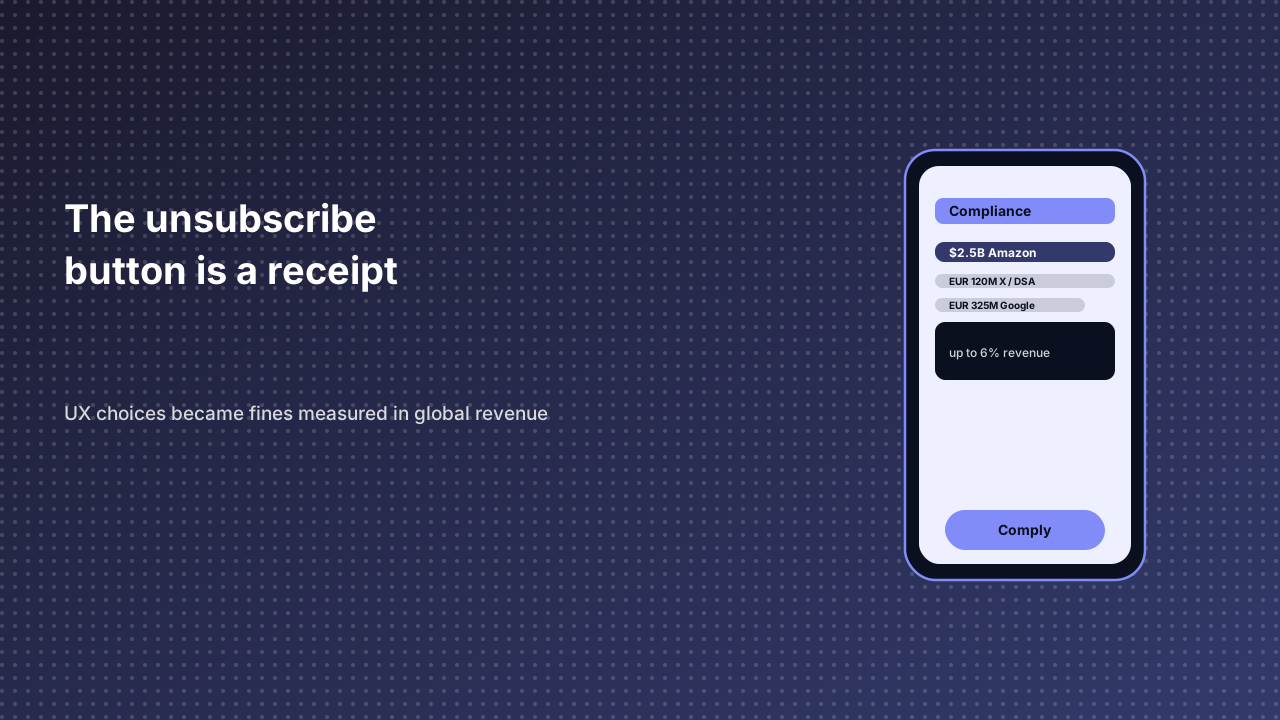
Regulation has begun to price the exit side of the equation. In September 2025 the US Federal Trade Commission secured a $2.5 billion settlement over a Prime cancellation flow that required multiple pages and repeated clicks; internally the flow was codenamed Iliad, a detail that tells the story without any unverified step count. The agency's Click-to-Cancel rule had been vacated by the Eighth Circuit in July 2025 after more than 16,000 public comments, yet enforcement under Section 5 continued. In the EU, Article 25 of the Digital Services Act already prohibits interfaces that make leaving materially harder than joining. The pattern is steady: accumulating commitment on the way in is acceptable, and making the way out expensive is where the law starts to look.
An open catalog has a concrete advantage here, and it is not rhetorical. Streak state, visibility rules and restore mechanics can live in the shared runtime as versioned, inspectable surfaces rather than as private logic buried inside each third-party program. That lets a directory operator compare a make-it-easier-to-keep variant against a make-it-costlier-to-lose variant on equal terms, and watch what happens after the incentive is removed — including whether people return or simply stop opening the app. Cross Mini App keeps those surfaces in the open catalog so any auditor can reproduce the comparison. The question worth asking is not whether a streak can be built; a number that has run for 365 days will always look impressive. The question is whether the path back is as short as the path down was long.
Sources
- Sciety — Four preregistered experiments on others' sunk cost, OSF preprint 2025 — 2025 preprint; peer review pending.
- Duolingo — How streaks build a habit — company-reported decoupling test and streak figures.
- VG Sources — How gamification took over everyday life — streak scale and the annual filing numbers.
- Consumer Rights Wiki — Negative option marketing — roach-motel designs, cancellation friction and the FTC rule.