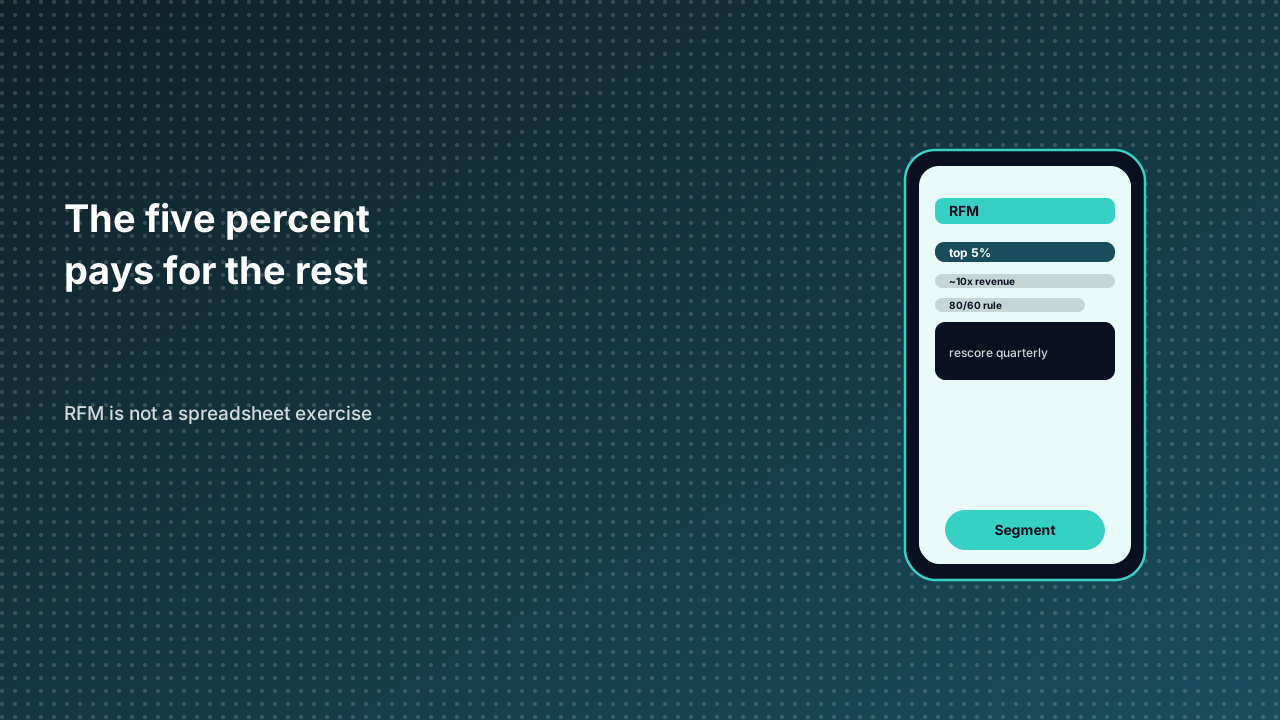
Pull the transaction log of any consumer product and sort by value. The top five percent of buyers often generate around ten times the revenue of an average buyer, and a surprising share of profit sits with people who have not been seen in weeks but bought often before that. A spreadsheet can surface that group in an afternoon; the hard part is deciding what to do differently once it is visible.
RFM — recency, frequency, monetary — scores each customer from one to five on three axes, usually by quintile so the labels mean something relative to the list rather than to an arbitrary absolute threshold. A buyer who purchased within thirty days scores five on recency; one whose last purchase was over a year ago scores one. Stack the three scores and recognizable segments fall out: Champions at 5-5-5, Potential Loyalists, At-Risk, Hibernating, and Lost.
Reading the segments as instructions
Champions are not just a revenue bucket; they create word-of-mouth and will try new things first. Potential Loyalists have the frequency but not the recent spend, which makes them the cheapest group to nudge upward. At-Risk buyers still have strong monetary and frequency history but their recency has slipped — and recency is usually the strongest single churn signal available. Hibernating and Lost customers need a different question entirely: whether reacquisition costs less than finding somebody new.
The classic budget rule says to direct about eighty percent of marketing spend at the customers producing roughly sixty percent of revenue. Applied with judgment, it protects the people who already trust the product. Applied mechanically, it starves the middle of the list, where tomorrow's Champions are hiding.
| Segment | Typical RFM shape | Default move |
|---|---|---|
| Champions | 5-5-5 | Early access, advocacy asks, low discount |
| Potential Loyalists | High recency, mid frequency | Bundles that raise basket size |
| At-Risk | High frequency, falling recency | Reason-matched reminder, not a blanket coupon |
| Hibernating | Low recency, prior frequency | One short reactivation sequence |
| Lost | 1-1-1 | Suppress; spend the budget on acquisition |
The awkward part of the model
Here is where the standard playbook gets too tidy. Recency is the most powerful churn signal precisely because it is the most volatile; a buyer who purchased last week can still be gone for good. Quintile scoring also forces a distribution onto a list that may not deserve one — if half the customer base bought last month, half the list gets a top recency score by construction, regardless of whether those buyers are valuable.
RFM also says nothing about why somebody stopped. A high-value customer who left after a bad support interaction and one who left after relocating look identical in the data and need completely different messages. That is why the scores need a qualitative layer, and why they should be recalculated quarterly rather than treated as a permanent identity. A static label turns a living customer base into a museum.
Where the data actually comes from
A segmentation is only as good as the events feeding it. Mini-programs run inside host apps, and a purchase made through one host may arrive as a different event shape than the same purchase through another. If recency is computed from one host's stream and frequency from another, the resulting score is fiction, however elegant the quintiles look.
A shared runtime across hosts can normalize those purchase, recency, and frequency signals into one event vocabulary, so the Champions in one host are comparable to the Champions in another. That is the unglamorous prerequisite for the whole exercise: the top five percent only stay visible when every host reports into the same ledger. Reward that group with recognition before reaching for a discount, and keep scoring them every quarter.
Sources
- RFM analysis and customer lifetime value — emplicit.co — how recency, frequency, and monetary scoring feeds lifetime value.
- Predictive segments and RFM — devenv.moengage.com — moving from static scores to predictive segments.
- Recency, frequency, monetary score — taglab.net — the five-level scoring scales behind common segments.
- Customer segmentation pitfalls — emplicit.co — where rigid RFM labels mislead.