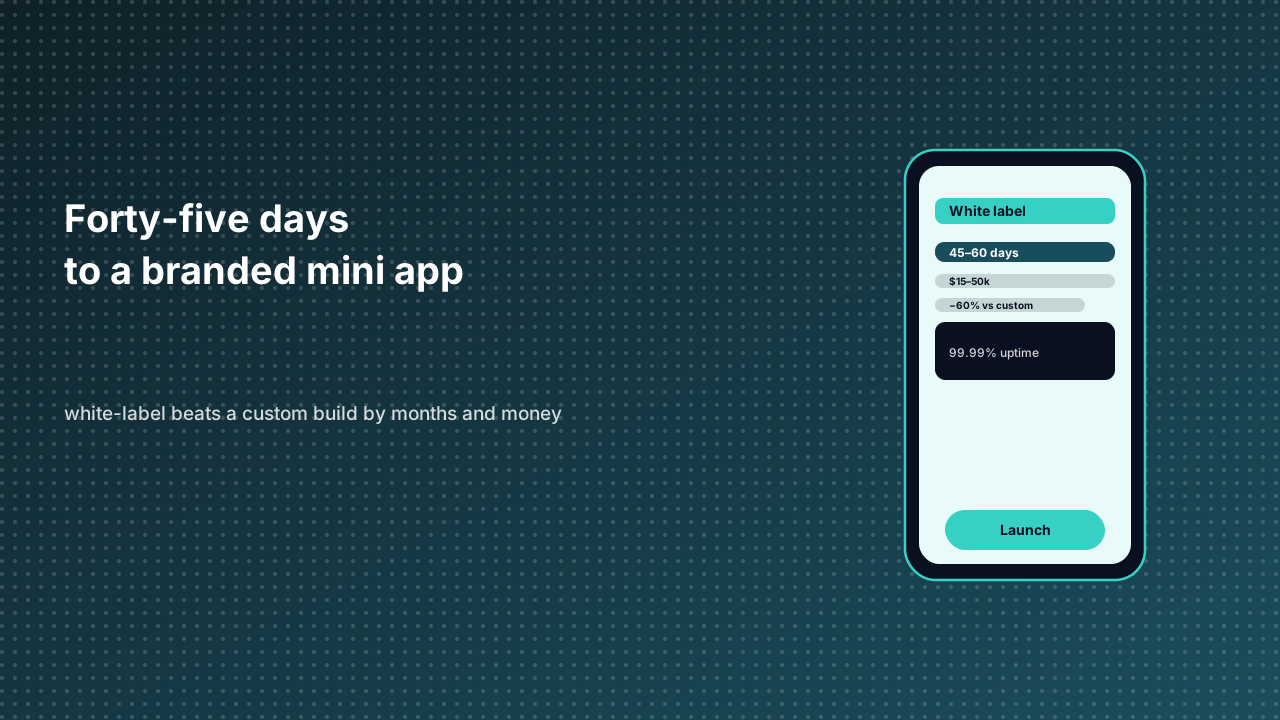
A custom-built super app is quoted at 100,000 to 300,000 dollars and eight to twelve months. A white-label stack lands at 15,000 to 50,000 dollars and 45 to 60 days, cutting cost by as much as 60 percent. That gap is the entire sales pitch, and it is real. It is also easy to misread. The forty-five days cover a branded shell with a working catalog; they do not cover the slow work of filling that catalog with services people return to.
The market makes the shortcut tempting. Appscrip put the global super-app market near 121.1 billion dollars in 2025, projected to reach 426 billion by 2030, a compound growth rate close to 28 percent. Some 66 percent of users prefer platforms that aggregate services, and Gartner expects more than half of the world's population to use several super apps daily by 2027. Those numbers describe demand for aggregation, not demand for another logo. A new brand entering this space inherits an expectation of breadth on day one.
HDIN Research named white-label mini programs as one of the sector's key trends in 2025, with B2B super-app growth between 15 and 27 percent. The same report attaches conditions that rarely fit on a pricing page: value chains operating at this level are expected to hold 99.99 percent availability and meet PCI compliance. Those are not optional extras that can be added in month four. They shape architecture, vendor selection and the kind of partner allowed into the catalog. A forty-five-day launch that quietly defers them is not a launch; it is a pilot with a marketing budget.
Dataintelo shows where the durable value sits. Huawei's HMS Core had generated 1.1 billion dollars in platform revenue and attracted 8.4 million developers by 2025, while banks such as DBS, OCBC and UOB captured 2.8 billion dollars in added transaction volume. Low-code approaches reached market about 40 percent faster. The common thread is infrastructure: revenue followed the host environment and its developer base, not the visual identity layered on top. The brand gets the customer's first glance; the runtime keeps the transaction.
The build paths compare like this:
| Path | Typical cost | Typical timeline | Main constraint |
|---|---|---|---|
| Custom build | 100,000 to 300,000 dollars | 8 to 12 months | capital and hiring |
| White-label kit | 15,000 to 50,000 dollars | 45 to 60 days | service depth in the catalog |
| Low-code integration | varies with host | about 40 percent faster to market | dependence on host APIs |
| Catalog on an existing host | shared infrastructure | limited by onboarding rules | compliance and availability gates |
The obvious conclusion is to take the cheap route and spend the savings on promotion. That inverts the problem. If 66 percent of users already lean toward aggregation, the scarce asset is not a storefront but the reason to open it twice. A branded mini app with three thin services is a brochure that loads quickly. The teams that benefit from a white-label start are the ones treating the sixty days as a head start on catalog curation, not as permission to skip it. Speed to market only pays when there is something in the market to meet.
There is also a quiet trade-off in the compliance numbers. Holding 99.99 percent availability and PCI standards from day one costs more than bolting them on later, which is precisely why white-label vendors price them separately. A buyer comparing a 15,000 dollar kit against a 300,000 dollar build should ask which line items are included in each. When the answer is unclear, the cheaper quote is usually borrowing time from a future audit. The forty-five-day claim survives contact with reality only when the compliance posture is inherited from the host instead of rebuilt.
For operators, the sensible sequence is to choose the host environment first and the brand wrapper second. A shared runtime such as Cross Mini App can supply the catalog, settlement and availability posture that a white-label front end needs, so the forty-five days are spent arranging services rather than proving basic infrastructure works. White-label distribution is a real shortening of the path. What still takes time is earning a place in a market where half the planet is expected to live inside a handful of super apps.
Sources
- White-label super app for startups — market size, build cost and timeline comparison.
- HDIN Research mini-program report — white-label trend, B2B growth and compliance requirements.
- Super apps market report — HMS Core revenue, developer numbers and banking transaction volume.
- Mini-program platforms in China — host platform landscape for catalog distribution.