Discovery that depends on a stranger sharing a link
Publish an H5 page and discovery is mostly someone else's job: a search engine crawls it, or a user copies a link into a chat. Outside the ecosystem, your page competes with the entire open web for ranking, and inside a messenger it is just another URL someone has to paste. The path from intent to your page runs through surfaces you do not control.
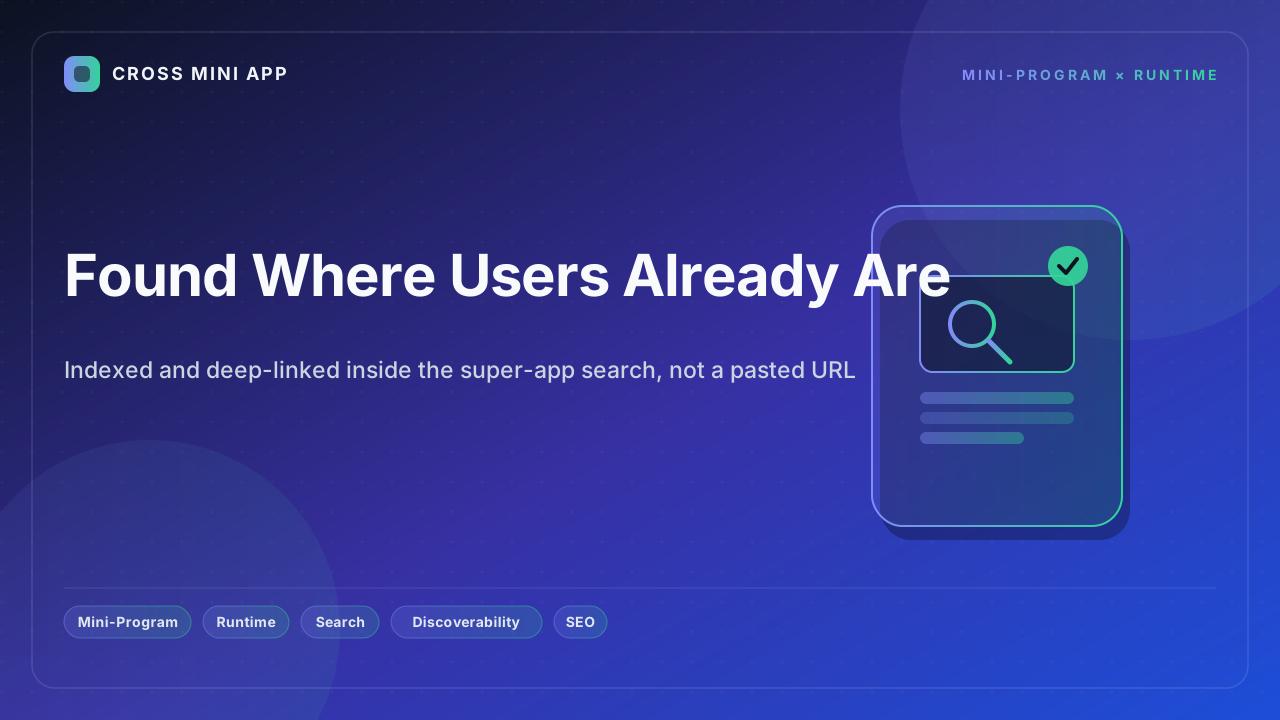
A mini-program runtime changes the starting line. The program is indexed and deep-linkable inside the host app's own search, so a user who is already in the ecosystem finds your program by typing what they want — not by receiving a link.
What in-app discovery actually is
The runtime registers the program with the host's search and routing system: pages get indexable entries, and deep links resolve straight to a specific screen rather than a generic landing page. Discovery happens where attention already lives, with the host's search quality working in your favor instead of an external crawler's whims. You still optimize, but the optimization is structured — a sitemap of pages, clear entry points — not a hope that a bot finds you.
This is the same principle as open-web SEO, applied where the users are. Google's starter guide and Moz's beginner guide describe the open-web version; the runtime version puts that discipline inside the super-app.
Where the gap shows up
| Step | H5 / external web | Mini-program runtime (in-app search) |
|---|---|---|
| Indexing | External crawler, slow | Host search, structured |
| Entry point | Generic landing URL | Deep link to a screen |
| Discovery surface | Open web, crowded | Inside the host app |
| Share dependency | Link must be pasted | Found by typing intent |
| Competition | Entire web | Host's indexed programs |
The result is shorter distance between a user's need and your program: they search inside the app they already use, and your program is a result.
Why indexed beats linked
An indexed, deep-linkable program means a developer declares pages once and users reach them by intent, instead of depending on shared links and external ranking. It also means the host's search quality, relevance, and routing all work for you, the same on every host that indexes the program.
How Cross Mini App applies it
Cross Mini App gives programs a runtime that registers pages with the host's search and routing, so each screen is indexable and deep-linkable inside the ecosystem. You declare your pages; users find them where they already are. You stop waiting for a link to be shared and start being found on purpose.
That is the difference between hoping someone passes your URL and being the answer when users search.