The blind spot under the page
Instrument a web app and you measure what the browser exposes: page views, DOM timings, a few paint metrics. But the things that actually lose users — a dropped frame in a native component, a crash in the bridge, a cold-start stall — live below the page, where your analytics tag never reaches. On top of that, web measurement scatters: every page, every single-page route, and every third-party tag reports differently, so the funnel you stitch together is half inference.
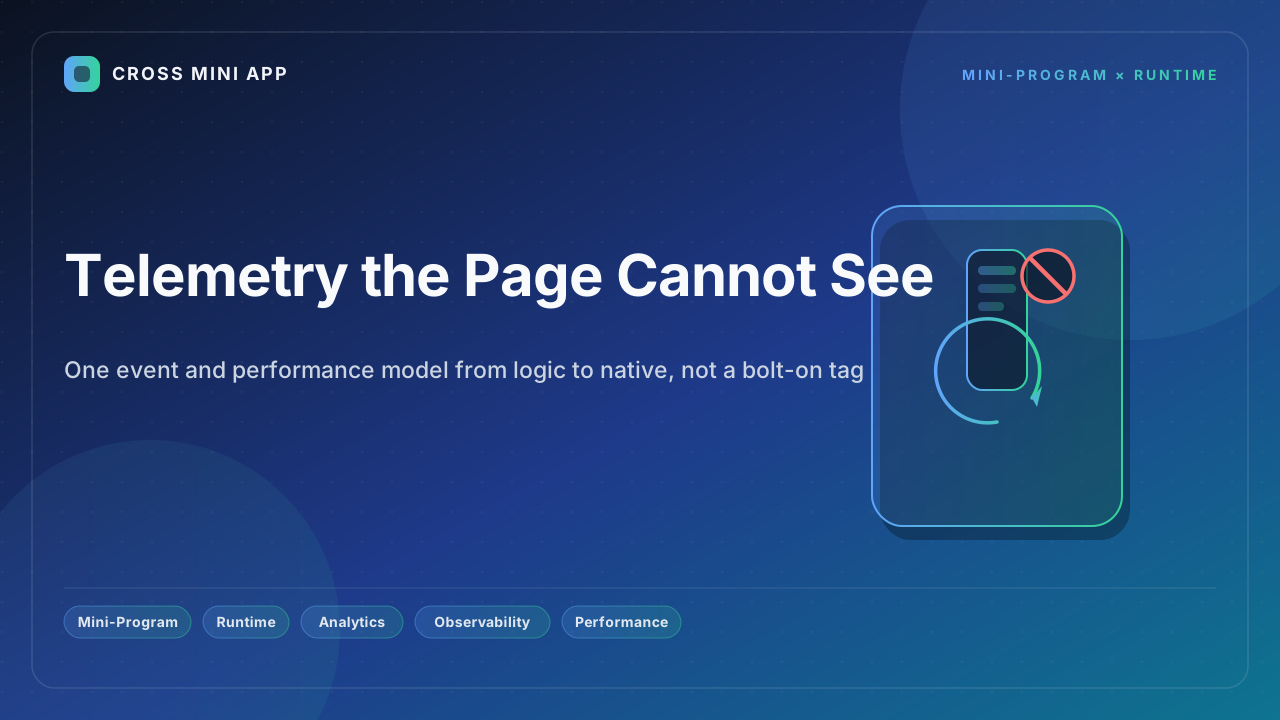
A mini-program runtime closes that gap because the same layer that runs your code also reports on it. Telemetry comes from the runtime, not from a tag you bolt on after the fact.
What runtime telemetry actually is
The runtime gives you one event and performance model that spans the logic layer and the native layer. A tap, a navigation, a payment, and a crash are all first-class events with consistent fields; frame timing, memory pressure, and startup cost are measured where they truly occur. Because the model is uniform, a session stitched on one host reads the same on another.
This is different from web analytics in kind, not degree. Web measurement is an overlay you attach to documents; runtime telemetry is emitted by the substrate the program runs on. You see the native-layer drops that a web tag literally cannot see.
Where the gap shows up
| Signal | H5 / Web analytics | Mini-program runtime telemetry |
|---|---|---|
| Event model | Per-page, inconsistent | One consistent schema |
| Native jank and crashes | Invisible | Reported at the layer |
| Session stitching | Inferred across tags | Native session identity |
| Startup and memory | Rarely measured | Measured where they happen |
| Cross-host parity | Re-implemented per host | Same model everywhere |
The payoff is a funnel you can trust: the same definitions, the same units, the same attribution whether the program runs in one host or ten.
Why one model beats an overlay
A single telemetry model means a developer instruments once and observes everywhere, instead of maintaining a different analytics integration per web surface and guessing at the native gaps. It also lets the platform supply baseline health — crash rate, frame drops, cold-start — without the program shipping its own fragile probes.
How Cross Mini App applies it
Cross Mini App gives programs a runtime that emits one consistent event and performance model from logic to native, so your dashboards describe the whole program rather than a sliver of it. You define a conversion event once; the runtime carries it across every host with the same schema. You stop inferring the funnel and start observing it.
That is the difference between measuring the page and observing the program.