The impression you were giving away
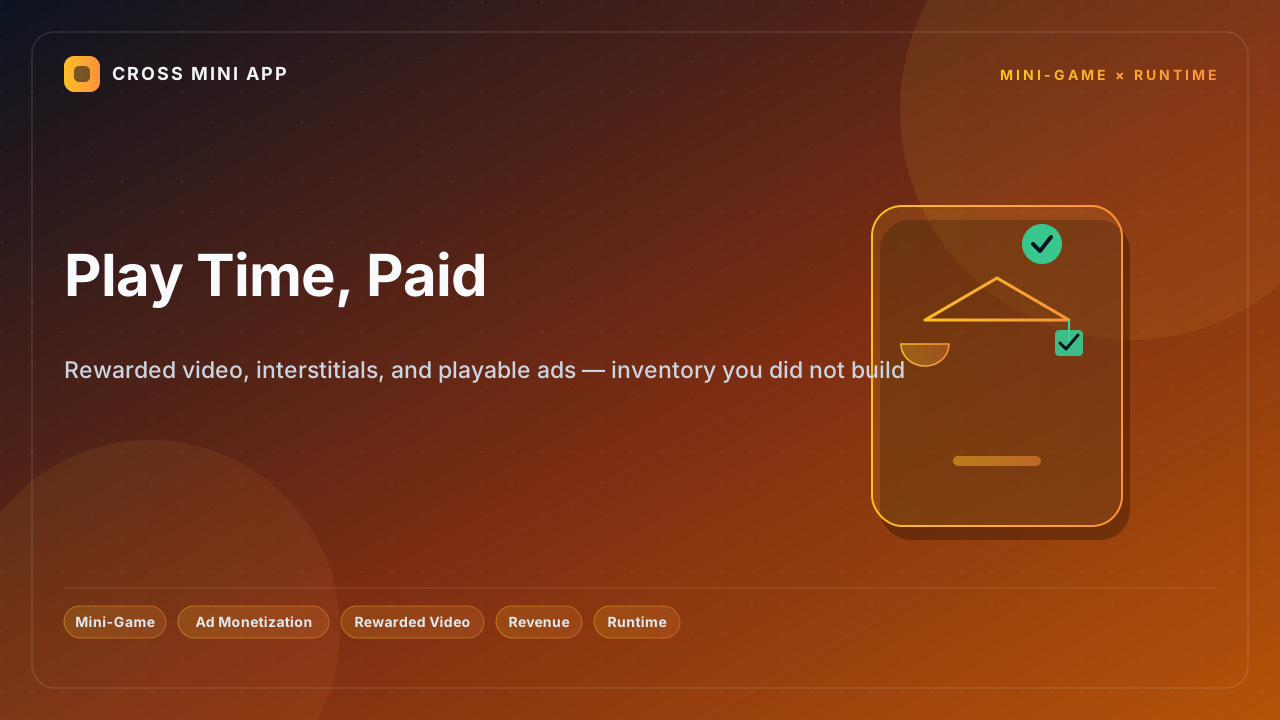
A mini-game session is attention. Before monetization, that attention was a cost you absorbed and a value you handed to someone else. In-game advertising flips it: the idle minute between levels becomes inventory, and inventory becomes revenue. In China's 2025 mini-game market of ¥53.5 billion, ad-based monetization (IAA) alone accounted for ¥17.1 billion — 31.9% of the total. That is a ¥17 billion line that did not exist as a category a few years ago.
Rewarded video is the engine
Among in-game formats, rewarded video is the clear leader. Players opt in — watch a short clip, get a reward — so completion rates sit at 85–92%, far above any forced format. That voluntary attention commands premium pricing: $15–40 eCPM in tier-1 markets, roughly 3.5–4.2x the eCPM of interstitials. In 2025 rewarded video was the single largest format in mobile game advertising at $5.7 billion, 38.5% of the market. Adoption is near-universal too: about 82% of free-to-play games use it, and 79% of mobile gamers say they prefer rewarded ads over interstitials.
| Format | Typical eCPM (tier-1) | Completion | Role |
|---|---|---|---|
| Rewarded video | $15–40 | 85–92% | Primary, player-positive |
| Interstitial | $2–15 | 20–35% | Transitions only |
| Playable | $20–60 | high | Acquisition + revenue |
| Banner | $0.5–3 | low | Background fill |
The rest of the stack
- Interstitials — full-screen, shown only at natural breaks (level clear, game over). Effective for volume but toxic if overused; cap frequency to protect retention.
- Playable ads — a mini-game demo embedded as an ad. Highest eCPM tier ($20–60) and doubles as user acquisition.
- Banners — lowest value, best as quiet fill at screen edges.
The art is mixing them: rewarded as the default for engaged players, interstitials sparingly at high-traffic moments, and A/B testing the blend. Balanced stacks report 20–40% higher total ad revenue than single-format approaches.
Why the runtime makes it effortless
Building ad infrastructure yourself means signing networks, wiring mediation, managing fill, and chasing payouts. With Cross Mini App, the runtime connects demand, fills inventory, and routes revenue splits — so a host or developer ships games instead of running an ad ops team. The inventory is built by the catalog; the fill and split are handled by the platform.
Best practice still lives in placement: put rewards at friction points — a loss screen, depleted energy, a paywall — where the player already wants something. Studios with 3+ rewarded placements earn 2.4x the ad ARPDAU of single-placement apps.
The takeaway
Mini-game advertising is not a tax on players; done right it is a value exchange players opt into. With a shared runtime, that exchange becomes a revenue line you did not have to build — turning the minutes users already spend into a business.