The 68% that ads do not capture
In China's 2025 mini-game market of ¥53.5 billion, in-app purchases (IAP) generated ¥36.5 billion — 68.1% of the total. Advertising is the on-ramp; direct spending by players is the core business. For studios, the question is not ads or IAP — it is how to run both through one lightweight runtime instead of two separate stacks.
What players actually buy
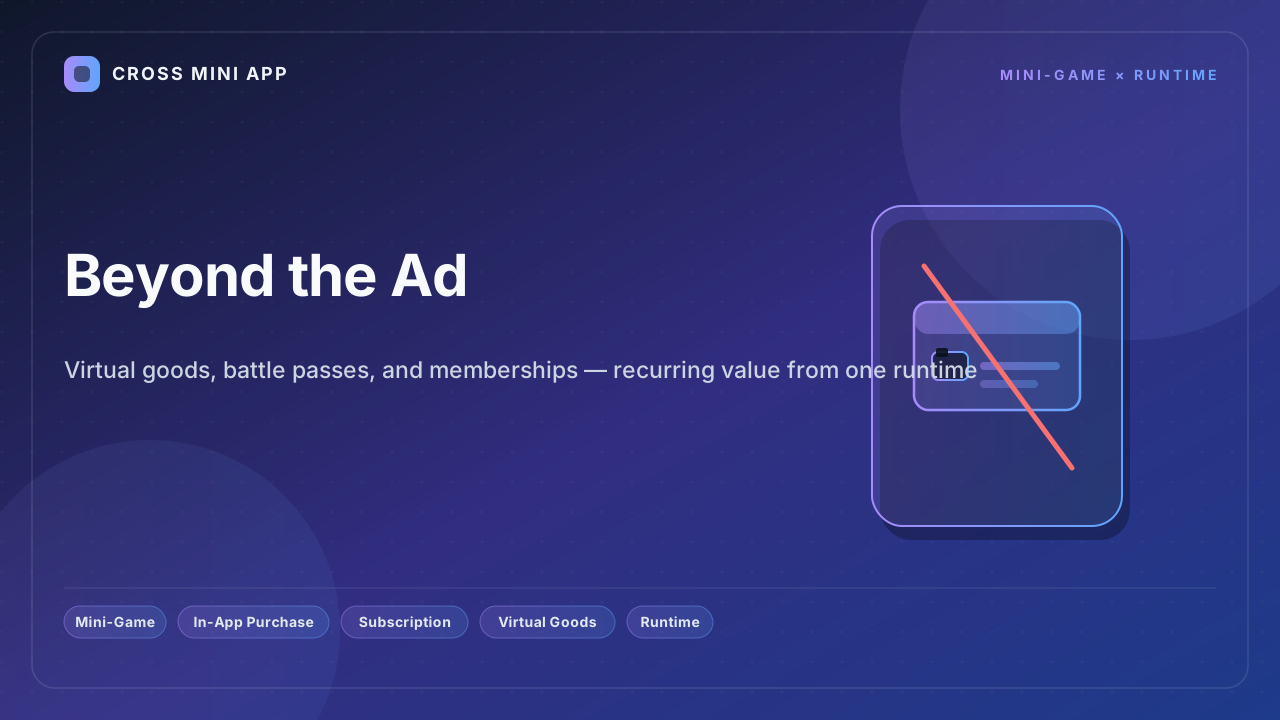
Mini-game IAP is a mature toolkit borrowed from the best of mobile:
- Virtual currency — premium coins bought for convenience or to access content.
- Battle passes & season passes — time-boxed progression that rewards returning players.
- Consumables — extra lives, energy, hints, boosts at friction points.
- Cosmetics & skins — purely expressive, zero balance impact.
- Starter packs & bundles — high-perceived-value packages for new and returning players.
Layered on top, subscriptions and memberships turn one-time buyers into recurring revenue: ad-free tiers, daily diamond allowances, exclusive season content. Recurring value is what separates a hit from a flash in the pan.
Lower friction, higher conversion
The structural advantage of mini-game payments is the lack of a store redirect. The purchase happens inside the runtime through one-tap methods already bound to the host — WeChat Pay, Alipay-style wallets, or the host's own balance. No app-store interstitial, no re-authentication, no cart abandonment at the OS boundary. That single step removed is often the difference between a tap and a bail.
One integration, every host
Cross Mini App routes payments through a single backend (the X-App-Id BFF pattern) so a game integrated once can take payments inside any host that enables it — without per-store SDK work or per-platform settlement. The runtime abstracts the wallet; the developer ships one flow.
| Layer | Without runtime | With Cross Mini App |
|---|---|---|
| Payment SDK | per store / per host | one integration |
| Auth & wallet | re-authenticate | host-bound one-tap |
| Settlement | per platform | unified BFF |
| Catalog reach | single store | every connected host |
Platforms are paying developers to build
The economics are already tilted in the developer's favor. WeChat's 2026 IAP incentive lifts combined support above 100% for new titles, with a single-title cap raised to ¥4 million, plus a 5% cash rebate on IAP revenue during launch. When the channel itself subsidizes your IAP, the runway gets longer and the content-driven model wins over pure traffic play.
The takeaway
Ads open the door; IAP and subscriptions build the house. With a shared runtime, both run on one payment backbone across every host you reach — turning casual taps into durable, recurring revenue.