The metric that actually matters
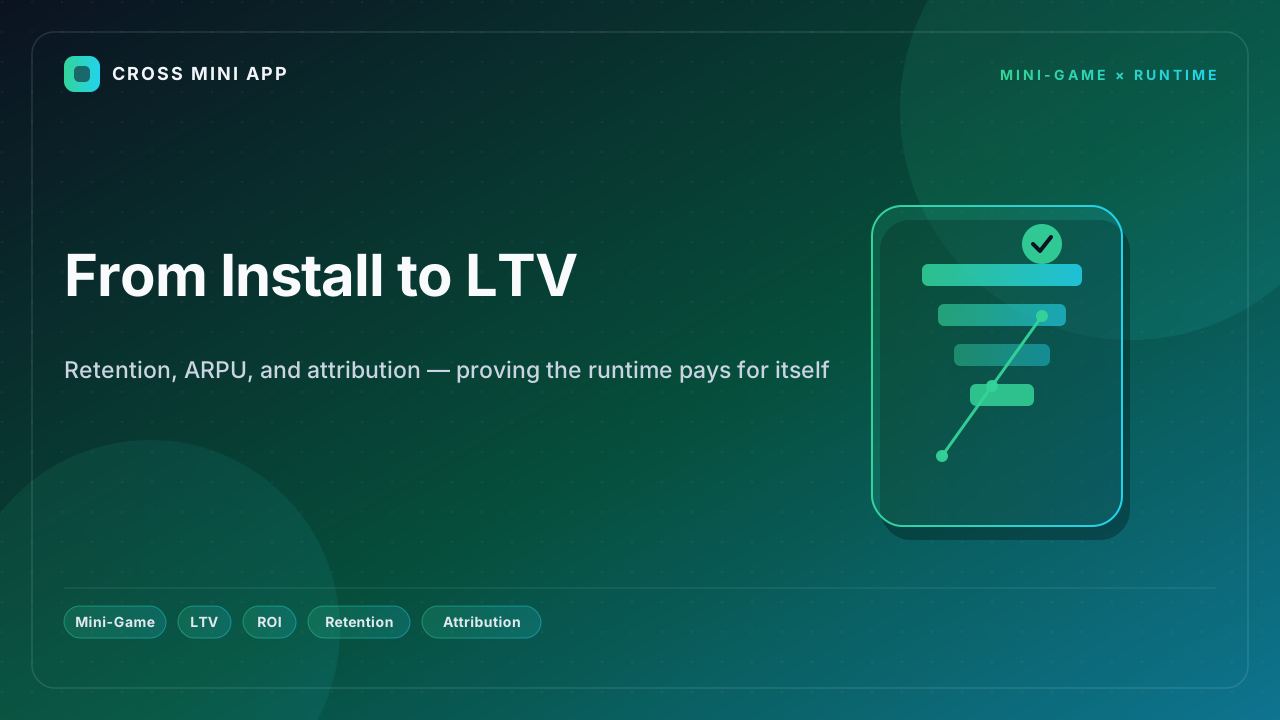
Download counts are vanity. What a game lives or dies on is LTV — lifetime value: how much a player is worth across their whole time with the game. For mini-games the math is unusual. Sessions are short — under 15 minutes — but users return 8–10 times a day. Value compounds through frequency and retention, not through long single sittings.
Why Day-1 ROI misleads
In ad-monetized (IAA) mini-games, the payback window is long. Day-1 numbers look thin because rewarded and interstitial inventory needs a week or more to mature. The industry has shifted to judging Day-7 and longer returns. A title that looks break-even on Day 1 can be strongly profitable by Day 30 — if it retains. That makes retention the lever everything else hangs on.
What to instrument
A healthy mini-game dashboard tracks a small set of linked metrics:
- Retention — D1, D7, D30; the shape of the curve predicts LTV better than any single point.
- ARPU / ARPDAU — average revenue per user and per daily active user; the monetization engine's output.
- LTV : CAC — lifetime value against the cost to acquire; the ultimate efficiency score.
- Session frequency — opens per day; mini-games' structural advantage.
- Payer conversion — IAP buy rate; separates ad-only from hybrid titles.
| Metric | What it tells you | Mini-game signal |
|---|---|---|
| D7 retention | Stickiness | High-frequency baseline |
| ARPDAU | Monetization health | Rewarded placements drive it |
| LTV:CAC | Efficiency | Organic + social lifts it |
| Opens/day | Habit strength | 8–10 is the norm |
One runtime, one source of truth
The trap of multi-store distribution is siloed data: each platform reports its own numbers in its own format, so you can never compare a player on host A to a player on host B. Cross Mini App instruments once through a single SDK across every connected host, so LTV, retention, and attribution share one comparable view. You can finally ask "which host's audience has the highest LTV?" and get a real answer.
Proving the runtime pays
The business case writes itself when the metrics line up:
- Lower CAC — organic discovery plus social sharing means most installs cost nothing.
- Higher LTV — cross-host re-engagement keeps players in the loop longer than any single app could.
- Faster iteration — one instrumented runtime means one experiment, measured everywhere at once.
China's market already shows the ceiling: over 70 mini-games exceed 1 million DAU and more than 300 clear ¥10 million per quarter — proof that disciplined measurement, not luck, scales mini-games.
The takeaway
You cannot improve what you cannot compare. A shared runtime turns fragmented host data into one attribution backbone, so mini-game ROI stops being a guess and starts being a number you can bank.