The hardest problem in games is not building them
Most teams can ship a playable game in weeks. What they cannot buy is an audience. Mobile app stores take a 30% cut, impose review cycles that stall launches, and force every new title into a brutal paid-user-acquisition auction where the cost to install a player keeps climbing. For a small studio, distribution — not development — is the wall.
Mini-games flip that equation. Because they run inside a host app through a shared runtime, they inherit the host's audience the moment they go live. No store listing, no install flow, no acquisition bid. The host app itself becomes the channel.
China already proved the flywheel
The numbers from China's mini-game market are the clearest evidence. In 2025 the domestic mini-game market reached ¥53.5 billion in revenue — up 34.4% year over year — after growing more than 10x from just ¥5 billion in 2022. WeChat mini-games alone now serve 571 million monthly active users, against the platform's 1.41 billion MAU, meaning the ceiling is still far from reached. More than 70 mini-games exceed 1 million daily active users, and over 300 clear ¥10 million in quarterly revenue.
| Signal | 2022 | 2025 | Note |
|---|---|---|---|
| Market revenue | ¥5.0B | ¥53.5B | ~10x in 3 years |
| YoY growth | — | +34.4% | Steady double-digit |
| WeChat mini-game MAU | — | 571M | vs 1.41B WeChat MAU |
| Games >1M DAU | — | 70+ | Compounding catalog |
| Games >¥10M/quarter | — | 300+ | Mid-tier viable |
None of that scale came from paid acquisition budgets. It came from embedding games inside an app people already open eight to ten times a day.
One runtime, many hosts
Cross Mini App extends the same model beyond a single ecosystem. A game built once against the runtime can be offered inside multiple host apps — a chat super-app, a ride-hailing app, a payments app — without rewriting for each store or each platform's native SDK. The host supplies reach; the developer supplies the game; the runtime supplies the bridge.
That multiplies distribution without multiplying engineering. A title that finds 1 million players in one host can be flipped on in a second host the same afternoon.
Why the flywheel compounds
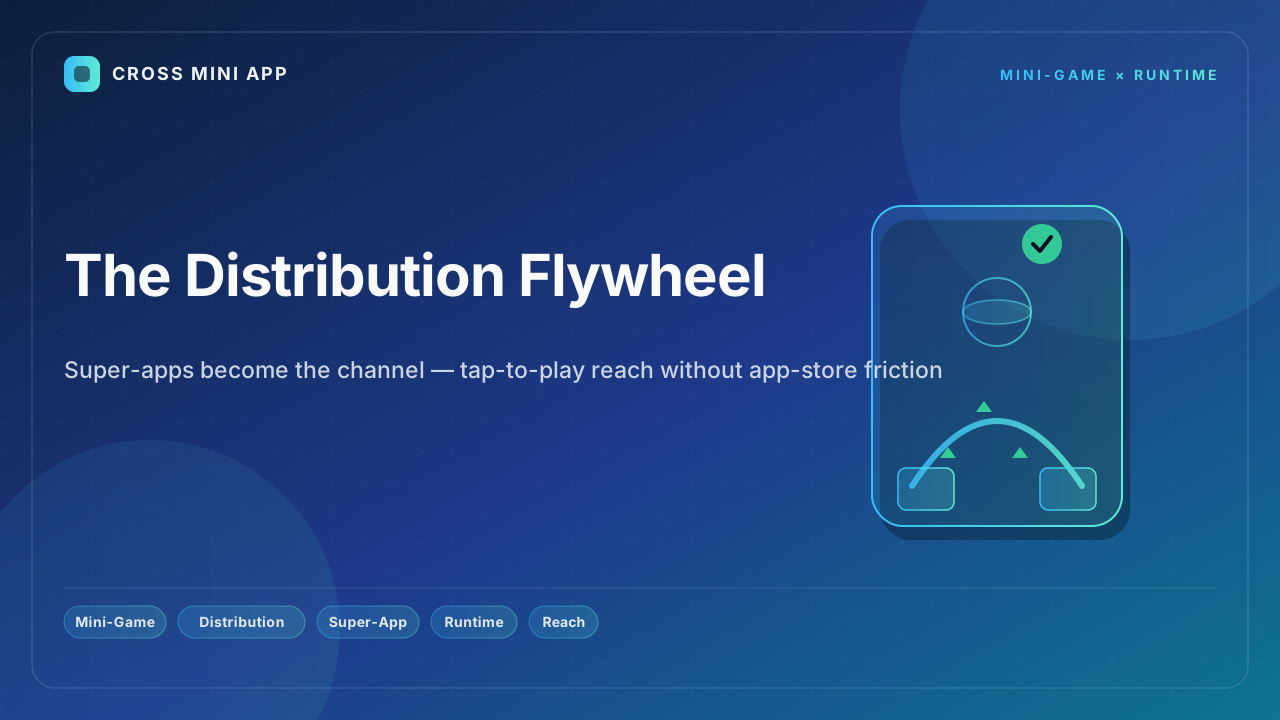
Distribution on a super-app is not a one-time boost; it is a loop:
- More host reach → more players see the game with zero friction.
- More players → more signal about what works, faster iteration.
- More working games → a richer catalog that makes each host stickier.
- Stickier hosts → more incentives to surface mini-games to even more users.
Each turn lowers cost-per-install toward zero and raises the value of the catalog for everyone. Competitors that rely on paid UA pay for the same users every single time.
What this means for your roadmap
If you run or build a host app, mini-games are the cheapest growth you can add: a catalog integration, not a game studio. If you build games, the runtime is the fastest path to an audience that does not require bidding against the world for every install.
Cross Mini App turns distribution from a budget line into a built-in property of the runtime — tap-to-play reach that scales with the host, not with your ad spend.