The wheel rebuilt on every platform
Build native and the same date picker, the same list, the same chart gets written three times — once per OS, again per app — because each target speaks its own component language. Reuse means copy-paste, and copy-paste means drift.
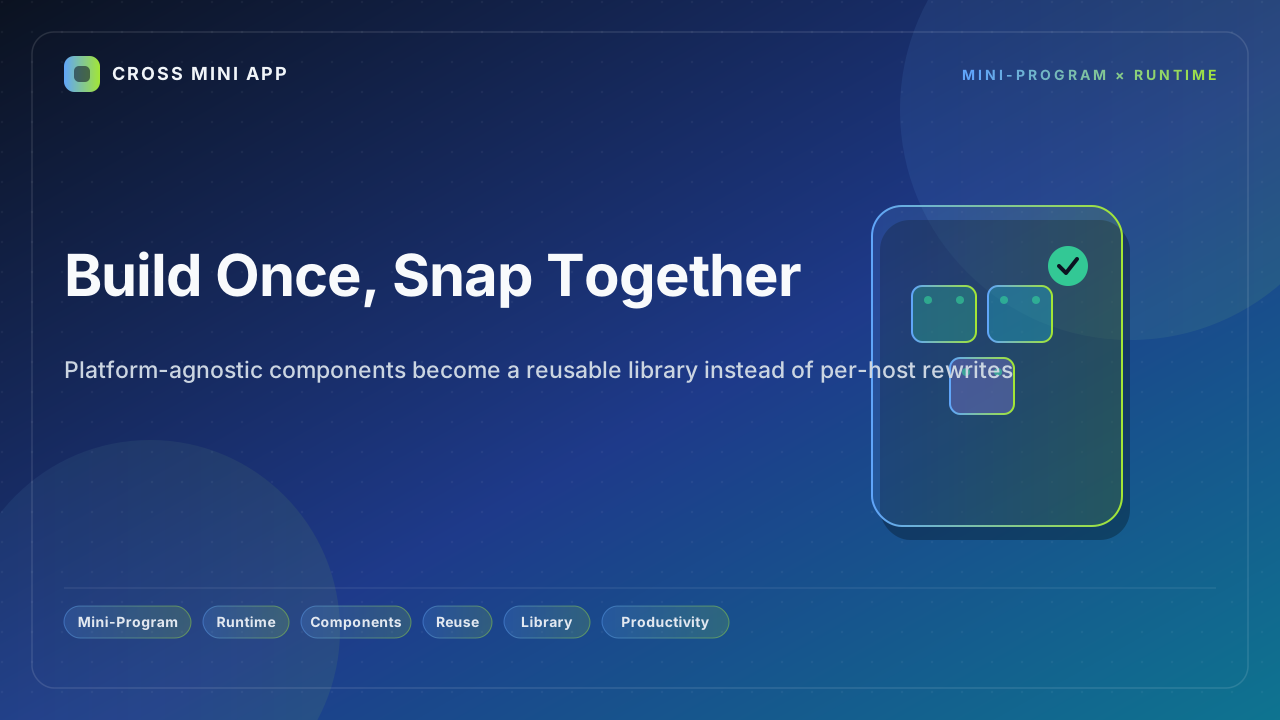
A mini-program component market turns a component into a published, versioned package. One build drops into any program, so teams assemble features from shared parts instead of rewriting them.
What a component market is
The runtime defines a component format that works across hosts, so a component author publishes once and consumers import it. WeChat's WeUI and extension components and Alipay's component library are market-style catalogs; npm shows the same leverage for the open web. A shared, versioned package means a fix propagates by bumping a version, not by editing every app.
Where the gap shows up
| Step | Native (rebuild) | Mini-program runtime (component market) |
|---|---|---|
| Component source | Copy-paste per app | Published package |
| Versioning | Manual, ad hoc | Semver, shared |
| Fix propagation | Edit every app | Bump version |
| Reuse across apps | Fragile | Drop-in |
| New feature | Rewrite | Compose |
The result is a library you assemble from, not a pile you rewrite.
Why reuse beats rewrite
A shared package means a team ships a date picker once and every program benefits, instead of ten apps each owning a slightly different one. It also means security and accessibility fixes land everywhere at once, because the part is shared, not forked.
How Cross Mini App applies it
Cross Mini App runs programs on a runtime with a component market, so a platform-agnostic component is published once and dropped into any program. You compose features from shared parts. You stop rewriting the same wheel and start snapping building blocks together.
That is the difference between a catalog of parts and a closet of clones.