The fork tax of many platforms
A few years ago the mini-program model lived almost entirely inside WeChat. Today it has spread to Alipay, Douyin, and a wave of international platforms — Telegram, WhatsApp, and regional super-apps are each standing up their own mini-program capability. That is good news for reach and bad news for anyone maintaining code: each platform keeps its own technical requirements, toolchain, and policy. Build natively for each and you do not have one app — you have N apps, diverging a little more with every release.
The WebView shortcut does not rescue you. Dropping a web page into each host's WebView seems portable until you need the host's identity, payments, or location. Then you re-wire a native bridge, a login handshake, and a review process per host anyway. You avoided one fork and inherited three integrations.
One surface, many hosts
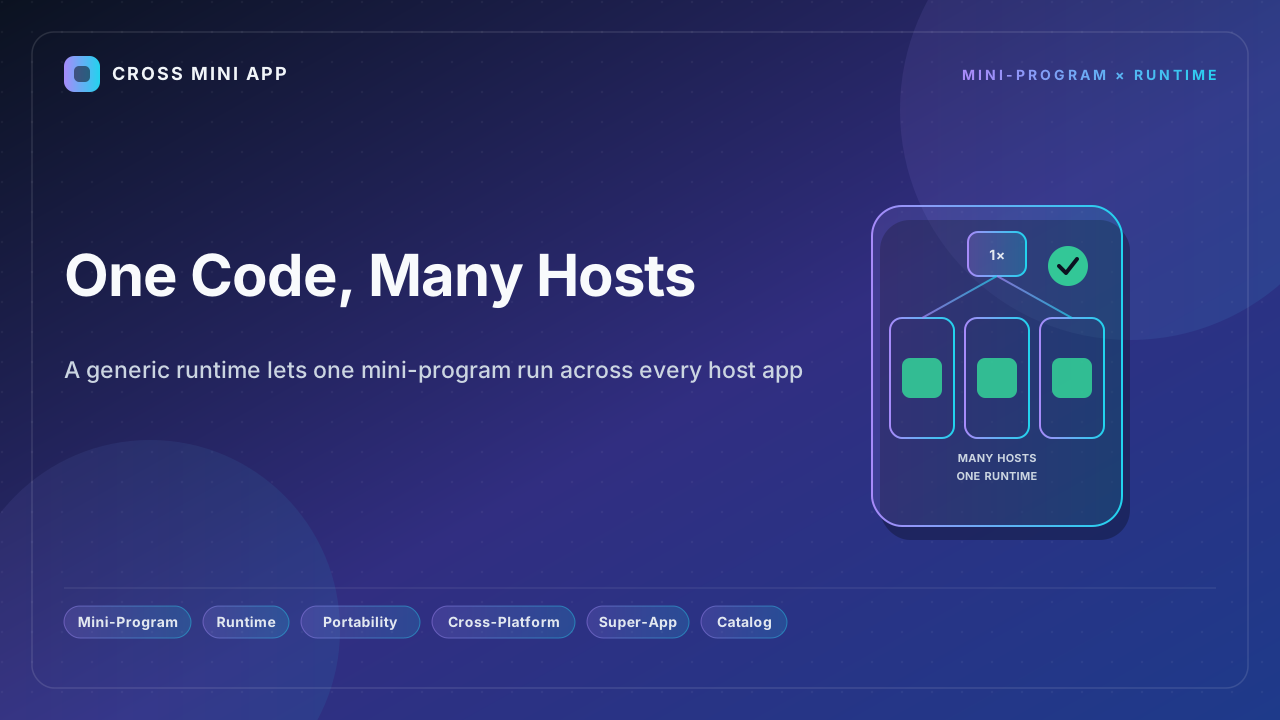
A mini-program runtime inverts the model. Instead of adapting your code to each platform, you write once against a uniform API surface — the familiar wx.* family — and the runtime maps those calls onto whatever the host provides. Cross-platform SDK vendors describe exactly this: an abstraction layer that translates standardized code into platform-specific implementations, so developers focus on application logic rather than platform adaptation.
Alibaba's mPaaS states the value plainly — develop once and deploy anywhere, distributing one mini-program across DingTalk, Taobao, and Alipay from a single codebase. FinClip makes the same promise for the host side: embed a lightweight SDK and your existing app becomes a mini-program platform without a rebuild. The runtime, not your team, absorbs the per-host differences.
Why this matters for an open catalog
For a catalog of proven mini-programs — the crossminiapp thesis of bringing validated Chinese mini-programs to overseas apps — portability is the whole business case. A program written once should land in any host that ships the runtime, the same way a web page lands in any browser. That is what turns a one-off porting project into a reusable library.
It also changes the compliance math. When the runtime brokers every privileged call and the platform reviews each submission, opening your app to third-party programs becomes a governed, repeatable operation instead of a bespoke security review per partner.
The cost, side by side
| Dimension | Per-platform fork | Generic runtime |
|---|---|---|
| Codebases to maintain | One per host | One |
| Native capability access | Re-wired per host | Uniform wx.* surface |
| Update cadence | Tied to each host's pipeline | Decoupled, runtime-controlled |
| Compliance surface | Per-integration review | Central submission review |
| Reach | Grows cost with each host | Grows reach, not cost |
The fork model taxes every new host you add. The runtime model taxes none of them — you pay once to write the program and again, lightly, to certify it for a new host.
How Cross Mini App applies it
Cross Mini App is built as a generic runtime: one wx.* API surface, capability-gated and reviewed at submission, that runs the same mini-program across every host that embeds it. A proven program becomes a portable asset — write it once, ship it to many apps, and let the runtime handle the rest.
That is the difference between per-platform forks and a real catalog: forks multiply your work; a runtime multiplies your reach.
Sources
- Alibaba Cloud — mPaaS Mini Program: develop once, deploy anywhere, update independent of app release
- super-apps.ai — Cross-Platform Mini-Program SDK Integration: technical implementation and best practices
- super-apps.ai — Upgrade Your App into a SuperApp with a lightweight, non-intrusive SDK
- Alibaba Cloud (Aliyun) — mPaaS multi-end development: one codebase, multiple platforms