The store review tax
Every native release pays the same toll: submit to the App Store or Google Play, wait for review, hope it clears, then wait for users to install. Industry write-ups put that cycle at 24 to 72 hours per update — and that is before a single user downloads the new build. For a critical bug or a fast-moving market moment, three days is an eternity.
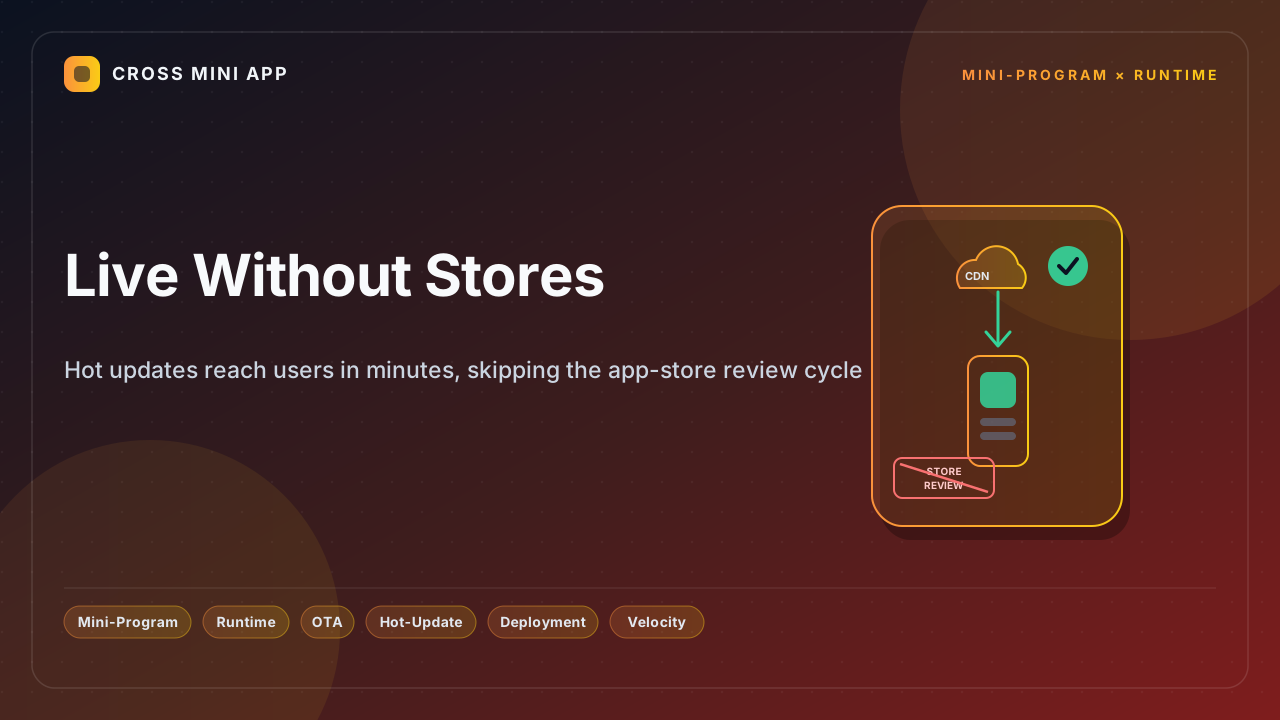
A mini-program runtime removes the toll entirely. The container that loads your program is distributed through the store, but your program's code is not. It travels over a CDN and is fetched by the runtime, which means you update the program without touching the host app's release pipeline.
How hot update actually works
When a user opens a mini-program, the container compares its local cache to the latest version on the management server. If a newer package exists, it downloads in the background and swaps it in atomically — typically on the next cold start, with the current session finishing on the old version so nothing breaks mid-use. WeChat documents this precisely: a silent async check on every cold start, with the new version taking effect the next launch, and local version enforced only when a minimum-required version is set.
The separation is the key. The container runtime — stable APIs, security enforcement, hardware access — ships through the store. The mini-program code — business logic and presentation — ships through the CDN. Because the two are decoupled, the platform can validate each update against security policy before execution, keeping the open-door risk closed while granting you speed.
What you get that native cannot
- No user friction. Users never see an update prompt or an install screen. The swap is silent.
- Instant rollback. A bad release is reverted from the console in minutes; the next launch reverts to the prior package. Tencent's lifecycle write-up describes both manual and emergency rollback reaching full effect within roughly ten minutes.
- Tiny deltas. Update systems ship only changed files — often 10 to 30 percent of a full package — so fixes reach even weak-network devices cheaply.
- Gradual rollout. Percentage, region, or user-group gating lets you validate before going broad, all without another store submission.
The cadence, side by side
| Dimension | Native app | Mini-program runtime |
|---|---|---|
| Update path | App store review | CDN package swap |
| Typical latency | 24 to 72 hours | Minutes |
| User action | Download and install | None (silent) |
| Rollback | New release + re-review | Console revert, minutes |
| Delta size | Full binary | 10 to 30 percent |
The native column turns every fix into a project. The runtime column turns it into a push.
How Cross Mini App applies it
Cross Mini App runs programs through a runtime that fetches packages from a governed CDN, validates them against policy, and swaps them atomically — so a fix you ship tonight is live for users tomorrow morning, with rollback one click away. Velocity stops being a constraint and becomes an advantage.
That is the difference between store-gated releases and a continuously iterated service: one asks permission to change; the other just changes, safely.
Sources
- WeChat Developers — Mini Program update mechanism (sync, async, and minimum-version control)
- DEV Community — From Code to Live: the complete lifecycle of a mini program (hot updates stage)
- Tencent Cloud — Managing massive mini-programs: versioning, hot update, and rollback
- super-apps.ai — Mini Program Hot Updates: bypassing app store reviews for faster deployment