The download decision vs the tap
In a typical app economy, discovery starts outside the product. A user sees an ad, browses a store ranking, or reads a review, then commits to a download before they can even try the service. That download is a real decision with a future cost: storage, notifications, setup, and a place on the home screen they may never open again.
A mini-program runtime flips the order. The front door already opens dozens of times a day inside a super-app, so a new service can be surfaced inside an existing habit. Trying becomes a tap — open a card a friend shared, scan a code on a table, or pick a result from in-app search — and the task is done. The psychological gap between "download a new app" and "open this now" is the whole game in acquisition.
Where the entry points actually are
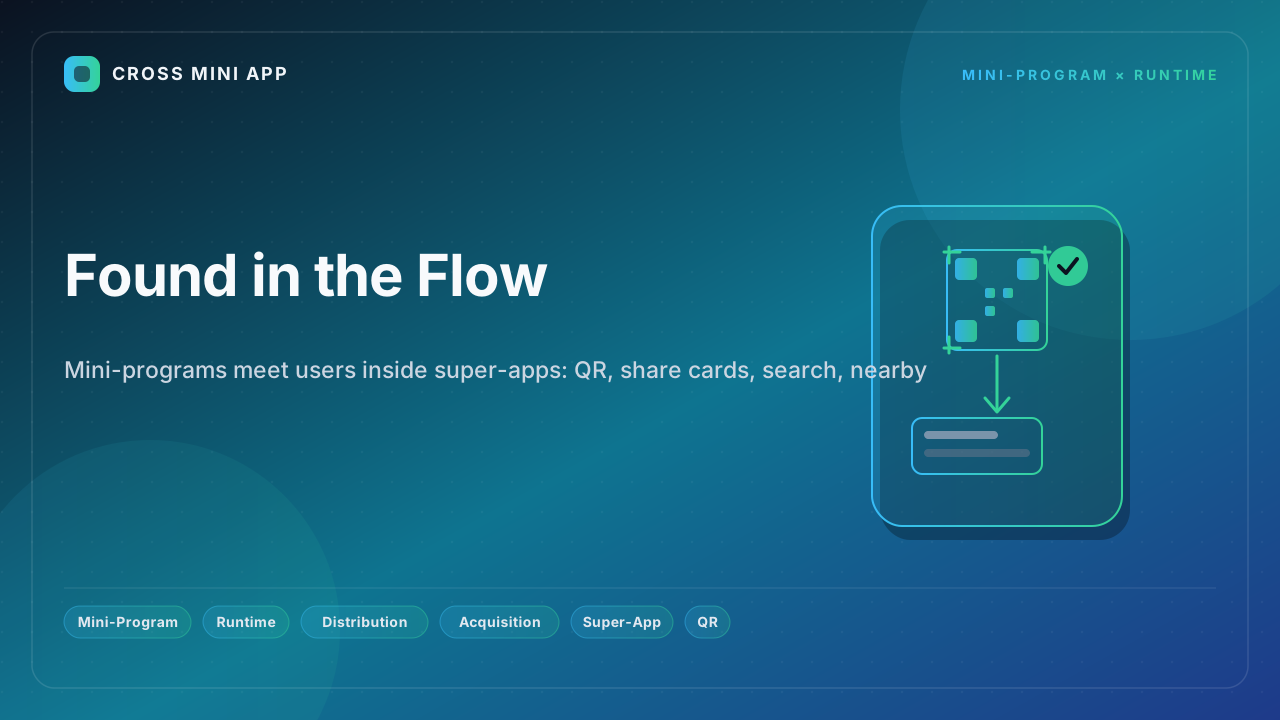
Super-apps concentrate discovery into a small set of in-flow touchpoints rather than a single launch moment:
- QR and code scan. Offline-to-online in one motion: posters, packaging, menus, and receipts become entry points with no typing.
- Chat and group share cards. A mini-program card dropped in a conversation is instantly actionable; the social graph does the distribution.
- In-app search. Users look up services in the same place they search chats, with brand zones and function-direct surfacing specific services.
- Nearby and local. Location-aware entry points surface services at the moment of intent, a major new-user source for local merchants.
- Official account and content linkage. Content and updates route users into a service at the peak of interest.
The effect is a loop, not a one-time launch. Users re-find the same service through chat history, saved lists, and payment records, which strengthens recall and weakens the pull of a standalone competitor.
What runtime gives the model
A generic runtime is what makes these entry points portable across host apps. The same program can be reached by QR in one app, by share card in another, and by search in a third, because the runtime — not a per-app build — owns the surface. For an overseas app that wants super-app-style distribution without rebuilding for each ecosystem, that portability is the asset.
Acquisition, side by side
| Dimension | Native app | H5 link | Mini-program runtime |
|---|---|---|---|
| Discovery start | Store browse, ads | Shared URL | In-app search, QR, share card, nearby |
| Action to try | Download and install | Tap link | Tap card or scan |
| Re-find | App icon, push | Bookmark URL | Chat history, saved list, payment record |
| User friction | High (storage, setup) | Low | Near-zero, in-habit |
| Acquisition cost | Paid UA plus store | Referral plus SEO | Social graph plus free entry points |
The native column spends budget to earn a download. The runtime column spends attention to earn a tap, and the tap is reversible.
How Cross Mini App applies it
Cross Mini App runs programs through a runtime that exposes the same QR, share, search, and nearby entry points across every host app it powers. A service you ship can be discovered wherever your users already are — not only where you can buy their attention. Distribution stops being a media budget and becomes a property of the runtime.
That is the difference between buying a download and being found in the flow: one competes for attention; the other is already there.
Sources
- WeChat Developers — 21 promotion methods for mini-programs (entry points and social fission)
- SEO for China — WeChat SEO 2026: traffic entry points for mini-programs
- Koder.ai — Tencent Super-Platform: how new services get found and re-found
- FireCat — Mini-program promotion and traffic channels (offline, social, and ad entry points)