The store round trip that slows every change
Ship a native app and even a one-line change starts a clock: submit, wait for review, hope users update. A pricing tweak, a regional banner, a kill switch for a broken flow — all of them sit in the same slow queue. You cannot react faster than the store lets you.
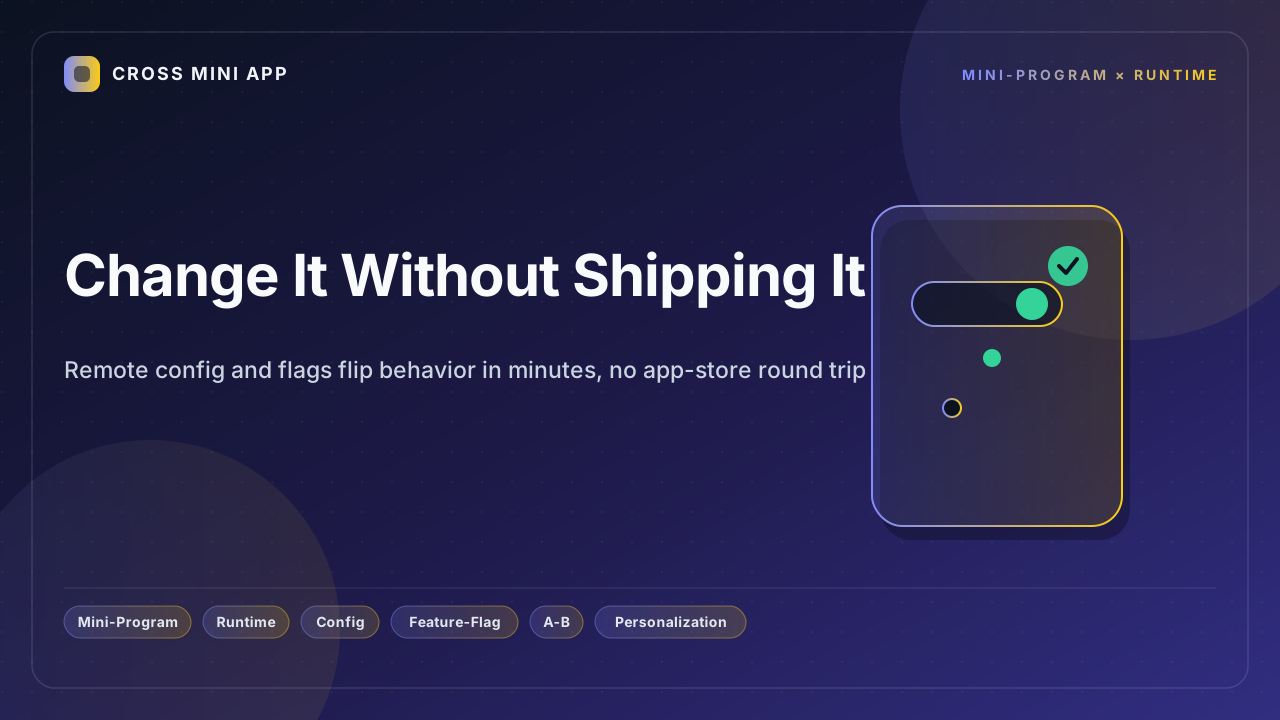
A mini-program runtime reads configuration at launch. Behavior, flags, and content come from the server, so you change what users see without resubmitting anything.
What remote config is
The runtime fetches a config object on start: feature flags, copy, endpoints, and rollout percentages. Firebase Remote Config and LaunchDarkly popularized this on the open web; Martin Fowler's feature-toggle writing describes the discipline. In a mini-program, the same idea runs server-side, so a flag flips for ten percent of users or one region, and you watch the result.
Where the gap shows up
| Step | Native (store submit) | Mini-program runtime (remote config) |
|---|---|---|
| Time to change | Days to weeks | Minutes |
| Review queue | Mandatory | None |
| Rollout control | All or nothing | Percentage, by region |
| Kill switch | Slow | Instant |
| Personalization | Rebuild per market | Server-side variant |
The result is the ability to react to reality instead of to the review calendar.
Why remote beats bundled
A remote config means a bad rollout is a toggle, not a hotfix race. It also means personalization lives in one place — the server — instead of in a dozen market-specific builds. The same program serves every region with a different face.
How Cross Mini App applies it
Cross Mini App runs programs on a runtime that reads remote config and feature flags at launch, so you change behavior, run an A/B test, or localize a flow without touching a store. You flip a flag and users see it on next launch. You stop waiting on review and start steering in real time.
That is the difference between a bundled decision and a live one.